

The 2026 Appropriation Bill of N58.47 trillion presented by President Bola Tinubu to a joint session of the National Assembly on December 19 has sailed through second reading in the Nigerian Senate.
This followed the presentation of the lead debate on the general principles of the bill by the Senate Leader, Senator Opeyemi Bamidele, during Tuesday’s plenary.
He said the bill was the legal instrument through which the policy direction outlined by the President in his 2026 Budget Address was translated into enforceable public expenditure
He noted that the bill was deemed to have been read the first time by virtue of its being laid before the joint session of the National Assembly on Friday, 19.
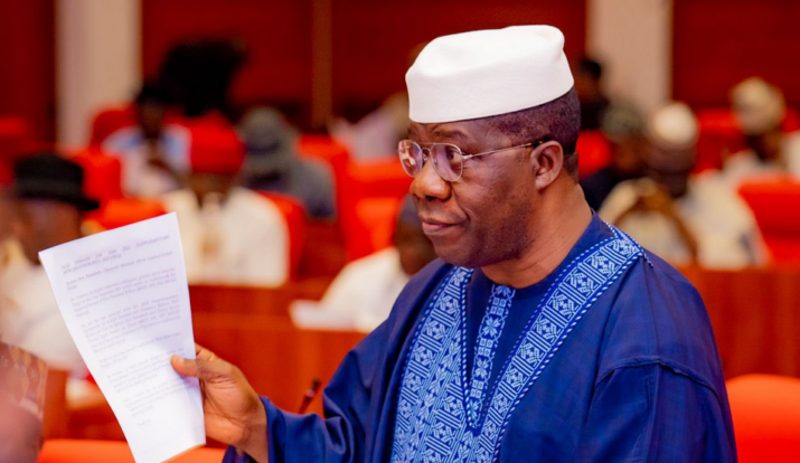
Senator Bamidele also said that the President’s Budget address was frank about the fiscal environment confronting the nation.
“The economy is in a phase of adjustment following far-reaching reforms aimed at restoring stability, correcting distortions, and strengthening public finance. The 2026 Budget is therefore not an experimental document.
“It is a budget of consolidation, consolidating reforms already undertaken, stabilising key economic indicators, and accelerating growth through targeted public investment,” the Senate leader said.
READ ALSO: President Tinubu Presents ₦58.18 Trillion Appropriation Bill to NASS
Speaker Abbas Backs President Tinubu’s 2026 Budget
According to the proposal, total expenditure of N58.472 trillion comprises N4.097 trillion for statutory transfers and N15.909 trillion for debt service.
“N15.252 trillion for recurrent (non-debt) expenditure, and N23.214 trillion for capital expenditure through contributions to the development fund,” he added.
Senator Bamidele said the structure of the budget reflected deliberate prioritisation, with capital spending emerging as the largest component of discretionary expenditure.
He said the N23.214 trillion capital allocation targets critical growth-driving sectors, including transport infrastructure, power and energy, agriculture, industrial development, housing and the digital economy.
“As the President emphasised, sustainable growth cannot be achieved without addressing infrastructure deficits and expanding the productive capacity of the economy,” Senator Bamidele said.
He added that the spending plan was designed to stimulate private investment, create jobs, and strengthen food and energy security.
He subsequently called on lawmakers to give the bill favourable consideration.
Thorough Scrutiny
Contributing to the debate, Senator Adamu Aliero (APC, Kebbi) said, “I support the bill. However, the committee on Appropriations should do thorough scrutiny. The N23 trillion for capital projects is impressive and has never happened since we came in 2023″.
“Well over N5 trillion on security is also commendable. Education allocation is also good and my prayer is that the funds be released for proper implementation”.
Senator Sani Musa (APC, Niger) said the debt service provision, though large, was critical for restoring investor confidence, especially as the country approaches an election cycle.
“Now that we are going into a political period, the allocation of N15.9 trillion is for servicing our debts, which will further restore confidence between Nigeria and its development partners. I believe that 2026 is going to be better with a single budget”.
Following the debate, the Senate passed the 2026 Appropriation Bill for second reading and referred it to the Committee on Appropriations for detailed consideration.