

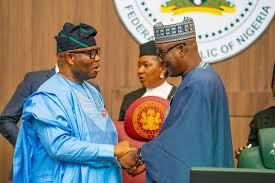
The President of the Nigerian Senate, Senator Godswill Akpabio has defended the continued collaboration between the 10th National Assembly and the Executive arm of government.
Senator Akpabio who was speaking during the joint sitting of the National Assembly when President Bola Tinubu presented the 2026 Appropriation Bill remarked that some people viewed the patriotic collaborative work between the Legislature and the Executive arm as a sell – out by the Parliament.
Senator Akpabio however recalled that “history is unambiguous on one enduring lesson: nations advance when the Executive and the Legislature work in concert, and they falter when the two become locked in hostility.
“In the United States, the era of Franklin D. Roosevelt’s New Deal stands as a classic illustration. Faced with the Great Depression, an aligned Congress partnered with the Executive to pass sweeping legislative reforms—banking regulations, social security, infrastructure investment—that stabilized the economy and reshaped American society for generations.
“Similarly, post-war Britain witnessed remarkable reconstruction because Parliament and the government of Clement Attlee acted with shared purpose, creating the National Health Service and rebuilding a shattered nation.
“In each case, progress flowed not from unanimity of opinion, but from institutional cooperation anchored in a common national interest. It is pertinent to note that history has often distilled its lessons into simple truths.
“One of them is this: Great nations are not built by perfect conditions, but by leaders who make hard choices together.
“By contrast, stagnation has often followed periods of executive-legislative warfare. In the later years of the Roman Republic, constant power struggles between magistrates and the Senate paralyzed governance, weakened institutions, and paved the way for collapse of the empire.
“More recently, repeated government shutdowns in the United States—triggered by budgetary deadlock between Congress and the Executive—have disrupted public services, shaken investor confidence, and slowed economic momentum.
“Across history and continents, the pattern remains consistent: when the organs of state treat each other as adversaries, the nation pays the price; but when they act as partners under the constitution, stability deepens, reforms take root, and progress becomes possible.
“It is within this spirit of constitutional partnership—not rivalry or servility—that great national decisions (like budgeting) acquire meaning and momentum,” Akpabio explained.
He noted that over the last one year, the Tenth Senate had recorded one of the highest levels of legislative output in its history by passing a record number of bills, including landmark legislations on security, economic reform, governance, judicial administration, electoral integrity, infrastructure development, and social protection.
Senator Akpabio said some momentous outcomes of this legislative productivity were bills that had fundamentally reshaped Nigeria’s reform architecture.
“The Senate passed critical security-sector legislation that strengthened coordination among security agencies, enhanced intelligence-sharing, and reinforced the legal framework for combating terrorism, banditry, and transnational crimes.
“Far-reaching economic and fiscal reform bills provided statutory backing for subsidy rationalization, public-finance discipline, revenue mobilization, and improved accountability in the management of national resources.
“Landmark governance and judicial-sector legislation modernized court administration, improved access to justice, reduced procedural delays, and strengthened the independence and efficiency of key democratic institutions.
“Electoral and political-process reforms were enacted to deepen transparency, safeguard electoral integrity, and reinforce public confidence in democratic outcomes.
“In addition, transformative infrastructure, energy, and social-protection legislation laid the legal foundation for accelerated capital development, power-sector reform, housing delivery, and targeted support for vulnerable Nigerians.
“Collectively, these laws did not merely add to the statute books; they translated reform intent into enforceable policy, stabilized governance, and provided the legal scaffolding upon which national recovery and long-term prosperity can be built.
“Progress still has to be translated into prosperity for all. Too many Nigerians continue to struggle with the cost of living. Too many young people seek dignified employment. Too many communities remain burdened by insecurity.
“Whenever we lose anyone to insecurity, a Senator and a Representative lose a constituent, share in the pain of the bereaved family, and are reminded—painfully—of their duty to act.
“We do not see these tragedies as mere distant statistics, but as human lives—fathers and mothers, sons and daughters—whose safety is the first duty of the Government.
“That is why the National Assembly remains committed to strengthening the legal and budgetary frameworks that support our security agencies, enhancing oversight to ensure accountability, and working in concert with the Executive to confront the roots of insecurity with clarity, firmness, and compassion,” he explained.
Senator Akpabio therefore enjoined all Nigerians to continue to support the patriotic efforts of President Tinubu and also assured Nigerians that the 10th Assembly would continue to serve them with heart and might and represent them with all its strength.