


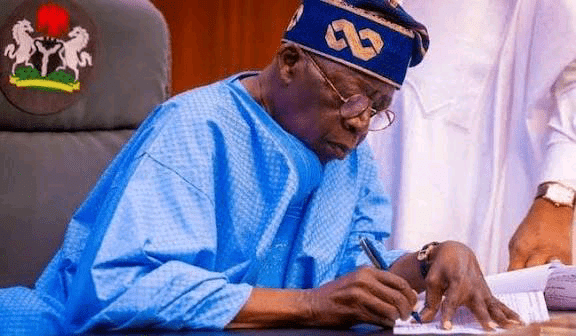
President Bola Tinubu has expressed confidence that the newly signed 2026 Electoral Act will strengthen the credibility of Nigeria’s electoral process and deepen democratic practice, assuring that the country’s democracy will continue to flourish.
The President made the assurance on Wednesday at the State House, Abuja, in the presence of the leadership of the National Assembly, including Senate President Godswill Akpabio and Speaker of the House of Representatives, Tajudeen Abbas, while signing the 2022 Repeal and Re-enactment Bill into law for 2026.
President Tinubu said Nigeria’s electoral process, which remains essentially manual, must be protected from internet limitations, system failures and criminal interference, stressing that the paramount concern is to conduct elections without confusion and safeguard citizens from disenfranchisement.
“It’s not as important as the history aspect of this; what is crucial is the fact that you managed the process to the extent there will be no confusion, no disenfranchisement of Nigerians, and that we are all going to see democracy flourish,” the President said.
He emphasised that, despite technological improvements, elections are managed by human beings and that results are ultimately announced by officials, not machines.
Also Read: Breaking: President Tinubu signs Electoral Act 2026
“No matter how good a system is, it’s managed by the people… In fact, for final results, you are not going to be talking to the computer, you are going to be talking to human beings, who’ll announce the results,” Tinubu noted.
The President also reiterated his concerns regarding Nigeria’s infrastructure realities, questioning broadband capacity and the country’s readiness for real-time electronic transmission of results.
“When you look at the crux of various arguments, maybe, Nigeria should question our broadband capability. How technically are we today? How technically will we be tomorrow?” he asked.
President Tinubu explained that the act of voting in Nigeria is still conducted manually: voters appear physically at polling units, receive ballot papers, mark them by thumbprint, and the ballots are sorted and counted by hand.
“As long as you appear personally as a manual voter in any polling booth, ballot paper is given to you manually… ballots are subsequently counted manually, sorted and counted manually… It’s still manually, essentially,” he said.
He said the focus should therefore be on how manual results are transmitted, warning against technological disruptions and deliberate cyber attacks.
“The transmission of that manual result is what we’re looking at, and we need to avoid glitches… interference, unnecessary hacking in this age of computer inquisitiveness,” he added.
Speaking after the signing, Senate President Akpabio described the work of the National Assembly as “very thorough” and reflective of the country’s peculiarities.
“A lot of provisions in the amended act will definitely make Nigerians very happy. We did a very thorough job, very painstaking. We took cognisance of the peculiarities of the country,” Akpabio said.
He noted that the key demand of Nigerians electronic transmission and visibility of polling unit results had been addressed through the legal recognition of INEC’s Result Viewing portal (IReV).
“All Nigerians wanted was that in the IReF Porter,which is a kind of viewing centre for polling unit results they would like to see those results transmitted electronically. We have included that in the amendment just signed into law,” he stated.
However, Akpabio said the law also accommodates areas without network coverage by recognising Form EC8A, signed at the polling unit by the presiding officer, party agents and security personnel, as the primary source of collation.