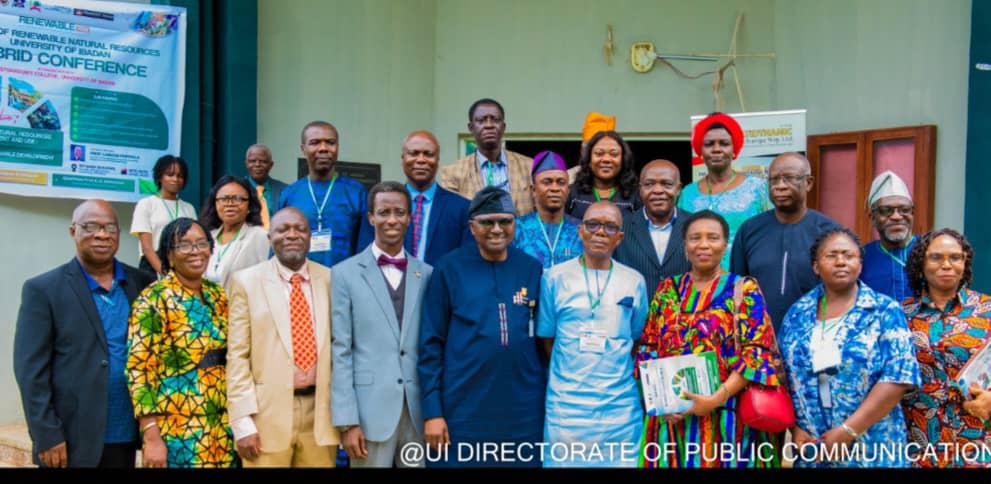
The University of Ibadan, Ibadan, has hosted its maiden conference on Renewable Natural Resources which marks a significant milestone not just for the university, but for Nigeria’s journey towards ecological resilience and sustainable prosperity.UI Hosts Conference on Renewable Natural Resources towards Sustainable Development
The Vice-Chancellor of the university, Professor Kayode Adebowale, while addressing participants at the opening ceremony of the conference, organised by the Faculty of Renewable Natural Resources, said the path to sustainable development is paved with the wise management of renewable natural resources.
Prof. Adebowale noted that poverty eradication, zero hunger, climate action, life on land, and below water all hinge on how wisely humans steward the gifts of nature, calling on researchers in Nigeria and Africa at large to manage the natural resources with courage, innovation, collaboration, and an unwavering commitment to intergenerational equity.
He reiterated that Nigeria and Africa’s rich endowment of natural resources forms the bedrock of economies, cultures, and ecosystems, but the resources face unprecedented pressure such as deforestation, desertification, biodiversity loss, soil degradation, water scarcity and the pervasive impacts of climate change.
The Dean, Faculty of Renewable Natural Resources, Professor Adejoke Akinyele, revealed that the conference, tagged “RENEWABLE 2025”, provides a vital platform for scientists, foresters, wildlife experts, extension workers, trainers, fishery professionals, government officials, NGOs, and other stakeholders to share their researches, discuss challenges and forge meaningful collaborations.
Professor Akinyele stated that renewable natural resources such as water, soil, forests, fisheries, and wildlife are essential to human well-being and economic development, affirming that sustainable management and utilisation of the resources are critical to ensuring their long-term availability and maintaining ecosystem health.
The Keynote Speaker, a Professor of Forest Economics and Sustainable Development at the University of Ibadan and Executive Secretary-CEO of the African Forest Forum, Nairobi, Kenya, Prof. Labode Popoola, submitted that renewable natural resources are not infinite, but when managed wisely, regenerate and continue to provide essential goods and ecosystem services that sustain human life and economic growth.
He asserted that renewable natural resources are central to six transformations: education, gender and inequality; health, wellbeing and democracy; energy decarbonisation and sustainable industry; sustainable food, land, water, and oceans; sustainable cities and communities and digital revolution for sustainable development.
Prof. Popoola stated that renewable resources are at the core of the survival and satisfaction of humans on planet earth performing environmental service functions, providing socio-cultural services, scenic and landscape services, and socio-economic services.
He recommended that government must prioritise integrated policies that promote the sustainable use and stewardship of renewable resources, invest in innovation, science and capacity building, support circular and inclusive green economies, promote sustainable production and consumption, integrate renewable resources into the global sustainability agenda, strengthen renewable natural resources and sustainability education and research, amongst others.
The Chairperson of the Local Organising Committee, Dr Siyanbola Omitoyin, said the conference with the theme “Renewable Natural Resources Management and Use: A Path to Sustainable Development” was relevant today as the impact of climate change seen in flooding, desertification, increased temperature and others are on the increase.
The opening ceremony of the five-day conference, organised in the hybrid mode to accommodate international participants, was attended by the university management team, deans of other faculties, retired professors of the faculty, government officials, researchers, scholars, international participants, NGOs, early researchers and students.
Oyenike Oyeniyi