Nigeria has formally validated its National Biodiversity Strategy and Action Plan, NBSAP, 2025-2030 with a focus on halting and reversing biodiversity loss by 2030.
The updated National Biodiversity Strategy and Action Plan, NBSAP has been adopted as whole-of-government policy with the 23 national targets each in alignment with the corresponding global biodiversity targets and goals.
The NBSAP fully aligns with the Kunming-Montreal Global Biodiversity Framework (K-M GBF), with a focus on halting and reversing biodiversity loss by 2030.
Nigeria’s Minister of Environment represented by the Director Forestry Department in the Ministry, Dr Amah Moses stated this in Abuja the nation’s capital at the validation workshop on National Biodiversity Strategy and Action Plan, NBSAP organised by the Ministry in partnership with Global Environment Facility, GEF and UN Environment Programme UNEP.
READ ALSO:Lagos Reiterates Commitment To Coastline Protection, Resilient Environment
The Minister noted that implementing the NBSAP will be a big task, but confident that with persistence and dedication from all stakeholders can implement the NBSAP for the benefit of all.
“As you are all aware, global attention is focused on an ambitious biodiversity agenda, as we look towards the implementation of the Kunming-Montreal Global Biodiversity Framework and its far-reaching goals and targets.”
“It is worth remembering that in 2022, Nigeria, and the wider ECOWAS region, were pivotal negotiators during the development of the Global Biodiversity Framework. We promoted our priorities and were identified as key stakeholders in the negotiation of the final version of the document”. He said.
The Minister explained that stakeholders must demonstrate full commitment towards comprehensive national implementation of the Global Biodiversity Framework.
“We need to demonstrate that we took that framework back to Nigeria and developed a robust National Biodiversity Strategy and Action Plan that will result in Nigeria meeting the framework’s global goals and targets’ ‘He stated.
Head of UNESCO Office, Abuja Dr Albert Mendy, represented by Head of Science Sector UNESCO Abuja office, Dr Enong Moma, says UNESCO will continue to support biodiversity conservation and work with relevant stakeholders to provide them with technical support for the validation process.
“That brings to mind a project which we are currently implementing in Nigeria, called the Nigerian UNESCO Biodiversity Business Project, where we are also looking at creating green biodiversity businesses around protected areas for the communities living in those areas.’’ She said.
She also stressed that the validation workshop for the National Biodiversity Action Strategy and Action Plan, NBSAP is a very important plan for Nigeria and all member countries because it’s an important instrument of the Convention for Biological Diversity.
She noted that NBSAP will also help Nigeria to restore, conserve biodiversity and integrate biodiversity into its national plants.
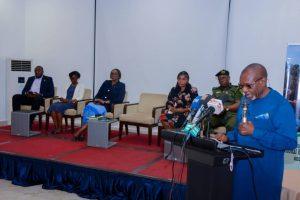
“We’re very supportive of this process, as you all know, biodiversity is very important, and it’s the living fabric of our planet. It also underpins our well-being, and we have to do everything to conserve it. at UNESCO, we support sustainable development. We support, we accompany our member countries. Nigeria is a member country of UNESCO, and so we accompany all our member countries to achieve sustainable development. one of the key initiatives and following on sustainable development is biodiversity conservation, and we are doing that using all our thematic areas in education, science, social and human sciences, communication and information, culture, to support biodiversity. We have what we call the World Network of Biosphere Reserves, which Nigeria has four of these biosphere reserves and we use this as a platform to conserve biodiversity and also encourage the sustainable use of biodiversity.” She explained.
On her part, the National Coordinator, Global Environment Facility, GEF Small Grant Programme UNDP, Mrs Ibironke Olubamise, says, the five focal areas of GEF are Biodiversity, climate change, land degradation, persistent organic pollutants, and international waters.
She noted that, GEF will continue to emphasize the importance of the civil society in the area of biodiversity.
“For the GEF, we have the ozone depletion as one of the focal areas, so in these five focal areas, when we first started, biodiversity has always taken the front line, and the majority of our projects that we have supported of course especially in our hotspots in Nigeria, has been in the biodiversity focal area.’’ Since then, we now have climate change taking the center stage, because all of us, we know that climate change is now a bigger issue that people are talking about, but I always say that there is no way you talk about climate change without referring to biodiversity, so biodiversity is very, very important.” She explained.
Mrs Olubamise stated that GEF has supported not less than 60 or 70 biodiversity projects in Nigeria.
“We have worked in almost all the National Parks we have supported NGOs, we have supported communities living around the National Parks in all the traditional eight or seven national parks that we have in Nigeria. And we are still counting. We have worked with over 150 civil society organizations in Nigeria, building their capacities, supporting and providing the technical and financial support for them to address environmental issues.” She added.
The Director General NBMA, Dr Agnes Asagbra, explained that the NBMA remain a strong partner to the Federal Ministry of Environment and fully aligned with the national vision for environmental sustainability and biodiversity.
“We recognise the value of collaboration and we are eager to explore new partnerships, especially with platforms on environmental facilities.”
“The private sector also has an important role to play and we are working to bring in key partners from biotech and agri-based industries to support biodiversity conservation through corporate social responsibility.” She explained.
She remarked that the NBMA is committed to building a strong foundation for NBSAP.
“We will continue to mobilise local actors from the universities, Their involvement will bring grounded perspectives, indigenous knowledge and the grassroots energy needed to make the NBSAP truly inclusive and effective.” She added.
The NBSAP will be implemented with a view to conserving Nigeria’s rich natural land- and seascapes and biodiversity and to ensure a sustainable future for citizens.
The updated National Biodiversity Strategy and Action Plan (NBSAP) 2025-2030 is articulated with a whole-of-society approach, embracing a diverse array of sectors and stakeholders.