

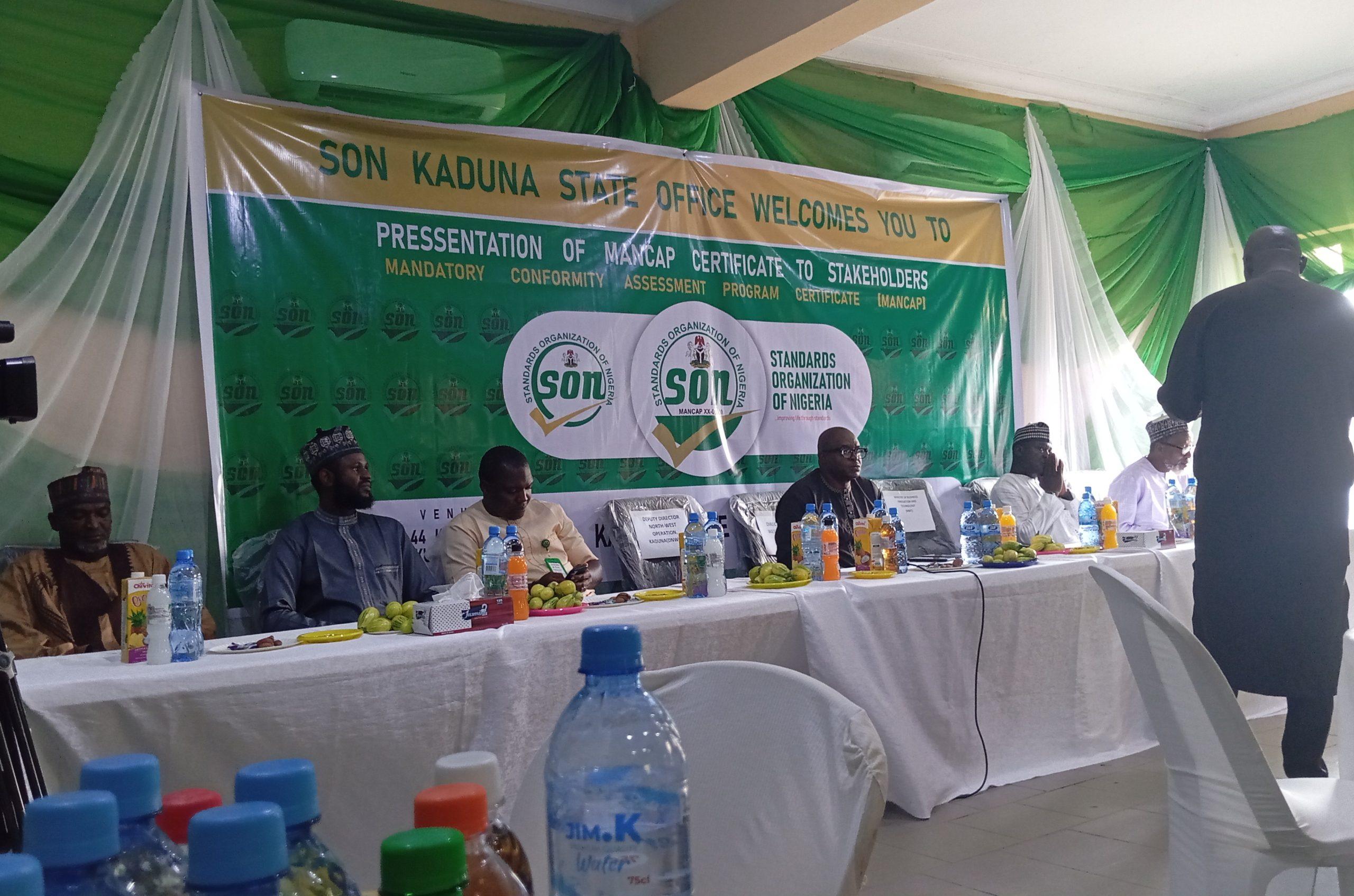
In a significant boost for local manufacturers, the Standards Organisation of Nigeria (SON) has awarded Mandatory Conformity Assessment Programme (MANCAP) certificates to 31 businesses in Kaduna State.
This initiative aims to ensure that locally produced goods meet the requisite Nigerian industrial standards, thus enhancing the quality and safety of products available in the market.
The certificate presentation was officiated on Thursday by the Director General (DG) of the Standards Organisation of Nigeria (SON), Dr Ifeanyi Okeke, who underscored the importance of the MANCAP scheme in promoting high manufacturing standards throughout the nation.
Dr Okeke, who was represented by Isaac Omebije, the Director of the North-West region of SON, acknowledged the efforts of the certified companies, citing their commitment to quality and excellence as a source of inspiration for others in the industry.
“The journey to obtaining MANCAP certification is no small feat. It involves rigorous testing and continuous improvement to ensure that every product bearing the MANCAP mark is synonymous with safety, reliability, and superior quality.
The companies we celebrate today have not just met but exceeded these standards,” Dr Okeke remarked.
The DG reaffirmed SON’s dedication to supporting manufacturers striving for excellence, assuring that the agency will continue to provide frameworks, guidance, and support to enable Nigerian products to compete on an international level.
During the event, the State Coordinator of SON, Mamza Irmiya, urged the business owners to maintain high standards and warned of the potential consequences of any infractions, including the revocation of their MANCAP certificates.
He encouraged the entrepreneurs to standardise their products, noting the multiple benefits, such as cost reduction, job creation, and the enhancement of their business ambitions.
“When you embrace standards, you will achieve results efficiently and with fewer resources. However, failing to adhere to these norms can lead to waste and inefficiencies,” Irmiya asserted.
One of the recipients of the MANCAP certification, Peter Kuku of Tak Agro and Chemicals Ltd., shared his experience:
“We have undergone numerous inspections and visits from SON. While the process was challenging, we remain committed to providing high-quality products to our customers.”
He expressed gratitude to SON for the certification and pledged to leverage it to improve his business.
The organisation has introduced a new macro certification fee to help small and upcoming companies more easily obtain certification, addressing the challenges they face.
The Products Identification Scheme (PIS)
The Products Identification Scheme (PIS) programme was introduced to help upcoming small businesses and entrepreneurs to acquire standards and secure certificates for their products.
This new certification process does not require the extensive requirements typical of standard certifications, as many existing products in the market do not meet those standards.
The P.I.S programme aims to mentor products that lack Nigerian industrial standards, recognising that many products are currently uncertified. To ensure these products’ quality and compliance, they will be tested against industrial standards.
Among the businesses that received MANCAP certification are Global Care Industry Ltd., Simalox Paint and Decoration Services, Matrix Fertilizer Ltd., Euro Form, and Al-babello Trading Company Ltd., among others. This accomplishment marks a pivotal moment for these companies as they strive to elevate their standards and cater to the growing demands of the market while contributing to the economic development of Kaduna State.
About the MANCAP Certification
MANCAP, which stands for Mandatory Conformity Assessment Programme, is a product certification scheme for locally manufactured goods in Nigeria, managed by the Standards Organisation of Nigeria (SON).
It ensures that products made in Nigeria meet the required standards of quality, safety, and performance as outlined in the Nigerian Industrial Standards (NIS).