
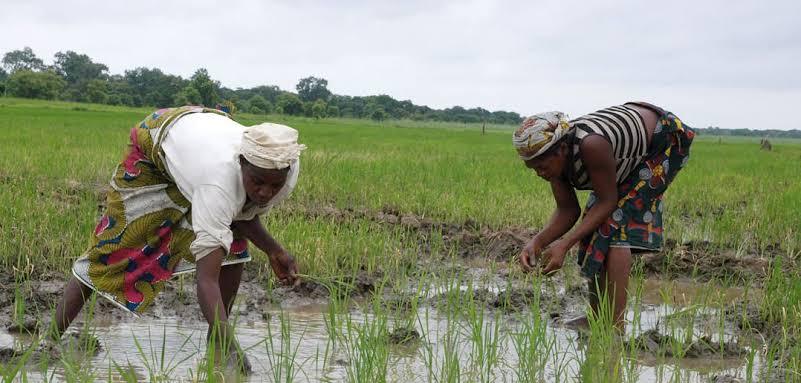
Stakeholders in agriculture have urged traditional rulers to end harmful traditional practices that are limiting women farmers’ access to farmland in rural communities.
They made the call during the International Fund for Agricultural Development (IFAD)-supported Value Chain Development Programme (VCDP) Stakeholders Policy Dialogue meeting held on Thursday in Enugu, South-East Nigeria.
The programme was titled “Gender Action Learning System (GALS) Policy Dialogue with Relevant Stakeholders for Institutionalization and Scaling Up of GALS Programme in Enugu State.”
The GALS methodology is a tool developed by IFAD to promote women’s empowerment through gender transformation.
Mr. Patrick Ubru, the State Commissioner for Agriculture and Agro-Industrialization, emphasized the need for traditional rulers to facilitate and make land available for women and youths to enable them to embrace agriculture.
Ubru, represented by the ministry’s Permanent Secretary, Mr. Victor Ngwu, called on them to also look into some harmful traditional practices that limit and adversely affect women, and to make some reforms.
He explained that the state government introduced a Land Bank, where they acquired land from communities and then gave it out to interested women and youths, as well as investors.
“We have also created a Farm Estate Initiative, where each ward is to donate 200 hectares of land to the government to develop, and one hectare each to 200 farmers within the community.
”The state is aware of the challenges women face in the acquisition of farmland; that is why we are taking all these bold steps to ensure that our women are great farmers,” he said.
Commending the impacts GALS is creating in families and communities, Ubru pledged to support the programme.
A farmer, Mrs. Nnenna Ejim, also urged communities and the state government to allocate farmland to women and youths, up to 50 and 30 per cent for women and youths respectively.
Also speaking, the Traditional Ruler of Mbu-Akpoti in Isi-Uzo Council Area, Igwe Sunday Agbo, while expressing excitement over the programme, said it would help correct gender disparity in the country.
The royal father, however, urged women to channel their agitation through political reforms that allow them to partake in the law-making process that overrides traditional practices affecting them, in order to change the narrative.
He added that, with time, all the obnoxious traditional practices affecting women in communities would be addressed, explaining that wealthy women could buy their own land without depending on family land.
Earlier, Mr. Humphrey Ubanyi, the Rural Institution, Gender and Youth Mainstream Officer, VCDP, Enugu, said the GALS policy dialogue came as a result of the huge successes that had been recorded from GALS activities.
He explained that the programme was designed by IFAD and pushed by VCDP to teach individuals, households, and communities how to live better, as well as to address unequal power relations among men, women, youths, and people living with disabilities.
According to him, the programme was introduced to the state in 2021 and has yielded tremendous results, as confirmed through testimonies from beneficiaries.
“In 2023, we were able to step down the GALS methodology to all the participating Local Government Areas of our intervention.
“Through this programme, women are now participating in household decision-making, own assets, have control over their income, while men assist their wives with house chores to reduce workload on them”.
It has also reconciled couples and restored harmony in broken families.
Today’s meeting was for stakeholders to see the benefits of GALS and institutionalize it to sustain the gains thereof beyond the life of the VCDP programme in Enugu State,” he explained.
He, however, commended the State Programme Coordinator, VCDP Enugu, Dr. Edward Isiwu, for supporting the RIGYMO department.

