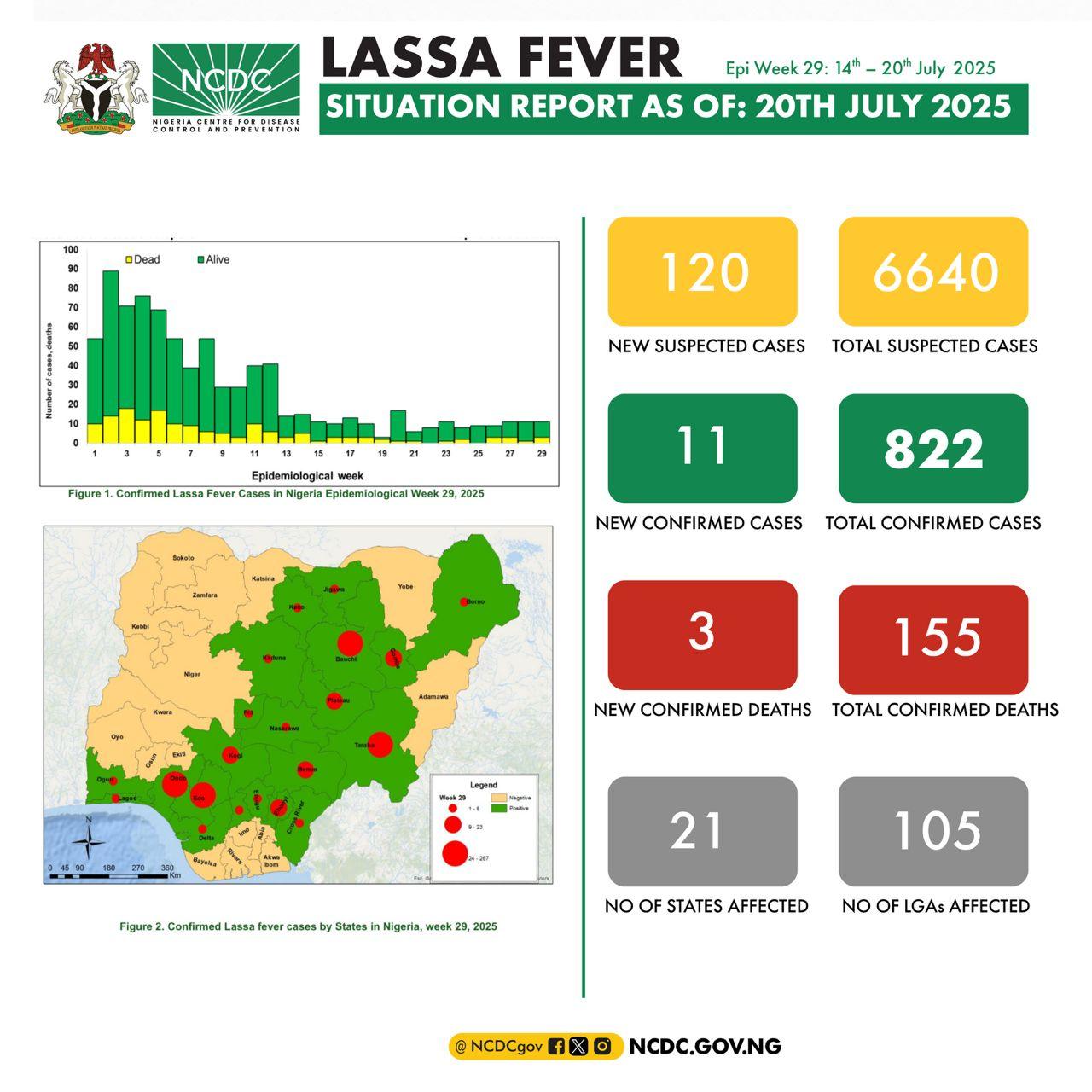
The death toll from Lassa fever in Nigeria has climbed to 155, according to the latest Week 29 Situation Report released by the Nigeria Centre for Disease Control and Prevention (NCDC).
The report, which covers the period from 14 to 20 July 2025, confirms three additional deaths during the week.
The NCDC also reported 11 new confirmed cases from Ondo and Edo states, bringing the total number of confirmed infections this year to 822.
Lassa Fever Update – Week 29, 2025
🗓 14th–20th July📍11 new confirmed cases in Ondo & Edo
📊 Cumulative 2025:
✅ 822 confirmed cases
✅ 155 deaths
✅ CFR: 18.9% (↑ vs 17.1% in 2024)
🔹 89% of cases from Ondo, Bauchi, Edo, Taraba & Ebonyi📄 https://t.co/GqONiqkARn… pic.twitter.com/0CijTbpcEW
— NCDC (@NCDCgov) August 5, 2025
The Case Fatality Rate (CFR) currently stands at 18.9%, exceeding the 17.1% CFR recorded during the same period in 2024.
Despite continued national efforts in prevention, treatment, and public awareness, the increasing number of fatalities has raised fresh concerns about the effectiveness of current interventions.
A tragic reminder of the disease’s severity came earlier this year with the death of a young physician, underlining the risk Lassa fever continues to pose even to healthcare workers.
According to the report, 89% of all confirmed cases this year have been recorded in five states:
- Ondo (32%)
- Bauchi (23%)
- Edo (17%)
- Taraba (14%)
- Ebonyi (3%)
The remaining 11% of cases have been reported across 16 other states, raising the total number of affected states in 2025 to 21, spanning 105 Local Government Areas.
The age group most affected remains those aged 21 to 30, with a median age of 30.
“The male-to-female ratio among confirmed cases is 1 to 0.8, indicating slightly higher male prevalence,” the report states.
“Encouragingly, no new infections among healthcare workers were recorded during the reporting week.”
“However, the multi-sectoral Lassa Fever Technical Working Group (TWG) continues to coordinate the national response, engaging partners and stakeholders to strengthen control efforts.”
While surveillance, risk communication, and clinical management activities continue nationwide, the persistently high fatality rate highlights the urgent need for:
- Improved early detection and diagnosis
- Timely treatment
- Greater community awareness
- Better healthcare-seeking behaviour, particularly in high-burden regions.
The NCDC continues to urge the public to maintain proper environmental sanitation, avoid contact with rodents, and report any symptoms early to the nearest health facility.
Further updates and preventive guidelines can be found on the official NCDC website.