
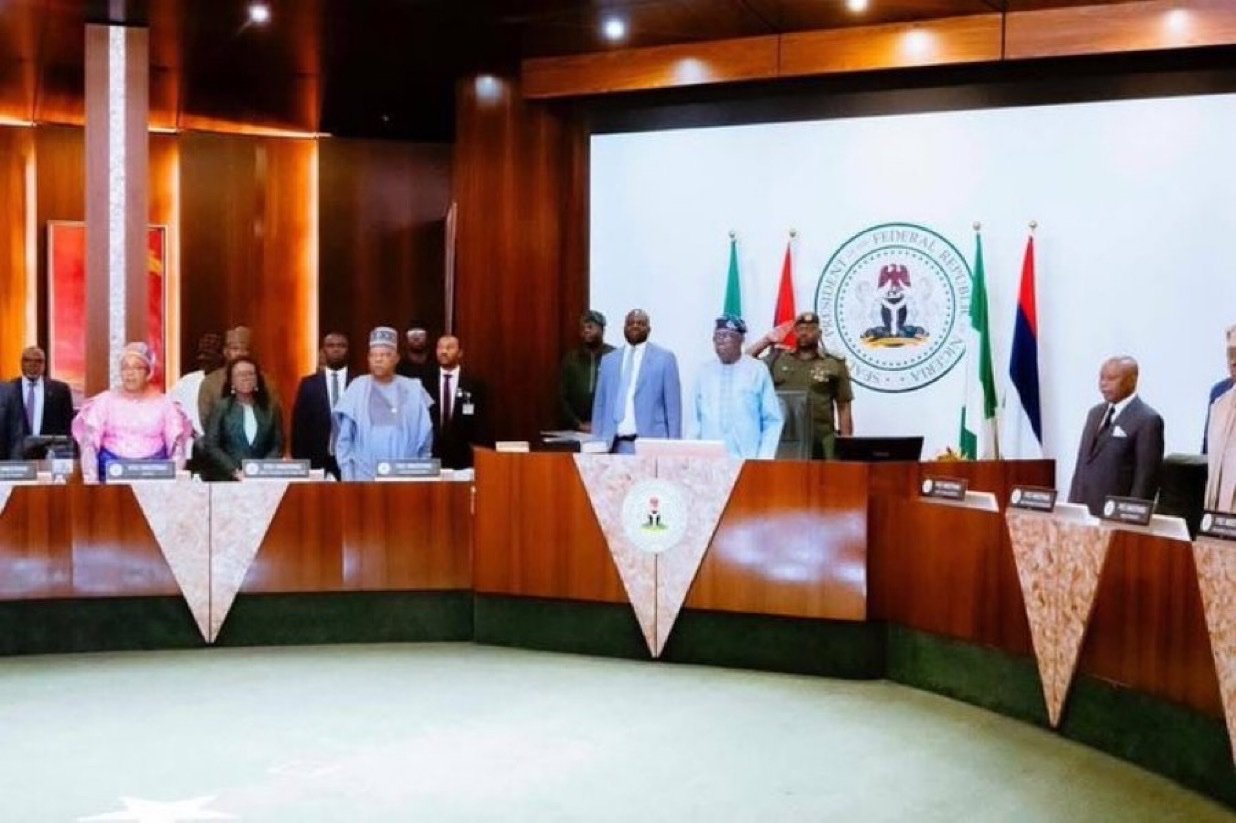
The Federal Executive Council has approved a seven-year moratorium on the establishment of Federal Tertiary Institutions.
The Minister of Education, Dr. Olatunji Alausa announced this while briefing State House correspondents on the approvals granted to the Education Sector by the Council, following the council meeting chaired by President Bola Tinubu at the Council Chambers of the State House, Abuja.
According to the Minister, the Federal government is putting on hold the establishment of new federal universities, polytechnics and colleges of education to invest more funds in strengthening infrastructure, recruiting and enhancing the capacity of lecturers, building more Engineering training centres, setting up laboratories, amongst other plans.
He decries the over-proliferation of institutions without corresponding demand or resource allocation.
“No more rampaging on the establishment of the new federal institutions that we do not need.
No need to establish new federal institutions without improving the infrastructure of existing ones. We will invest funds into improving infrastructure, building more laboratories and Engineering facilities, employing more lecturers and enhancing their capacity of productivity.
“Several of those applications have been there for over five years. So what we did quickly was to bring new guidelines, and we made almost 300, almost 500, almost 351 of such applications inactive. And as we did that, making them inactive, we created new guidelines regarding the timing and the requirements.
So, today, we have about 79 active private universities. Application of the 79 we just approved nine today, but with the new traded guidelines that we’ve created, we don’t expect up to 20 or such applications. So when you see the succeeding months that will come, I will go to the Feb universities.
“These were applications that have been there for years. They’ve invested money, they’ve built campuses, and they built structures. But what happened before was the inefficiency, inefficiencies of the National University commission in getting these universities visited and getting them approved. But we have to be kind and fair to these investors. They’ve built, they spent, they’ve spent billions of Naira building these infrastructures. So it’s not fair to penalise them because of the inefficiencies of the National University Commission.
“In fact, by the time I and honourable state for Education Professor Suwaiba assumed the responsibility of leading the Ministry of Education, there were about 551 applications for private universities waiting.” the Minister explained.
Speaking on the context and necessity, Dr Alausa emphasised that the current challenge in Nigeria’s education sector was no longer about access to federal tertiary education but tackling the duplication of institutions, which has led to significant deterioration in both infrastructure and manpower.
He further revealed that the seven-year moratorium also covers the conversion of institutions of federal tertiary institutions.
“So and if we do not act decisively, what would have will have significant reduction in equality of graduates coming out of these institutions, institutions which impact at local globally and the respect that international community as for the graduates, for the people graduating from our universities, Polytechnic and College of Education, and if we don’t act decisively as well, the unemployment rate will worsen, because hundreds of 1000s of these graduates will not have life skills at all, which will eventually lead to significant reduction in capital index. Let me give you some data as well.”
Alausa reeled the scale of Nigeria’s tertiary education landscape, noting the vast number of institutions. He mentioned 72 federal universities alongside 108 state universities and 159 private universities, and highlighted similar patterns within polytechnics and colleges of education.
“Today we have 72 public federal universities and about 108 state universities, as well as 159 private universities. For polytechnics, we have 42 public polytechnics, federal polytechnics, 98 state polytechnics and 91 private polytechnics.
For colleges of education, we have 28 federal colleges of education, 68 state colleges of education, and 152 private colleges of education in areas of allied institutions that we used to call mono-technics.
“We have 42 public allied institutions and 54 private giving a total of 98 we have 31 public college, colleges of agric and one private combined between colleges of Health Sciences and nursing, we have 158 public and 120 private of such institutions, which gives a total of 278 colleges of Health Sciences and nursing for innovation, enterprise institutions which are also degree awarded.
“We have 16 public and 165 private, giving a total of 181 such institutions. Now this is what we’re seeing when I say, access is no longer an issue this 2024 2020 2025 2026 academic session, about 2.1 million young Nigerians applied to come, to go to any of this, any of our federal any of our eh, tertiary institutions, universities, polytechnics, uh, colleges of education, college of agric College of Nursing and Health Sciences, as well as innovation, Enterprise Institute, he said.
800 students
The Minister cited a northern region federal university with fewer than 800 students but employed over 1,200 staff members.
“This is simply not sustainable,” Alausa said, stressing that many federal universities operated at suboptimal capacity while unnecessarily stretching government funding.
“They had fewer than 800 students, and they have staff. A count of 1200 staff for 800 students. And if this is the commonality in our federal institutions, several federal universities today have fewer than 2000 students, so it’s just a waste of government resources.
We have to decisively move to do what we’ve done today, and I want to thank our president, President Bola Tinubu, who believes so much fervently and benevolently in education and his mandate to us that we should ensure that every single Nigerian gets the highest quality of education that is comparable to anywhere in the world,” he analysed.
In addition to the moratorium, the Council approved the establishment of nine new private universities. Addressing concerns about what he described as a contradiction, Alausa clarified that the newly approved universities’ applications were pending and backlogged with the National University Commission (NUC).
“Also today, the Federal Executive Council approved the establishment of nine private universities. And you would say before the Ministry of Education is talking with both sides of its mouth at all, yes, but let me clarify that for you, the reason for that, and that’s why I chose to talk to that myself.”
Alausa emphasised that the President has met his mandate in significant political will and commitment in supporting the education sector.
He thanked the president for his support towards the education sector.
Lateefah Ibrahim

