
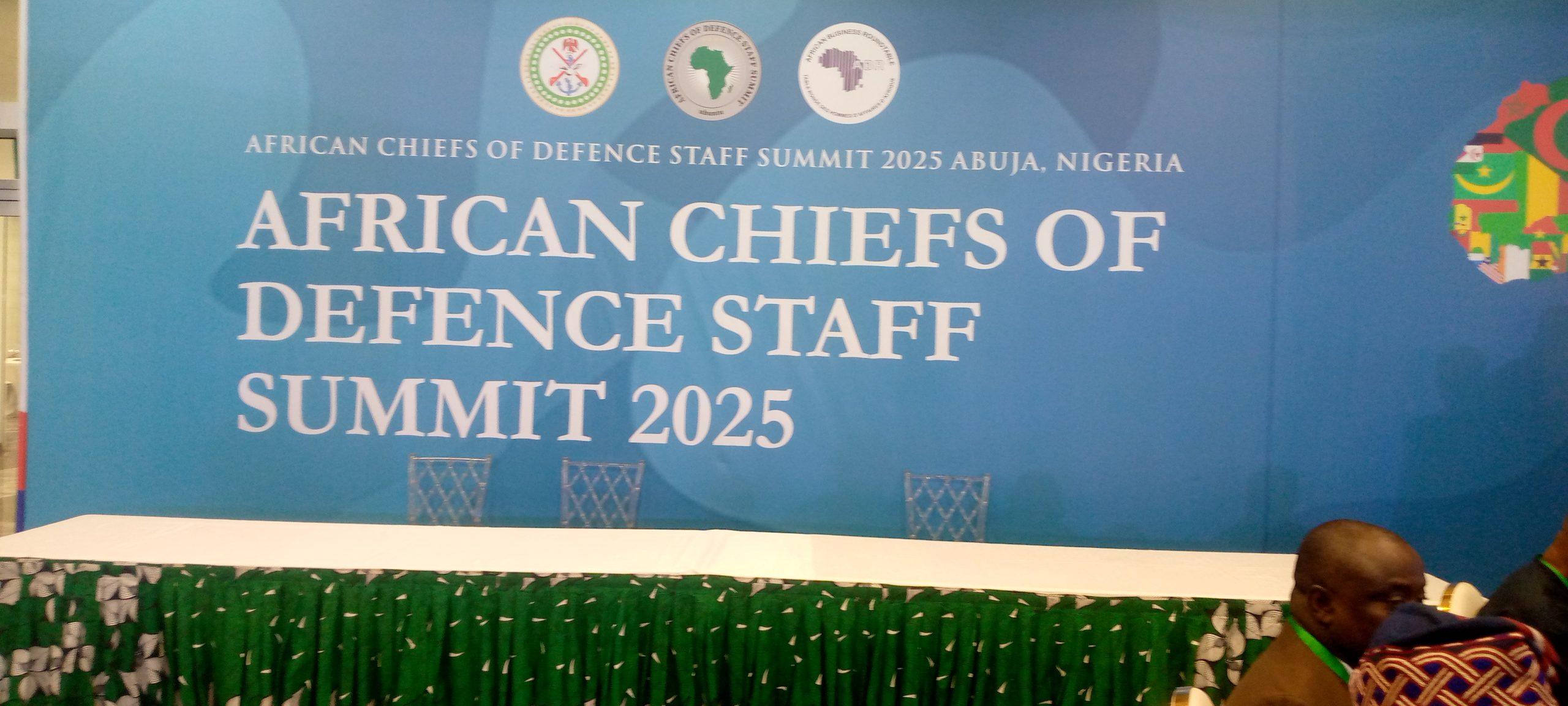
The Nigerian Minister of Defence, Mohammed Badaru has promised that the country would take the leadership role in curbing evolving security threats from terrorism, insurgency, cyber-attacks, and maritime security in Africa.
The Defence Minister made this known during the opening ceremony of the African Chiefs of Defence Summit 2025 in Abuja, Nigeria’s capital.
The theme of the event; “Combating Contemporary Threats to Regional Peace and Security in Africa: The Role of Strategic Defence Collaboration” focused on the country’s commitment to strengthening Africa’s Defence partnership.
Represented by the Minister of State for Defence, Dr. Bello Matawalle, the Defence Minister noted that the challenges are complex, transnational, and increasingly asymmetric.
He said that “Nigeria has been building on both bilateral and multilateral, to support peace, development, and democratic values,” he said.
Accordingly, the summit reflects belief that no single country can scare the continent alone.
“The summit is more than a meeting, it is a bold statement of their collective commitment to building a safer, stronger, more united Africa,” he stated.
The Minister noted that security threats require not just national resilience but also strong continental cooperation to tackle them.
“Let us build a continent where peace is permanent, and our armed forces stand as a symbol of pride, professionalism, and progress,” he said.
The Nigerian Chief of Defence Staff, General Christopher Musa, said the summit was timely in view of the security realities across the continent. He underscored the need for Africa to take ownership of its Defence strategies.
General Musa said “Africa stands on the edge of unprecedented opportunity, but this promise is challenged by violent extremism, terrorism, piracy, organised crime, and the impacts of climate change on conflict. These challenges demand a response that is dynamic, unified, and strategic,”.
He reaffirmed Nigeria’s commitment to regional stability and continental Defence integration, stressing that collaboration in intelligence sharing, joint training, and coordinated action is crucial.
General Musa called for greater investment in indigenous Defence technology.
“The battlefield is evolving. The threats of today are digital, asymmetric, and often invisible. We must lead the charge in modernizing our forces and building a Defence industrial base that is Africa in origin, Africa in design, and Africa in purpose,” he said.
The Defence Chief further paid tribute to fallen soldiers across the continent, requesting a minute’s silence in their honor. “Their courage and sacrifice must inspire us to build institutions that are strong, just, and accountable,” he explained.
“From the scourge of violent extremism and terrorism to the menace of transnational organised crime, piracy, and the insidious impacts of climate change on conflict – these challenges recognize no borders. They are hydra-headed, resilient, and demand a response that is equally dynamic, unified, and strategic,” he said.
Consequently, this gathering offers us a rare opportunity to forge a unified front. It is a platform to harmonise our doctrines, strengthen interoperability, and build enduring trust among our Defence institutions.
He noted that they must therefore seize this moment to craft a new architecture of African-led security cooperation.
“Our Armed Forces have consistently contributed to peacekeeping operations, counterterrorism efforts, and humanitarian missions across Africa. We believe that true security is not achieved in isolation. It is built through shared intelligence, joint training, and coordinated action. Nigeria stands ready to work with our brothers and sisters across the continent to develop frameworks that are proactive, resilient, and responsive to the realities of our time, ” he said.
The President of the ECOWAS Omar Alieu Touray represented by the ECOWAS Commissioner for Political Affairs, Peace and Security, Ambassador Abdel-Fatau Musah said that “this inaugural summit of the African Chiefs of Defence Staff is a logical sequel to Nigerian-led continental initiatives born out of the vision and determination of President of Nigeria, to empower the peace and security intelligence establishments in this country to regionalise their initiatives to benefit the entire continent”.
He stressed that this bold foresight has materialised in, among other endeavours, the ongoing transformation of the National Counterterrorism Centre in Nigeria into an African non-kinetic counterterrorism centre.
He said that “the Joint Doctrine and Warfare Centre recently inaugurated in Abuja is a microcosm of the key objectives of this summit that is, ensuring intelligence sharing, coordinated, and interoperable approaches to responses to the myriad insecurity facing the continent”.
“ECOWAS is therefore incredibly delighted and welcomes this groundbreaking summit that will, among other objectives, be discussing border management and regional security, leveraging artificial intelligence for regional security, as well as the cardinal importance of regional cooperation in responding to threat posed by terrorism and violent extremism, banditry, transnational organised crime on land, at sea, and in the skies, and most importantly, the objective to integrate the continent’s burgeoning private sector into the security discourse,” he stated.
The Deputy Secretary-General of the United Nations, Ms Amina Mohammed emphasized that in this new era of technology where it should be advancing as a human endeavour these groups are using new technologies like unmanned aerial systems and improvised explosive devices to wreak havoc.
She said that “they cannot afford to be bystanders. Africa must take ownership, must be proactive and shape how these tools will be used”.
“Cyberspace today is now a battle space. Elections are manipulated. Institutions undermined,” she mentioned.
According to her, “lies are spread until neighbour turns against neighbour and they have seen this before, once it was a radio carrying messages that ignited genocide. Today it is social media amplifying hate at terrifying speed.
“Artificial intelligence is already transforming the landscape of security. Today we do have AI tools that are helping countries suffering from conflict and insecurity, identifying food insecurity, predicting displacement caused by climate shocks, even detecting and clearing landmines. Soon they could help us to spot patterns of unrest before violence erupts,” she said.
The summit brought together Chiefs of Defence Staff from across the continent, regional bodies, and international partners.
Lateefah Ibrahim

