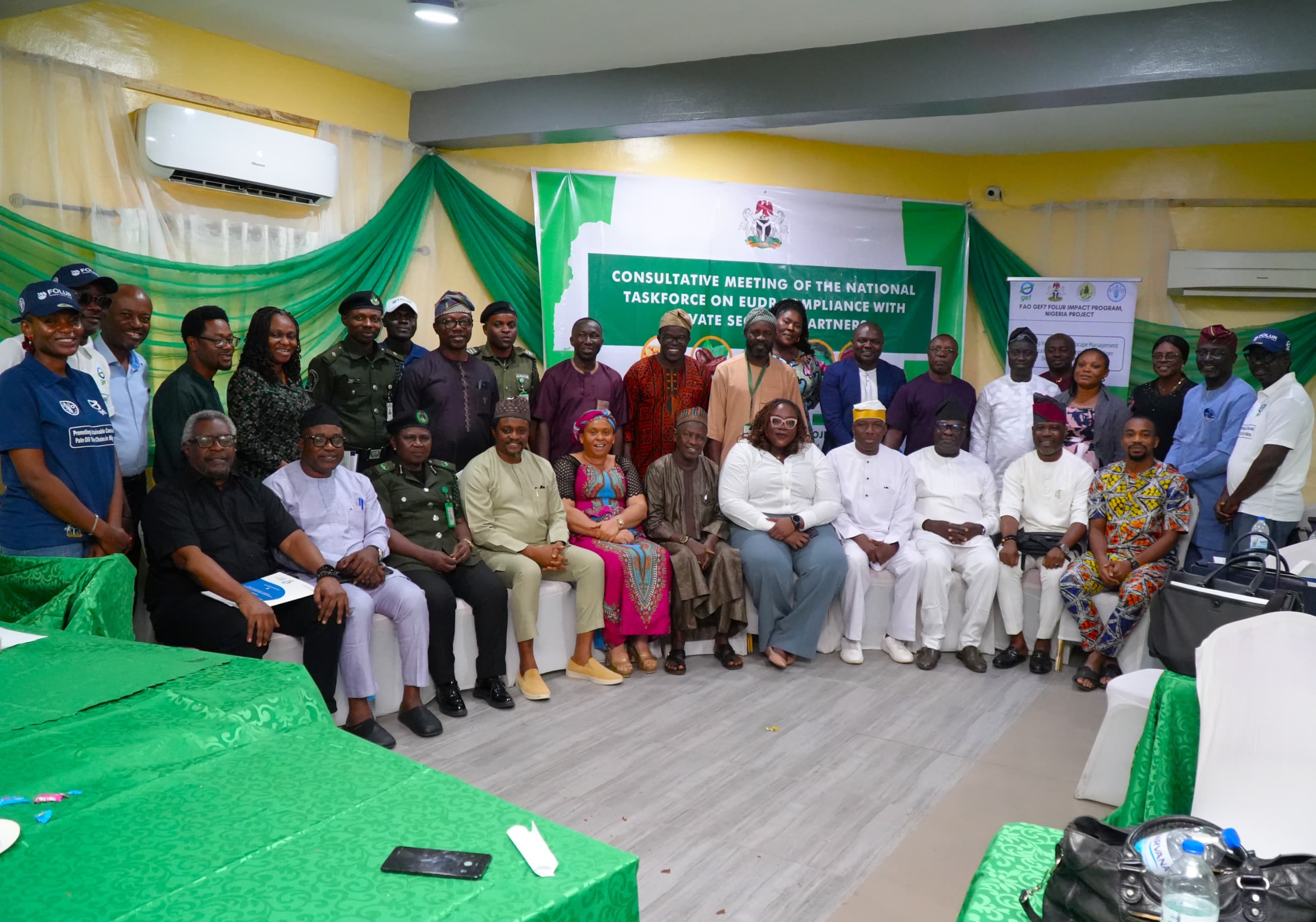
The Food and Agriculture Organisation of the United Nations (FAO), through the GEF-7 Food Systems, Land Use, and Restoration Impact Program (FOLUR), has reiterated its commitment to enhancing Nigeria’s preparedness for the European Union Deforestation Regulation (EUDR).
To this end, FAO facilitated a consultative meeting of the National Taskforce with private sector stakeholders and development partners.
The meeting, held in Lagos, Southwest Nigeria, convened representatives from the Federal Ministry of Agriculture and Food Security (FMAFS), the National Cocoa Management Committee (NCMC), cocoa exporters, farmers’ cooperatives, compliance service providers, donor agencies, and international development partners.
It aims to build consensus on a clear and practical roadmap to help Nigeria’s agricultural commodities, particularly cocoa, to comply with the EUDR before its enforcement deadline of December 31, 2025.
The EUDR policy document seeks to guarantee that products sold in the European Union are not linked to deforestation or forest degradation.
READ ALSO: FAO, Ministry Inaugurate Food, Agriculture Policy Monitoring Review
Its provisions extend across cattle, cocoa, coffee, palm oil, soy, rubber, and wood, as well as products derived from them. For Nigeria, one of Africa’s largest cocoa exporters, the regulation presents a dual reality: a challenge that requires urgent action and an opportunity to restructure its cocoa industry into one that is more sustainable, traceable, profitable, and fair.
Speaking at the meeting, the Chief Technical Advisor of the GEF7 FOLUR project, Prof Adebayo Shittu, stressed the importance of urgent and coordinated action.
“EUDR compliance is no longer a problem to be tackled tomorrow, but right now. By working together, the government, private sector, farmers, and development partners, we can ensure no stakeholder, especially our smallholder farmers, is left behind.”
During the consultations, exporters and private sector stakeholders called for the government’s support in mapping farmers who are yet to be captured by private actors and in providing updated land-use and land-cover maps.

The stakeholders emphasised the need for a phased approach to traceability that combines immediate measures with longer-term solutions while also highlighting the importance of equitable access, calling for policies that protect farmers who have already been mapped while urging stronger national coordination to integrate private efforts into a government-led framework.
The deliberations identified seven key areas that should form the backbone of Nigeria’s strategy: good agricultural practice assessments, polygon mapping and traceability, development of a national cocoa database, stakeholder capacity building, the use of GIS tools for deforestation analytics, legal and regulatory reviews, and improved logistics and institutional coordination.
Recently, Nigeria has already recorded significant progress in its journey toward compliance. The establishment of the National Taskforce, under the guidance of the NCMC, has created a structured platform for coordinating public and private sector actors. A national roadmap has also been proposed, focusing on policy alignment, traceability systems, capacity building, and financing strategies.
As the compliance deadline approaches, the National Taskforce, with FAO’s continued support, is expected to intensify collaboration with state governments, farmer cooperatives, exporters, and development partners.
Nigeria’s race against time to achieve EUDR compliance is gathering momentum. The Lagos consultations have underlined the need for stronger national coordination, inclusive participation, and a clear technical roadmap.
With FAO’s facilitation, the country is now better positioned to safeguard its exports, strengthen its cocoa sector, and seize the opportunities of a sustainable, deforestation-free future.
Under the GEF7 FOLUR project, the FAO provided technical expertise, fostered knowledge exchange, and created a platform for multi-stakeholder dialogue.
The meeting also offered opportunities to draw lessons from countries such as Cameroon, where international partnerships have proven pivotal in accelerating EUDR compliance.