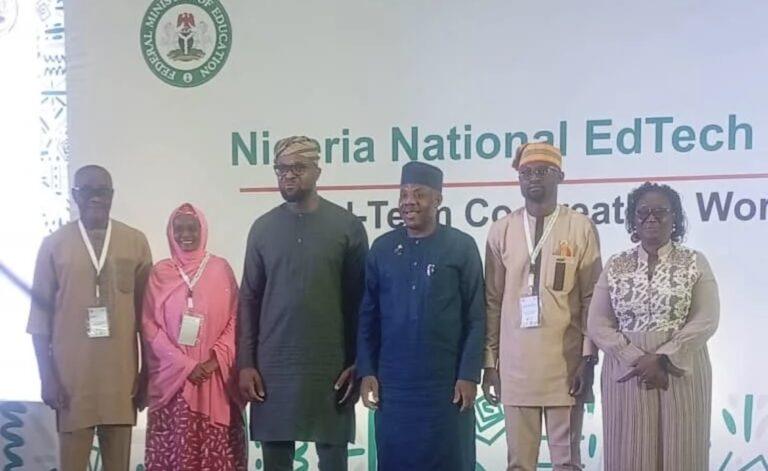
The Federal Ministry of Education and the Federal Ministry of Communication, Innovation and Digital Economy have begun jointly developing a national edtech strategy aimed at building an inclusive digital education ecosystem to transform teaching and learning across Nigeria.
The initiative was announced at the Mid-term Co-creation Workshop in Abuja, held in partnership with the Mastercard Foundation and the World Bank Group.
The Minister of Education, Dr. Olatunji Alausa, said Nigeria could no longer deliver knowledge through outdated frameworks while preparing children for a digital global economy.
“Doing nothing, or doing what we did before, is a total failure. We must embrace technology in how we deliver content to students, how we train teachers, how classrooms operate, and how learning materials are accessed,” he said.
Alausa announced that within the next four months, every classroom in federal government-owned secondary schools would have a smart board, with full internet access embedded as part of the infrastructure.
He added that the government was working to provide zero-rated data access so teachers can log into digital training platforms at no cost. A structured compensation mechanism, he said, would also begin in January, rewarding teachers who engage in verified online professional development courses.
The minister noted that Nigeria is implementing online, real-time subject instruction for junior secondary students, using master teachers to deliver interactive virtual lessons accessible to both public and private schools.
Digital Inclusion
The Minister of Communication, Innovation and Digital Economy, Dr. Bosun Tijani, stressed that modern economies can only expand with a digitally empowered education system.
According to him, technology is not just a tool but “an ecosystem involving content creators, educators, engineers, telecom providers, investors, device manufacturers, maintenance technicians, and regulators.
“If we don’t have a unified strategy, technology becomes something we spend money on but never derive value from,” Tijani said.
He revealed plans to install 4,000 telecommunications towers in rural regions, targeting more than 20 million Nigerians currently without connectivity, to boost digital inclusion in underserved communities. The towers, he said, would connect to a nationwide fiber-optic backbone, reducing data costs and improving connection speeds.
Tijani also disclosed that the government is negotiating to lower the cost of smart devices, including exploring local manufacturing options that leverage Nigeria’s lithium deposits for battery production.
Both ministers acknowledged that past interventions by agencies such as the Nigerian Communications Commission (NCC), Universal Service Provision Fund (USPF), National Information Technology Development Agency (NITDA), and Tertiary Education Trust Fund (TETFund) were meaningful but insufficient.
Alausa said this gap was being addressed through the Nigeria Education Data Infrastructure, which would enable a unified education data system, seamless communication between platforms, integrated student–teacher learning records, and national-level planning and monitoring.
Both ministers agreed that the new initiative must lead to irreversible transformation in how Nigerian children learn, rather than becoming another impressive but idle document.
The workshop is expected to produce an actionable blueprint for edtech interoperability, teacher training, digital inclusion, and real-time content delivery across the country.