

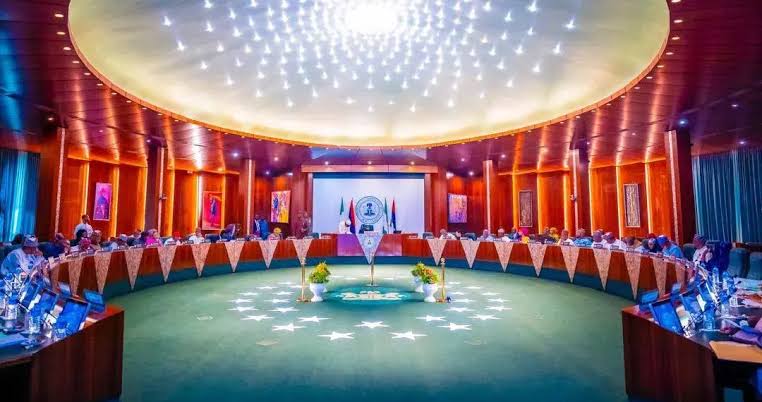
The Federal Executive Council (FEC) has endorsed the 2026–2028 Medium-Term Expenditure Framework (MTEF), outlining the nation’s core economic benchmarks, projected revenues, and fiscal direction for the next three years.
Addressing State House Correspondents after the Council meeting chaired by President Bola Ahmed Tinubu, the Minister of Budget and National Planning, Senator Atiku Bagudu said the framework was jointly presented by the Director-General of the Budget Office of the Federation and senior officials of his ministry.
Bagudu said that “the Council approved a crude oil production benchmark of 2.06 million barrels per day for 2026, while a more cautious figure of 1.8 million barrels per day will serve as the basis for budgetary planning.”
“The first time, a target oil production as well as benchmark oil production is a production figure of 2.06 million barrels by day, which the management of the oil industry is tasked to produce, however, so that we don’t run into revenue problems, we use a benchmark oil production figure of 1.8 for the budget purposes,” he said.
The Council also approved an oil benchmark price of $64 per barrel, alongside a projected exchange rate of ₦1,512/$1 for the 2026 fiscal year.
The Minister said; “But for avoidance of caution, we are using $64 8585 cents, as well as an exchange rate of 1512 to the naira for the year 2026 given that it’s a pre-election year by though there is a lot of election activities pending that can affect, typically affect exchange rate and the gross rate is projected at $4.68 the Federation revenue is estimated at 50.7 4 trillion.”
Bagudu stated that the Nigerian government’s projected revenue for 2026 stands at ₦34.33 trillion, reflecting ongoing efforts to boost non-oil earnings, strengthen tax administration, and expand the nation’s economic base.
“Nigeria revenue from all sources is projected at 34.3 3 trillion inclusive of 4.98 returned .And this figure is lower 16% lower than that of the 2025, budget estimate and the federal government expenditure breakdown by major heads shows that the statutory transfers will be around 3 trillion debt service expenditure, 10.9 1 trillion, and non-recurrent debt expenditure, which is personnel cost, about 15.2 7 trillion. And interestingly, the deficit is projected at 20 point 1 trillion, which is 3.61% of estimated of the estimated GDP, ” he explained
The Minister further explained that the exchange rate assumption took into account the fact that 2026 precedes a national election year, noting that all parameters were drawn from extensive fiscal and macroeconomic analysis undertaken by the Budget Office and other relevant agencies.
He said; “In addition, the Federal Executive Council took comments and approved the medium term expenditure planners, fiscal strategy paper for presenting presentation to the National Assembly,.
“However, it is also noted that Mr President, in addition to this, have taken several steps in his role as the president of the Federation and the Chief Executive Officer of the Federation, where he had invited state governments and local government, the three tiers of government, at the meeting of the National Economic Council to call for more collaboration and coordination between fiscal and monetary policies, which was approved by the National Economic Council and the coordinating Minister of the Economy , the central bank Governor and myself are directed to sit with the board periodically”
Bagudu said that FEC reviewed comments from Ministers and subsequently approved the Medium-Term Fiscal Expenditure Ceiling (MFTEC), which guides spending limits and helps ensure a disciplined budgeting process.
He explained that President Tinubu sought the endorsement of the National Economic Council (NEC) for enhanced vigilance across the Federation to curb revenue leakages arising from illegal activities in the oil and gas sector as well as in the exploitation of critical minerals.
“Mr. President sought the approval of the National Economic Council, and it indeed compact approval that there should be increased Federation vigilance to eliminate revenue loss from illegal activities in the oil and gas sectors as well as critical mineral sectors,” the Minister stressed.
He said that the President also underscored the need for substantial transformational investment in national infrastructure.
According to him, President Tinubu believes that with macroeconomic stability now taking root, it is imperative to sustain the ongoing reforms.
He noted that once the outlined measures are fully implemented—alongside the Medium-Term Expenditure Framework and the Fiscal Strategy Paper—they will catalyse stronger and more sustained economic growth.
“Mr. President emphasized and sought the approval of the National Economic Council that critically, minimum transformational investment is required for infrastructure, and therefore renewed hope infrastructure funding from both the federal government and constituents of the Federation should be as well as measures to boost domestic production and diligent implementation of the renewed work development programme,” the Minister added.
The 2026-2028 MTEF, is now expected to be deliberated upon by the Nigerian Senate and returned to the Executive for final adoption and use for the preparation of the national budget for the next fiscal year.

