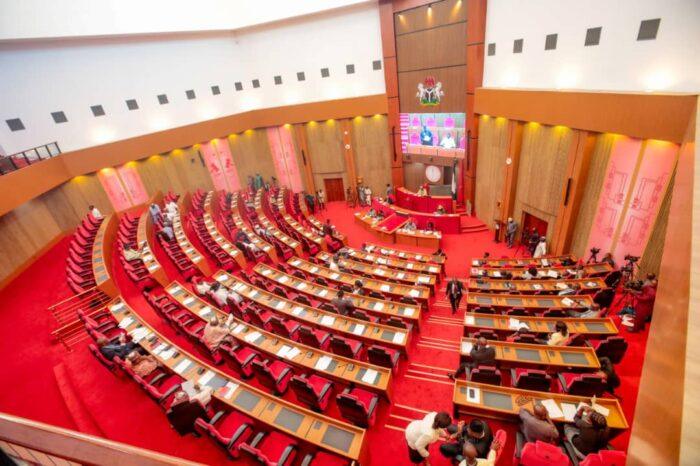
The Nigerian Senate has challenged the National Drug Law Enforcement Agency (NDLEA) and National Human Rights Commission (NHRC) to work together to pursue a comprehensive review of the country’s anti-drug war regime.
The Legislature explained how the National Assembly completed the process of reviewing the National Drug Law Enforcement Agency Act, 2004 in June 2025, but President Bola Ahmed Tinubu declined assent because a section of the amendment bill conflicted with Section 58(4) of the 1999 Constitution.
Leader of the Senate, Senator Opeyemi Bamidele made the remarks during a technical workshop of the NHRC at Civil Society, Human Rights Defenders Forum and Human Rights Expo held in Abuja on Monday.
The workshop, titled “Towards a Comprehensive Drug Harm Reduction Strategy in Nigeria: Legislative Perspectives and Opportunities,” was convened to improve drug laws and policies, so that they are not detrimental to the health and wellbeing of people who use drugs and their communities.
Senator Bamidele, represented by his Chief of Staff, Mr. Charles Luri-Bala, commended the NHRC and its strategic partners for organising the workshop aimed at crafting a comprehensive drug harm reduction strategy for the country.
The Senate leader noted that the Senate “recognise that the challenges posed by illicit drug use require a multi-sectoral approach that respects the fundamental rights of all persons, particularly those in vulnerable populations.
“At the National Assembly, we believe that an effective drug strategy must shift away from overly punitive policies that only exacerbate stigma to comprehensive approach that prioritize treatment, rehabilitation, and social reintegration.
“These are the issues that informed the decision of the 10th National Assembly to amend the National Drug Law Enforcement Act, 2004. But Mr. President declined assent to the bill because it conflicted with Section 58(4) of the Constitution of the Federal Republic of Nigeria, 1999 (as amended).”
He observed that the fact that the president declined assent to the bill in June 2025 “does not mean the bill cannot be brought again if the section that conflicts with the Constitution is substantially addressed.”
Senator Bamidele, therefore, urged the stakeholders to work together towards this end because the bill, if eventually enacted, will revolutionise the country’s anti-drug war, pointing out its significance to national development.
He assured the stakeholders that the lawmakers “are committed to reviewing and supporting an amendment to the legislation that would provide adequate legal and institutional backing for evidence‑based drug‑harm‑reduction strategies.
“The insights and recommendations generated from this workshop, particularly from the legal and specialist perspectives, will be invaluable for the National Assembly as we consider necessary policy reforms.”
In June 2025, President Tinubu declined assent to the National Drug Law Enforcement Agency Act (Amendment) Bill, 2025 into law, citing its breach of or conflict with Section 58(4) of the 1999 Constitution (as amended).
The President explained that the proposed law seeks to give the NDLEA a portion of the proceeds from drug-related crimes.
Currently, according to him, all proceeds of crime must be paid into the Confiscated and Forfeited Properties Account.