The United Nations Office on Drugs and Crime (UNODC) and its partners have unveiled a new Cybercrime Assessment Report, warning that Nigeria must act urgently to strengthen its digital security or risk deeper economic and social harm.
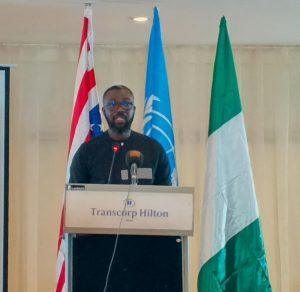
Presenting the report in Abuja, the UNODC Country Representative, Sheikh Ousmane Touré, said the assessment was not just a report but a roadmap for action, stressing that Nigeria’s rapidly growing digital economy had created new vulnerabilities.
“Cybercrime is one of the fastest-growing threats in the world today. It doesn’t respect borders, it does not discriminate, it undermines economies, erodes trust, and threatens national security,” he stated
Touré commended the institutions that contributed to the assessment, as well as the U.S. Department of State’s Bureau of International Narcotics and Law Enforcement Affairs, for funding the study.
“Your commitment has made this assessment research a report that is doable, possible, and for that we are very grateful,” the UNODC Country Representative noted.
He warned that despite recent progress, Nigeria still faced critical gaps, including limited technical capacity in law enforcement and the judiciary, weak public awareness, and insufficient private-sector involvement.
“Cybercrime is evolving faster than our ability to respond. With cybercrime moving at the speed of light and law enforcement moving at the speed of the law, without sustained investment, the gains we have made risk being eroded,” he explained.
Touré also raised alarm over the rise in sextortion and revenge porn, describing them as crimes that damage children and destroy lives. He appealed to lawmakers to strengthen intelligence coordination across security agencies.
“We all have daughters, we all have children… and we know how those images can be used. The damage is not only physical harm but reputational harm that can create bullying and even stop brilliant children from wanting to go to school. Nigeria doesn’t lack intelligence. The problem is predictive analysis and a common position to work on intelligence. If we achieve that, Nigeria will be safer and will predict the move of criminal networks before they act,” Touré said.

The Director of the U.S. Embassy International Narcotics and Law Enforcement Affairs Office, Douglas Grane, said the assessment formed part of a shared responsibility between both countries, noting that Nigerian-linked cybercrime had caused enormous financial damage globally.
“Crimes such as sextortion, business email compromise and other kinds of online fraud and abuse have harmed thousands, really millions of Americans,” he stated.
Grane added that Nigeria now ranks fifth globally as a source of cybercrime and lost an estimated 500 million U.S. dollars to cybercrime in 2022 alone.
“Business email compromise schemes linked to Nigerian accounts caused losses of over 1.8 billion dollars in a single year, most of them suffered by Americans,” he said.
Grane stressed that cybercrime was not a victimless crime and called for deeper collaboration, noting that cooperation between the two countries had already produced results.
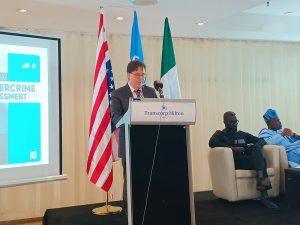
“Our children, our nieces, our nephews are all vulnerable to sexual exploitation online, especially this wicked crime of sextortion. For this reason alone, we are partners in this fight. The work of trained Nigerian officers has led to extradition, prosecution, and the recovery of 700,000 dollars in victim restitution since I arrived in August,” he disclosed.
Stronger Inter-agency Collaboration
Also speaking, the Chairman of the Senate Committee on ICT and Cybersecurity, Senator Shuai Afolabi-Salisu, commended the partnership with the United States and UNODC.
“The presentation of the assessment shows the progress we have made in our determined and committed drive to stem the tide of cybercrime and change the narrative of our country from being a haven for cybercrime to being recognised for who we are. We are Nigerians. We are enterprising, we are talented, we make marks. We will not allow a few among us to define us,” he said.
Afolabi-Salisu urged the U.S. to continue its support, especially in training Nigerian law enforcement and judicial officers. He called for stronger inter-agency collaboration.
“What is the essence of having a cybercrime law if you walk into a police station to report an incident and the man you are reporting to is as clueless as you? Unless we build the capacity of our law enforcement agents, our fight against cybercrime will not be as profound as we want it to be. It does not matter who identifies the crime first. What is important is that we must work collaboratively to bring an end to this crime,” he added.
On the legislative front, the Chairman of the House Committee on Digital Information Technology, Stanley Olajide, said the report provided an honest, data-driven evaluation of Nigeria’s cyber posture.
He gave the assurance that the National Assembly would take the report’s recommendations seriously.
“Nigeria’s digital economy is expanding rapidly but with this growth comes increased exposure to cyber threats that endanger our national security, economic stability, and societal trust. Our committee will work closely with ministries, security agencies, regulators and the private sector to strengthen our legal frameworks. This includes improving the Cybercrime Act, enhancing inter-agency coordination, expanding capacity building, and supporting investment in critical digital infrastructure,” he said.
Dr Olajide reaffirmed Nigeria’s commitment to global cyber cooperation, stressing that cyber threats were borderless and required collaborative efforts to curb the menace.
The report, funded by the United States Department of State’s Bureau of International Narcotics and Law Enforcement Affairs, was made possible with the contributions of the Department of State Services (DSS), the Economic and Financial Crimes Commission (EFCC), the Federal High Court (FHC), the Office of the National Security Adviser National Cybersecurity Coordination Centre (ONSA-NCCC), the Nigeria Police Force National Cybercrime Centre, the Independent Corrupt Practices and Other Related Offences Commission (ICPC), the National Drug Law Enforcement Agency (NDLEA), the Nigerian Financial Intelligence Unit (NFIU), the National Agency for the Prohibition of Trafficking in Persons (NAPTIP), the Ministry of Justice (Cybercrime and Central Authority Units), the National Assembly, and the National Judicial Institute (NJI).
The event ended with renewed commitments from all partners to implement the report and strengthen Nigeria’s cyber resilience.
PIAK