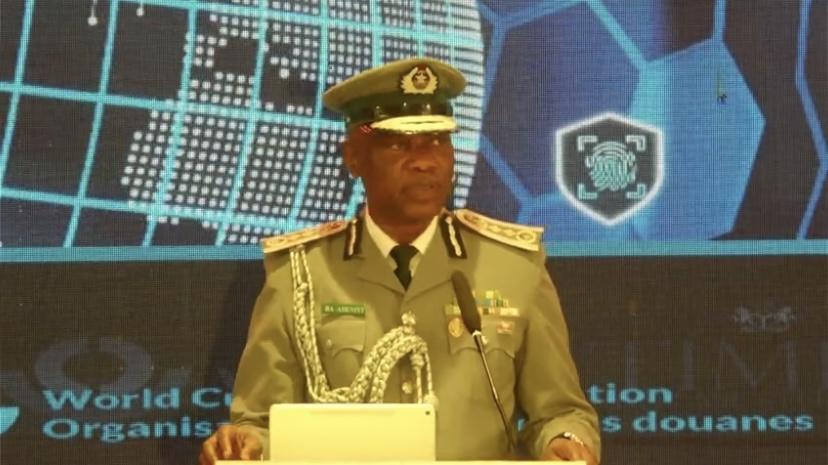
The Comptroller-General of Customs, CGC, Bashir Adewale, has reaffirmed the Nigeria Customs Service’s commitment to safeguarding society while facilitating legitimate trade.
Speaking at the launch of the Nigeria Time Release Study (TRS) during the 2026 International Customs Day celebration in Abuja, the Comptroller-General described the TRS as a major milestone in Nigeria’s journey towards a modern, efficient, and globally competitive Customs administration.
“The TRS marks a major step toward making Nigeria’s trade gateways secure, efficient, predictable, and globally competitive. It signals our commitment to move from opinion-driven reforms to evidence-based reforms, and from complaints-driven policy to data-driveno Policy.
“The Study conducted at Tincan Island Port provides us with the most comprehensive measurement of clearance performance in our recent history,” he said.
The study revealed that while examination processes are relatively efficient, excessive idle periods caused by fragmented scheduling, manual documentation, and weak inter-agency coordination continue to delay cargo movement.
“Our challenge is not that we cannot move goods fast; it is that goods are not allowed to move fast. We now have validated clearance timelines covering more than 600 declarations, combining manual timestamps and platform data.
“We now know with precision how long it takes from booking for examination to physical gate exit, and where bottlenecks concentrate. Armed with such evidence, we are now able to say: the fastest way to protect Nigerian traders and our economy is both through border security and procedural reform.
“The TRS also demonstrates another truth, Customs cannot reform the ports alone. Effective trade facilitation requires terminal operators, shipping lines, Partner Government Agencies, truckers, brokers, banks, and port authorities to work in a synchronized ecosystem rather than parallel silos.
“We will therefore be institutionalizing the TRS as a regular diagnostic tool, not as a one-off exercise. Our intention is to monitor, to learn, and to reform continuously over future cycles,” the Customs Boss explained.
Commemorating the World Customs Organisation ’s 2026 theme:’Customs Protecting Society Through Vigilance and Commitment,’ Adewale said the theme reflects the everyday reality of Customs operations in Nigeria, noting that protection goes far beyond revenue generation or the seizure of contraband goods.
He explained that Customs plays a critical role in intercepting narcotics, counterfeit medicines, arms, hazardous materials, and wildlife products, “interventions that often go unseen but prevent devastating consequences for public health, security, and the environment.
“In total, the Service recorded over 2,500 seizures nationwide with an aggregate value exceeding ₦59 billion, effectively removing harmful goods from circulation,” he said.
Strong Revenue Performance
The Comptroller-General also reported strong revenue performance by the Nigeria Customs Service, announcing that ₦7.281 trillion was collected in 2025, exceeding the ₦6.584 trillion target by ₦697 billion.
This represents growth of over 10 per cent above target and a 19 per cent increase compared to 2024 collections.
He attributed the improved revenue performance to enhanced compliance, better use of data and technology, and disciplined enforcement rather than increased pressure on legitimate traders.
The CGC stressed that the Nigeria Customs would sustain its dual mandate of protection and facilitation through deeper investment in intelligence-led and technology-driven enforcement, institutionalisation of procedural reforms to reduce clearance times and improve transparency, and strengthened collaboration with partner government agencies, the private sector, and international organisations.