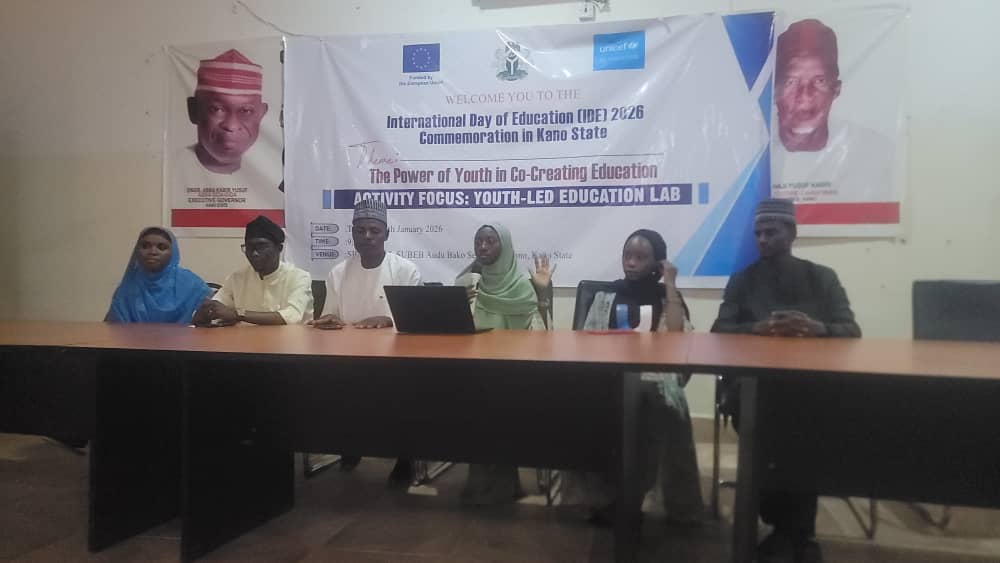
The Kano State Universal Basic Education Board (SUBEB) has expressed appreciation to the United Nations Children’s Fund (UNICEF) for its continued support in promoting basic education across Kano State and Northern Nigeria.
The Executive Chairman of SUBEB, Yusuf Kabir, made this known while declaring open the 2026 World Education Day celebration, organised by the UNICEF Kano Field Office in collaboration with the Board.
Kabir described education as the centre of development in any society, stressing that achieving meaningful progress requires the collective support of all relevant stakeholders.
He highlighted several interventions provided by the UNICEF Kano Field Office in the education sector, including the supply of reading and learning materials as well as continuous training for teachers working with the Board.
The SUBEB chairman also outlined key achievements recorded by the Kano State Government in the area of universal basic education, particularly in inclusive education.
According to him, access has been expanded for children with disabilities, Qur’anic schools have been integrated into the formal education system, and the number of out-of-school children across the state has been significantly reduced.
In the area of teacher recruitment and capacity building, Alhaji Kabir disclosed that over 8,000 schools now benefit from about 50,000 teachers. He added that 4,315 former Better Education Service Delivery for All (BESDA) volunteers have recently been absorbed as permanent staff.
Additional incentives include a teacher vehicle loan scheme, the provision of 444 motorcycles and 300 computers to strengthen school supervision.
“We are in the process of recruiting 4,000 more teachers in the state,” he said.
On infrastructure and safety, the SUBEB chairman revealed that more than 2,000 classrooms have been renovated, while 250 new classrooms have been constructed.
He added that 1,600 security personnel have been deployed to schools across the state to ensure a safe learning environment.
Kabir further noted that the adoption of Gender-Responsive Budgeting (GREB) is another major milestone. He explained that the framework ensures education spending directly addresses the needs of girls through improved sanitation, mentorship and safe transportation.
According to him, over 30,000 girls have been returned to school through the Adolescent Girls Initiative for Learning and Empowerment (AGILE) project.
“We will continue to expand digital literacy, increase scholarship opportunities, and strengthen community-based School-Based Management Committees (SBMCs) to ensure local ownership and sustainability. Our partnership with federal programmes like the National Home-Grown School Feeding Programme will provide nutritious snacks, boosting attendance and learning outcomes,” he added.
During the event, pupils in attendance were divided into three groups for interactive sessions focused on identifying challenges in the education sector and proposing solutions, which they later presented.
Speaking at the event, the Chief of Field Office, UNICEF Kano, Mr Rahama Rihood Muhammad Farah, described education as a beacon of hope and the foundation of every strong society.
“In Kano and across Northern Nigeria, we understand deeply what education means. It is a beacon of hope and the foundation of every strong society
“A thread that weaves together our shared humanity, binding us in dignity and purpose. It means dignity to walk with pride. It means a future where every child, girl or boy, can dream freely and contribute meaningfully to their community a future where every voice is heard and every story is valued,” he added.
Mr Farah noted that children desire an education system that is relevant, inclusive, safe and empowering.
“They want classrooms that inspire creativity, teachers who motivate learning, and systems that catch every child, ensuring no one is left behind
“At UNICEF, we remain firmly committed to supporting the government and people of Kano Field Office states to strengthen education systems, improve learning environments, promote adolescent development, and ensure that every child has access to quality education,” he added.