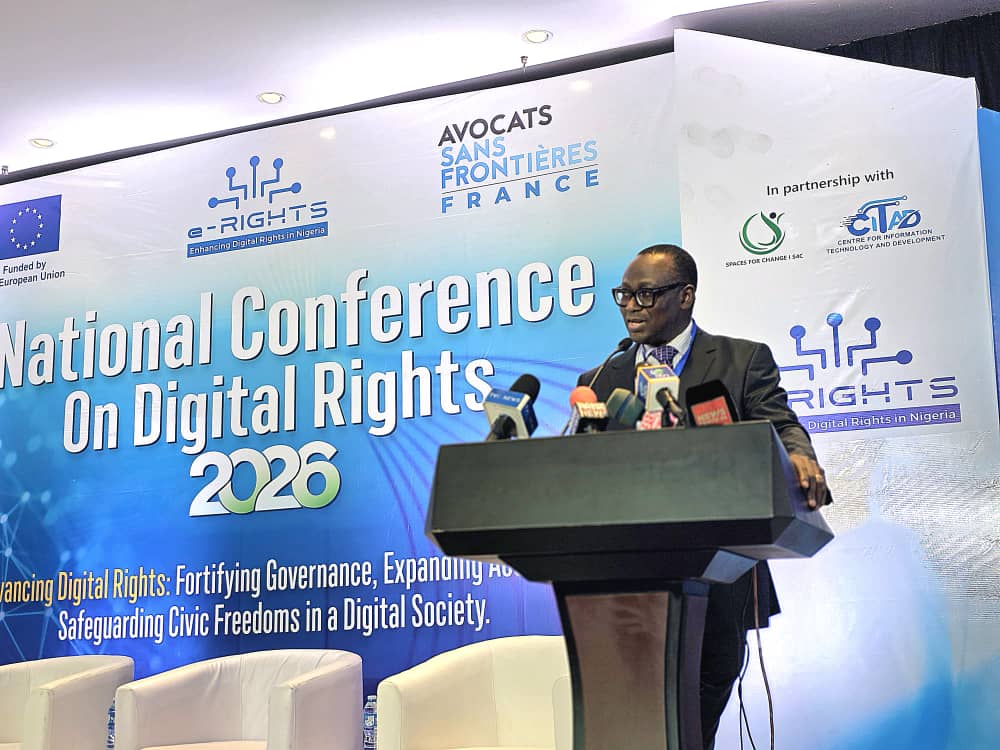
A former Director General of the Nigerian Institute of Advanced Legal Studies and researcher, Professor Adedeji Adekunle, has called for a shift in Nigeria’s approach to digital rights from narrow regulation to inclusive, transparent, and accountable governance.
Professor Adekunle made the call while delivering a keynote presentation on “Digital Rights” at the National Conference on Digital Rights 2026.
He noted a recurring tension between regulatory mandates and national security, describing Nigeria’s current digital governance landscape as “fragmented, and yet some might say confused.”
Professor Adekunle stressed that as Nigeria builds future digital infrastructure, it must not dismantle “fundamental freedoms and inclusive policies,” stating that “true digital resilience is found when government structures are designed to be inclusive, transparent, and accountable.”
According to him, the increasing digitalisation of state services such as biometric voting, tax collection, and identity management systems carries serious risks if governance logic is driven only by control. “If the logic of governance remains purely regulation, these tools risk the permanence of control rather than empowerment,” he said, adding, “We really want to empower, not just to focus on service providers and break down their neck.”
Professor Adekunle also raised concerns about persistent data breaches, despite the existence of regulatory mandates meant to protect consumers.

He questioned the effectiveness of redress mechanisms, noting that “you cannot imagine the number of breaches that have occurred.”
On inclusion and transparency, he described these as “a good governance imperative,” pointing to Nigeria’s commitments under the Open Government Partnership.
“We have made commitments under that partnership to have inclusive and transparent governance,” he said.
He warned that digital rights discourse must also address exclusion and the widening digital divide, emphasising that digital rights extend beyond connected citizens.
“There is need to also pay attention to those who are excluded because of digital services,” he stated.
Professor Adekunle further identified the right to property as a critical but underdeveloped area in Nigeria’s constitutional framework, explaining that constitutional provisions focus largely on immovable property despite the rise of digital assets.
“Property or proprietary rights comprise immovables and intangibles. All of them deserve to be protected,” he said, arguing that technological realities such as crypto assets and algorithm-based registries were not anticipated when the constitution was drafted.
He stressed that defining digital property rights requires balancing national security with human rights, noting that the African Charter does not share this limitation and remains part of Nigerian law.
On privacy, he raised questions about employer surveillance and regulatory jurisdiction, and cited consumer complaints against telecom operators, including call billing practices. “We are not interested in fining. We are interested in redress for consumers,” he said.
Concluding, Professor Adekunle urged judicial activism in digital governance, arguing that courts must be technologically informed. “Judicial activism is required in this role,” he said, adding that digital rights must include those excluded from digital systems. “For as long as those people are more than us, then we are not winning this war.”
The National Conference on Digital Rights 2026, themed “Advancing Digital Rights: Fortifying Governance, Expanding Access, and Safeguarding Civic Freedom in a Digital Society,” was convened under the European Union-funded e-Rights Project, implemented by Avocats Sans Frontières France in partnership with Spaces for Change and the Centre for Information Technology and Development (CITAD) in Abuja.