
The Nigerian Government has announced a major shift in the preparation and execution of the 2026 national budget, urging Ministries, Departments and Agencies (MDAs) that submissions will be judged strictly on realism, readiness and measurable results.
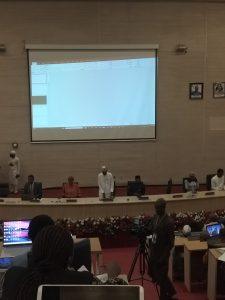
Speaking at the opening of the 4-day Government Integrated Financial Management System (GIFMIS) and the Budget Preparation Subsystem(BPS) sensitisation/training, Director General of the Budget Office of the Federation, Tanimu Yakubu told government officials from Ministries, Departments and Agencies that the meeting was not a routine annual exercise but a decisive implementation-focused engagement.
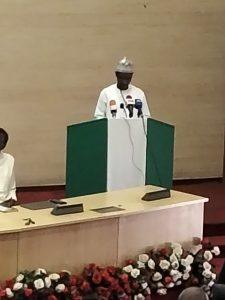
The Director General who was represented by Yusuf Mohammed, Director Social Expenditure department, noted that the objective was to translate policy into action, raise the credibility of budget submissions and execution, and improve outcomes for citizens rather than simply increasing spending.
Macroeconomic Stability
According to him, Nigeria’s ongoing economic reforms aimed at restoring macroeconomic stability and rebuilding public finance credibility must now be reflected in how budgets are prepared and implemented.
Yakubu said ” reforms only succeed when implementation succeeds, “ describing the budget as government’s strongest implementation tool.
He said that “weaknesses in past budgeting practices, including rollover budgeting and fragmented project lists, had weakened execution, reduced clarity, diluted accountability and created hidden obligations.
The Director General said the 2026 budget, is designed to correct the problems by treating government spending as one coherent implementation framework in line with President Bola Tinubu’s directive, by adopting a “single train approach” to budgeting and execution.
“Under this framework, commitments will be consolidated into a single visible pipeline, managed as a disciplined delivery programme,” he said.
Also, he noted that the approach will improve prioritisation, strengthen control, reduce duplication and give government a clear, real-time understanding of what it has committed to deliver.
“All commitments must be visible. One plan, one pipeline, and one execution logic. MDA submission for the 2026 budget would be subjected to non-negotiable assessment tests. First is policy alignment, requiring programmes to clearly reflect national priorities rather than institutional preferences. Second is credibility, meaning proposals must be implementable and backed by realistic assumptions. Third is consolidation, aimed at reducing fragmentation and improving visibility of total government commitments.
Value for money will also be a key criterion, with an emphasis on performance and measurable outcomes rather than the volume of funds requested.”
Mr Yakubu emphasised that the training session was critical because it marks the point where planning must translate into execution.
He urged MDAs to approach the 2026 budget with discipline and clarity, noting that credibility in budgeting is essential to rebuilding public trust and delivering tangible benefits to citizens.
The DG Budget Office of the Federation stressed that the new standards are intended to ensure that public resources deliver real impact, as Nigeria positions its economy for sustainable growth under ongoing reforms.
The GIFMIS/BPS sensitisation/training is taking place simultaneously in the six geopolitical zones of Nigeria between February 2-5 2026.
The 2026 Budget titled ” Budget of Consolidation, renewed resilience and shared Prosperity” was presented by President Bola Tinubu in December 2025, passed by the Nigerian House of Representatives late January 2026 and scheduled for final passage in March 17 2026.