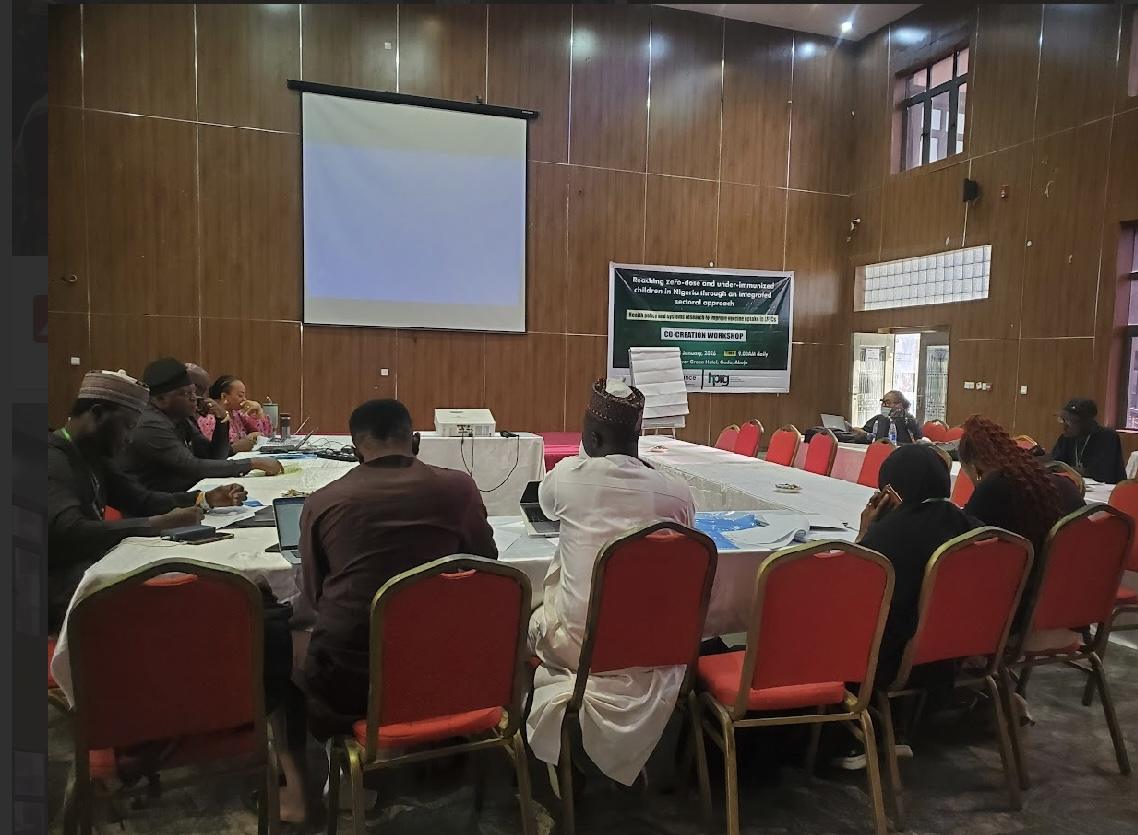
The Health Policy Research Group (HPRG), a health advocacy organisation affiliated with the University of Nigeria, Nsukka, in collaboration with key stakeholders has announced its commitment to enhancing vaccination rates among children classified as zero-dose and under-immunised in Nigeria.
The development emerged at a recent workshop organised by the group in Abuja, Nigeria’s capital, aimed at presenting and evaluating findings from a research team commissioned over a year ago.
The team was tasked with examining the persistent poor immunisation outcomes in the country despite sustained interventions by government agencies and partner organisations.
In her opening remarks, the Principal Investigator of the research project, Professor Chinyere Ojiugo Mbachu, said the three-day Co-Creation Workshop on Health Policy and Systems Research was designed to critically examine the team’s progress report and develop practical, results-oriented strategies to address challenges hindering vaccine uptake in Nigeria.
She stressed the importance of reaching zero-dose and under-immunized children through coordinated, multisectoral engagement.
Read Also: Organisation lauds Sokoto Government’s Commitment to Child Immunisation
Findings from the team’s report highlighted several lingering challenges, including limited involvement of key non-health sectors in nationwide vaccination efforts, widespread misinformation about vaccines, and infrastructure and workforce gaps at the primary healthcare level.
Other barriers identified include transportation costs, long distances and difficult terrain, all of which hamper access to vaccination services.
The report also noted that the practice of incentivising vaccination, although common, has in some cases fuelled suspicion and vaccine hesitancy among local populations.
Such concerns have led to questions such as why vaccines are offered for free while treatments for other illnesses, including malaria, are not. Religious and cultural reservations surrounding vaccination were also identified as significant obstacles.
The report comes against the backdrop of the 2024/2025 WHO and UNICEF data, which ranks Nigeria as having the highest number of zero-dose and under-immunized children in Africa. While the findings serve as a wake-up call, renowned epidemiologist and vaccine expert, Professor Abanida, cautioned against focusing solely on data without swift action.
“One of the ways of addressing this issue is what we are doing now. You bring everybody together to have a common understanding of the issues. Once you understand the issues, you now look at the various aspects of the issues outlined. What are the problems? What are the possible solutions? Who are those that are supposed to do what and what? Then, when are they supposed to do it? What resources do they need to do it? Then how do you measure the impact or the outcomes of what they are doing? Eventually, how do you measure the impact? It’s an algorithm, and there are two types. You have the United Nations algorithm, and some of the partners’ algorithm. But the most important thing is that you do a spreadsheet and a logical framework on how to deal with the challenges,” he said.
The field research focused on six pilot states representing Nigeria’s six geopolitical zones, Abia State in the South East, Bauchi State in the North East, Edo State in the South South, Kano State in the North West, Nasarawa State in the North Central region, and Oyo State in the South West.
The workshop is expected to culminate in the development of a blueprint to guide the next phase of HPRG’s interventions aimed at significantly improving vaccine and immunisation uptake across Nigeria.