
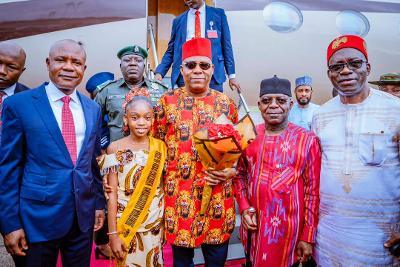
Vice President Kashim Shettima has unveiled a 25-year development blueprint for the South-East region, describing the area as a central pillar of Nigeria’s economic future.
He also announced that President Bola Tinubu has approved the establishment of the South East Investment Company Limited, designed to mobilise resources from the diaspora, capital markets, and development finance institutions for the region’s development.
Speaking on Wednesday during the South-East Vision 2050 Regional Stakeholders’ Forum in Enugu, the Vice President said the gathering represents a decisive break from short-term governance cycles, moving towards a structured, multi-decade development framework.
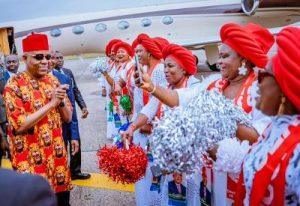
“This forum reflects foresight, responsibility, and a shared understanding that the future is not something we wait for, but something we must deliberately design,” VP Shettima said.
“In recognition of the distinctive character of the South-East, its entrepreneurial spirit, its global diaspora, and its long-standing relationship with international capital, President Bola Ahmed Tinubu approved the establishment of the South East Investment Company Limited.”
Infrastructure Gaps
He added that the company will work in synergy with the South-East Development Commission (SEDC) to address post-war infrastructure gaps and drive long-term regional competitiveness.
VP Shettima reaffirmed that the SEDC was conceived to focus on structural transformation rather than routine administrative activity, stressing that Nigeria is strongest when its regions thrive.
“Let me be clear. This is not another layer of bureaucracy. It is a delivery institution, focused on tangible outcomes that translate into jobs, productivity, and growth,” he stated, noting that the South-East carries a unique historical burden, which makes deliberate regional planning both urgent and necessary.
The Vice President praised the inclusive nature of the forum, which brought together federal and state governments, traditional institutions, the private sector, civil society, and development partners.
Diaspora Support
He also acknowledged the presence of Umu Igbo Unite, a United States–based network of over 10,000 young professionals, saying: “The future of the South-East will be built both at home and abroad, together.”

Addressing the youth directly, VP Shettima insisted that development must yield concrete results.
“To the young people of the South-East and of Nigeria as a whole, let me speak plainly. You are not spectators in our national journey. You are central to it. Your energy, creativity, and ambition are essential to the Nigeria we are working to build. Development must not remain an abstract promise. It must be felt in the daily lives of our people,” he said.
Governor Peter Mbah of Enugu State, along with his colleagues in the region, endorsed the Vision 2050, explaining that it aligns with the national agenda, Vision 2060.
He praised the unity of purpose among leaders and stakeholders in the region and proposed the creation of a South-East common market, describing the moment as the awakening of an economic giant.
On reimagining the South-East as an economic bloc, Governor Mbah emphasised that unity and synergy of ideas and resources, as well as changing the mindset of leaders and citizens about regional development, must remain paramount.
He urged a paradigm shift in the planning and execution of projects across the region and called on the populace to complement the renewed federal drive to improve security and integrate all aspects of the region’s inclusive development plan.
Governor Francis Nwifuru of Ebonyi State pledged his government’s support for implementing the development plan, noting that it will reduce unemployment and poverty while unlocking potential across various sectors.
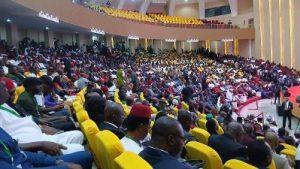
He highlighted that Ebonyi State, under his administration, is building on previous achievements in agriculture, agribusiness, education, solid mineral development, and a roadmap for transforming the state into a hub of rural development in the South-East.
Similarly, Governor Alex Otti of Abia State expressed satisfaction over the unanimous adoption of South-East Vision 2050, stating that the summit is pivotal to the region’s economic transformation.
Dream Come True
Governor Charles Soludo of Anambra State thanked President Tinubu for creating the SEDC, describing it as “a gift to the region that stakeholders have long clamoured for.”
He added that the discussion around SEDC Vision 2050 was historic, marking the first time governors and other leaders across the region united in adopting a framework to guide its transformation.
In a keynote address, the UNDP Resident Representative, Mrs Elsie Attafuah, highlighted global lessons in long-term regional planning, emphasising the importance of institutional capacity for sustainable implementation.
She said that for genuine industrialisation to be achieved, infrastructure across the region must serve domestic production, urging stakeholders to execute Vision 2050 effectively and leverage the comparative advantages of South-Eastern states to ensure sustainability.
Minister of Regional Development, Abubakar Momoh, described the event as a crowning moment in the South-East’s development, particularly in fostering a united and prosperous future.
He stated that the creation of the SEDC under President Tinubu reflects an institutional commitment to coordinated transformation, including revitalisation of critical infrastructure such as the rail sector and commodity ecosystem.
Minister of Trade and Investment, Dr Jumoke Oduwole, emphasised the importance of aligning resources and efforts, which have been prioritised through the South-East Vision 2050 programme.
The Vice President, accompanied by South-East governors and other dignitaries, later toured the exhibition gallery mounted by the Director-General, National Council for Arts and Culture.

