
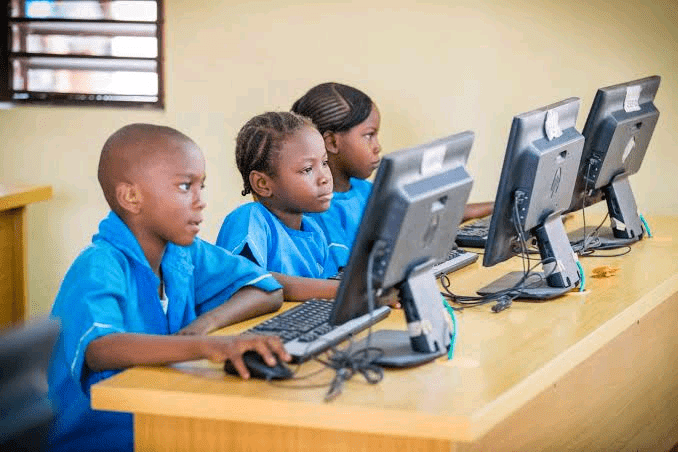
The Nigerian Government has taken decisive steps to connect schools across Nigeria to reliable internet services.
This is part of a major initiative to strengthen digital learning, expand access to modern educational tools, and harness technology, including Artificial Intelligence (AI), to improve the nation’s education system.
A statement by the Director of Press of the Ministry of education, Boriowo Folashade, said the initiative follows a directive by President Bola Tinubu to expand nationwide digital infrastructure and ensure that key sectors such as education benefit directly from ongoing broadband and telecommunications investments.
Read Also: Nigeria Unveils $552m HOPE-EDU Funding For Education Reform
To advance this objective, Minister of Education, Dr. Maruf Tunji Alausa and Minister of Communications, Innovation and Digital Economy, Dr. Bosun Tijani, held a high-level collaborative meeting in Abuja with key stakeholders to strengthen coordination between both ministries in connecting schools across the country.
The meeting focused on developing a coordinated framework to ensure internet connectivity reaches institutions at all levels of the education system from foundational and secondary schools to universities, polytechnics and colleges of education.
Speaking after the meeting,
Dr. Alausa explained that the initiative builds on earlier connectivity efforts through the Nigerian Research and Education Network (NgREN), which previously supported broadband connectivity for tertiary institutions under a World Bank-funded project.
According to him, although the programme recorded significant progress in connecting universities and other tertiary institutions, the momentum slowed after the initial funding cycle ended, creating the need for a renewed and expanded strategy.
The current effort, he said, seeks to revive and strengthen the programme while extending connectivity across all levels of the education sector.
“Connectivity is not limited to broadband fibre alone. It also involves telecommunications towers, satellite systems and other digital infrastructure required to provide reliable internet access across the country,” the Minister said.
Major Projects
Dr. Alausa noted that the Federal Government is implementing major connectivity projects, including the deployment of approximately 90,000 kilometres of fibre optic broadband infrastructure, the installation of about 3,700 telecommunications towers, particularly in rural and underserved communities, and the expansion of satellite capacity to strengthen nationwide coverage.
The Minister explained that the objective is to ensure that as broadband cables are deployed and towers installed across the country, schools at every level are deliberately connected to the network.
“We are planning proactively so that as broadband cables are laid and towers deployed across the country, they are strategically connected to our schools from primary and junior secondary schools to senior secondary schools and all tertiary institutions,” he said.
Dr. Alausa disclosed that the meeting produced several concrete steps aimed at accelerating connectivity within the education sector. As part of the outcomes, the governing council of NgREN will be expanded to include representatives responsible for foundational and secondary education, thereby strengthening coordination across the education system.
Technical Groups
In addition, two technical working groups have been established to drive implementation. One will focus on connectivity for tertiary institutions, while the other will focus on foundational and secondary schools. The teams will coordinate planning, develop implementation strategies and ensure schools benefit from ongoing national connectivity projects.
Dr. Alausa expressed optimism that the first phase of the initiative would begin to produce visible improvements within the next three months. He noted that improved connectivity will enable students and teachers to access digital learning platforms, global knowledge resources and emerging technologies, including artificial intelligence tools that are increasingly shaping modern education systems.
The Minister emphasisid that expanded digital infrastructure will support ongoing reforms aimed at strengthening examination integrity through the gradual transition to Computer-Based Testing (CBT) for major national examinations.
He stressed that digital learning centres being established in schools would also function as CBT centres for national assessments.
“Our plan is that within the next two to three years, major examinations such as WAEC and NECO will transition fully to Computer-Based Testing, similar to what is currently being implemented by JAMB,” he said.
Also speaking, Dr. Tijani emphasised that technology-driven education cannot thrive without reliable connectivity.
The Minister noted that although Nigeria hosts about eight international subsea internet cables the highest number in Africa the key challenge lies in distributing that capacity inland through extensive fibre networks capable of reaching communities nationwide.
“Most of the internet capacity enters Nigeria through submarine cables landing in Lagos, but without sufficient inland fibre infrastructure, that capacity cannot effectively reach schools and communities across the country,” he said.
According to the Minister, the ongoing 90,000-kilometre national fibre expansion project is designed to address this challenge and ensure broadband connectivity reaches all local government areas.
Rural Telecom Towers
He added that the deployment of 3,700 rural telecommunications towers will further extend connectivity to underserved communities, with many located close to schools to ensure educational institutions benefit directly from the infrastructure.
Both ministers reaffirmed the Federal Government’s commitment to sustained collaboration between the education and communications sectors to ensure that digital infrastructure investments translate into improved learning outcomes.
The Federal Government emphasised that expanding connectivity across Nigeria’s education system will equip students with the digital skills required to thrive in a technology-driven global economy while ensuring that every Nigerian child has access to quality education comparable to global standards.

