
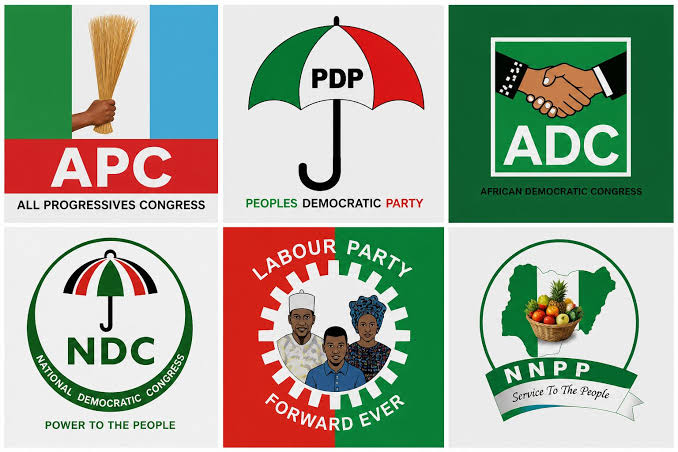
Nigeria’s political landscape is gradually taking shape ahead of the 2027 General election, defined less by clear ideological divisions and more by a fragmented opposition struggling to build cohesion against an increasingly dominant ruling party.
At the centre of this unfolding reality is the weakening of what was initially projected as a formidable opposition coalition centered on the African Democratic Congress, ADC.
The alliance, which brought together political heavyweights such as former Vice President Atiku Abubakar, former Governors Peter Obi, Rabiu Kwankwaso, and Rotimi Ameachi, among others, was designed to consolidate votes and present a united front against the ruling All Progressives Congress (APC) ahead of 2027 elections.
However, the early withdrawal of key figures like Obi and Kwankwaso from the ADC coalition has exposed deep cracks within the arrangement, raising questions about its viability.
Political politics in Nigeria has long been defined by weak ideological alignment and a heavy reliance on personalities with diverse political interests.
What is unfolding appears to be a coalition built more on electoral arithmetic than on shared vision or enduring trust. Once personal ambitions and strategic interests came into play, the fragile alliance began to waver.
The implications are many. In Nigeria’s electoral system, opposition unity is not just an advantage, it is often a necessity meant to provide viable alternative to the electorate.
A divided opposition risks splitting votes across multiple candidates, ultimately benefiting the party in power. If this trajectory continues, the All Progressives Congress APC, could enter the 2027 race in a considerably stronger position due to the fact that its challengers remain disjointed and fragmented.
That advantage is further reinforced by a steady wave of defections into the ruling party. With control of a vast majority of States, the APC continues to strengthen its political machinery nationwide.
In a system where State structures are critical for mobilisation, funding, and grassroots influence, this dominance provides not just numerical strength, but strategic depth needed for electoral mobilisation.
Irrespective of the current situation in the camp of the opposition, it would still be premature to declare the 2027 election a foregone conclusion in favour of the ruling party. Nigerian voters have, in recent years, demonstrated increasing independence and unpredictability.
The 2023 elections, for instance, showed how emerging political movements can disrupt established patterns. Notably, the APC itself came to power through a coalition that successfully challenged and ousted the then-dominant Peoples Democratic Party, underscoring the enduring power of strategic alliances.
What the current situation reveals, however, is the urgent need for an opposition built on shared ideology rather than personalities. For any coalition to succeed, it must evolve beyond selfish ambitions, convenience and become a sustainable, trust-driven partnership anchored on clear policy direction and ideology.
For now, the signs point to a divided house, one that may struggle to mount a serious challenge against a well-entrenched incumbent. But in Nigerian politics, alignments can change quickly. The real question is whether the opposition can rediscover a sense of common purpose before time runs out.
As 2027 approaches, the contest may not only be between parties, but within them. And as always in politics, the final outcome will be determined not just by structure or strategy, but by timing, unity, and the will of the electorate.

