
The People’s Republic of China has reiterated its commitment to the One-China Principle, describing it as the basis of China’s sovereignty and a key pillar of China Nigeria relations.
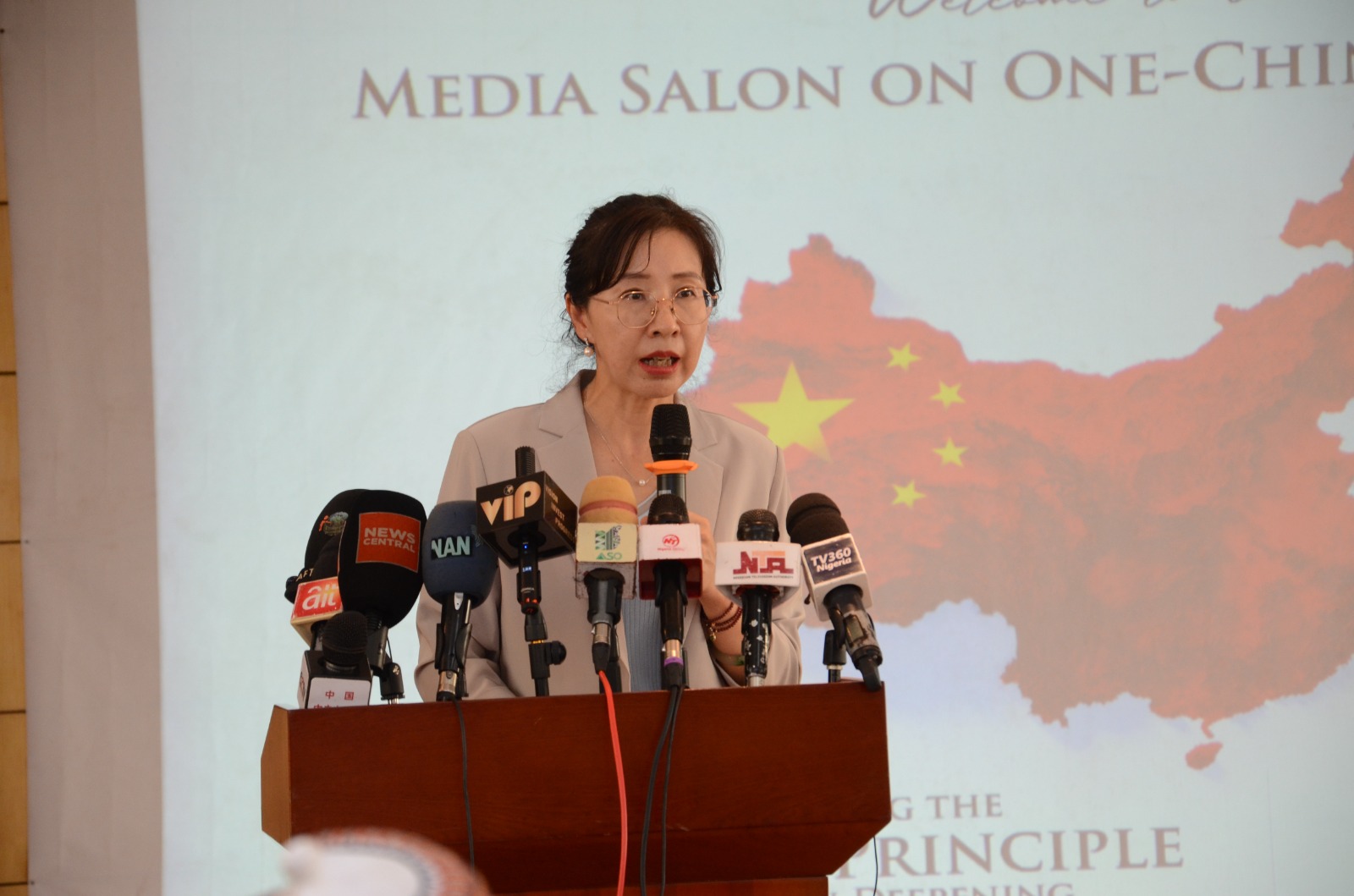
The position was restated during a media salon organised in Abuja by the Centre for China Studies and the Centre for Contemporary China-Africa Research.
Speaking at the event, Chinese Embassy Counselor Dong Hairong said misunderstandings about Taiwan continue to encourage separatist narratives and weaken global understanding of China’s territorial integrity.
She criticised recent diplomatic activities involving Taiwan’s leadership, including what she called a “sneaky visit” by Taiwanese leader Lai Ching-te to Eswatini.
“These two incidents show that the international community still lacks a clear understanding of the fundamental facts regarding the Taiwan question, as well as the true nature and harm of Taiwan independence,” she said.
Dong maintained that Taiwan has always been part of Chinese territory, citing historical records and international agreements such as the Cairo Declaration and Potsdam Proclamation.
“Taiwan has never been a country, was never one, and will never be,” she said.
She also referenced United Nations Resolution 2758 of 1971, which recognised the People’s Republic of China as the only legitimate representative of China at the UN.
“This resolution has explicitly established politically, legally and procedurally that there is only one seat for China in the United Nations, leaving no room for ‘two Chinas’ or ‘one China, one Taiwan”, she continued.
Dong commended Nigeria for consistently supporting the One-China Principle since both countries established diplomatic relations in 1971.
“It is precisely on the political foundation of the One-China Principle that China-Nigeria relations have grown into a comprehensive strategic partnership, yielding fruitful outcomes across all fields,” she said.
Highlighting cooperation between China and African allies, she mentioned the Chinese-assisted ECOWAS headquarters in Abuja and China’s zero-tariff policy for exports from 53 African countries, including Nigeria. She noted that the policy would improve access for Nigerian products such as sesame, ginger, cocoa and cashew nuts.
READ ALSO: Nigeria, China Sign Pact to Deepen Economic Cooperation
Professor Sheriff Ghali Ibrahim, Provost of the Anti-Corruption Academy of Nigeria and Head of Contemporary China-Africa Research, also defended the One-China policy, describing Lai Ching-te’s visit to Eswatini as secretive and contrary to diplomatic norms.
“As of May 2026, 53 out of 54 African nations adhere to the One-China policy, recognising Taiwan as an inalienable part of China. Eswatini is the sole African nation maintaining diplomatic ties with Taiwan. African nations have consistently stood with China on issues concerning its sovereignty and territorial integrity,” he noted.
Director of the Centre for China Studies, Charles Onunaiju, said the One-China Principle remains central to China’s sovereignty, adding that stronger political and economic ties across the Taiwan Strait show growing convergence between mainland China and Taiwan.
“The People’s Republic of China is not begging anyone to accept or reject that Taiwan is an integral part of China. The consequences of violating that very fundamental definition of China’s sovereignty would be so consequential and so costly that nobody would dare to try”, he botres.
He added that the 1992 Consensus provides the basis for dialogue across the Taiwan Strait, while the “One Country, Two Systems” framework preserves Taiwan’s social and political identity within national unity.
Foreign Policy Scholar Professor Mukhtar Imam described Taiwan as one of the world’s most sensitive geopolitical issues, warning that rising tensions could affect global trade and regional stability.
“Achieving durable peace across the Taiwan Strait requires sustained diplomacy, mutual restraint, economic cooperation and an international environment that prioritises stability over confrontation,” Imam said.
Also speaking, Dr. Segun Showunmi highlighted the economic gains of Nigeria’s partnership with China, especially in infrastructure projects like the Abuja-Kaduna and Lagos-Ibadan railways.
Participants at the forum called for improved media understanding of the One-China Principle and encouraged balanced reporting on Taiwan-related matters.
The event, themed “Understanding the One-China Principle and Its Role in Deepening China–Nigeria Strategic Relations,” brought together diplomats, scholars, journalists and policy experts to discuss China’s position on Taiwan and its implications for Africa-China cooperation.
The seminar concluded with renewed calls for stronger China–Nigeria collaboration in diplomacy, trade, infrastructure and cultural exchange.

