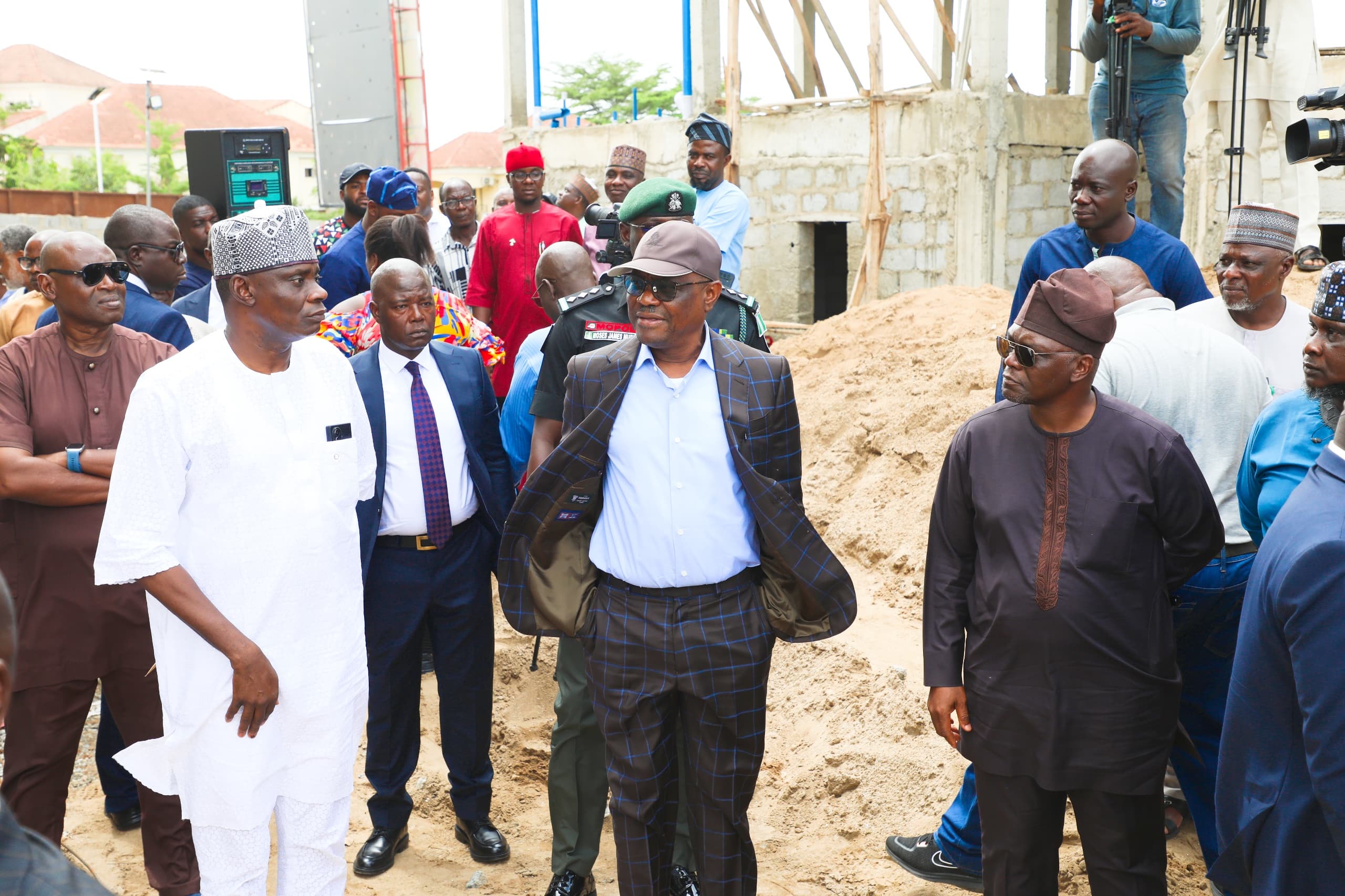
The Minister of the Federal Capital Territory (FCT), Nyesom Wike, on Monday ordered a full-scale investigation into the building collapse in Abuja that claimed five lives, directing that the premises be sealed off immediately.
Wike also disclosed that an engineer linked to the collapsed structure had been arrested, while the developer would equally face arrest and a panel set up to unravel the cause of the collapse.
The Minister, who visited the collapsed building on Monday, described the incident as “very pathetic”, stressing that the government would not compromise on the safety of residents.
“From the report I got, we lost five people, and some lives were saved. It’s very pathetic. Nobody is happy when you lose somebody,” Wike said.
“The Department of Development Control has sealed off the premises. We are going to set up a panel to really look at what happened. One of the engineers has been arrested already. From there, we’ll get to the developer, and the developer will also be arrested.”
He said the FCT Administration was taking over the matter, while the Department of Development Control would carry out preliminary investigations pending the outcome of the panel’s findings.
Wike warned developers against obstructing officials of the Federal Capital Development Administration (FCDA) from carrying out routine supervision of construction projects.
According to him, some developers often resort to blackmail whenever government agencies attempt to enforce compliance with building regulations.
“Sometimes when we come to a site like this, the press has not been kind to us. Instead of finding out why the government is taking that decision, some people will go to blackmail government officials,” he stated.
The minister stressed that strict compliance with building standards, including soil tests and the use of quality materials, remained critical to preventing future disasters.
“In the construction of buildings, we must know the quality. What materials are they using? Are they doing the soil test? What is the result of the soil test? Can it allow for two floors or three floors? All these are very key,” he said.
He maintained that the government’s primary responsibility was the protection of lives and property, lamenting that the lives lost in the collapse could never be replaced.
“How can you buy back these lives? They are gone. That is the responsibility of the government: to protect life and property,” Wike added.
Providing a technical breakdown of the incident, the Director of the Department of Development Control, Bashir Madaki Sanusi, revealed that an independent integrity test conducted by a consultant, identified as Mr Emeko, exposed critical underground anomalies that were completely hidden from developers.
Sanusi said the soil at the site was composed of dredged waterways accumulated over the years. Crucially, a historic local well, filled with loose debris and clay, lay directly beneath the construction footprint—unbeknownst to the development team.
”Columns C and D were unfortunately placed directly on top of this hidden pit.
“The depth of the well was two meters, but the length of the columns was only 1.5 meters. That shortage and structural gap created the collapse”, Sanusi explained.
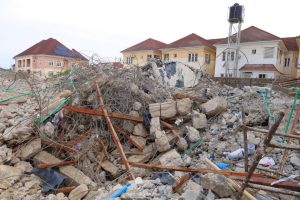
Defending his department’s oversight, Sanusi emphasised that regular soil tests and approvals had been obtained, showing no initial negative tendencies or variations.
“Before approval, there must be a soil test. My guys were here supervising every stage, from the foundation to the last floor. But if a local well is backfilled with debris and clay underground, development control volume tests will not detect that from the surface,” he added.
While the Department of Development Control has been mandated to conclude its preliminary investigation, the upcoming independent panel is expected to scrutinise the structural designs, soil test authenticity, and supervision logs to determine ultimate liability for the fatal collapse.