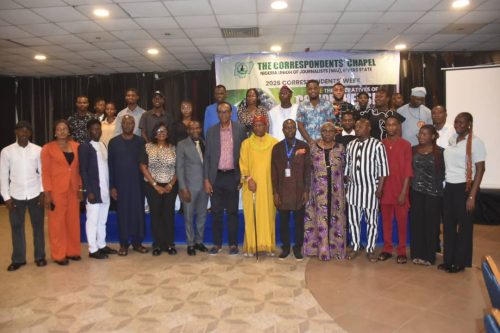
Stakeholders in Rivers State South-South Nigeria, have declared that Nigeria was economically and socially better positioned before crude oil emerged as the country’s dominant source of revenue.
Renowned environmental activist and Executive Director of Health of Mother Earth Foundation, Nnimmo Bassey made the assertion in Rivers State Port Harcourt the State capital, while delivering the keynote address at the 2026 Correspondents’ Week organised by the Correspondents’ Chapel of the Nigeria Union of Journalists.
The event, themed “The Imperatives of Comprehensive Cleanup of the Niger Delta Environment: Role of the Media,” brought together journalists, environmental advocates, civil society groups and stakeholders in the oil and gas sector.
READ ALSO: Nigerian Leader Attributes Economic Growth to Citizens’ Sacrifices
The programme was organised with support from Renaissance Africa Energy Company Limited, operator of the NNPC/Renaissance/TotalEnergies/AENR Joint Venture, alongside Nigeria LNG Limited, Kebetkache Women Development Centre and HOMEF.
In his presentation, Bassey lamented that Nigeria’s heavy dependence on crude oil had weakened the country’s productive capacity, destroyed agriculture and entrenched economic dependence
“Despite decades of petroleum wealth, according to him, before oil became the nation’s economic mainstay, Nigeria had a thriving agricultural economy that sustained livelihoods and regional development.” He said.
He argued that the oil economy merely reinforced colonial patterns of exploitation in Africa, where raw materials are extracted and exported while local communities remain impoverished and environmentally degraded.
The environmentalist further advocated for Nigeria to strengthen alliances with emerging global blocs such as BRICS, insisting that Western powers continue to dominate and dictate the global economic system to the disadvantage of developing countries.
Bassey also issued a warning over the worsening environmental condition of the Niger Delta, stressing that unless urgent cleanup efforts are undertaken, the region could be abandoned to irreversible ecological devastation by the time the world transitions away from fossil fuels.
He faulted the persistent narrative that attributes most oil spills in the Niger Delta to sabotage and vandalism, maintaining that many spills are caused by obsolete pipelines and operational failures by oil companies.
According to him, several pipelines operating in the region were installed more than five decades ago and have exceeded their lifespan. He therefore insisted that such facilities should have been replaced long ago to prevent recurring spills and environmental pollution.
“Your pipelines laid over 50 years ago are obsolete, expired and ought to be replaced,” Bassey declared.
Gas flaring
The activist equally condemned the continued gas flaring in oil-producing communities despite multiple court judgments declaring the practice illegal,
He noted that affected communities are increasingly resorting to foreign courts in search of justice because environmental judgments delivered by Nigerian courts are often ignored or poorly enforced.
He charged the media to sustain pressure on both government and oil companies by consistently highlighting the environmental crisis in the Niger Delta, insisting that authorities could no longer pretend that conditions in the region were normal.
Petroleum Industry Act
Meanwhile, host communities in the Niger Delta have called for an urgent review of the Petroleum Industry Act, alleging that the law unfairly places responsibility for oil theft and pipeline vandalism on local communities.
In his welcome address, Chairman of the Correspondents’ Chapel, Amaechi Okonkwo, described the gathering as more than a ceremonial event, saying it represented a solemn call to conscience over the continued environmental degradation in the Niger Delta.
Okonkwo observed that despite serving as the economic backbone of Nigeria for decades, the Niger Delta remains one of the most environmentally devastated regions in the world.
Also speaking, the National Vice President of Zone F of the Nigeria Union of Journalists, Opaka Dokubo, lamented that mangrove forests which once sustained local livelihoods have been destroyed and replaced with tank farms in the relentless drive for oil extraction.
Stakeholders at the event collectively stressed the need for stronger environmental accountability, comprehensive remediation of polluted communities and sustained media advocacy to ensure that the ecological and human impact of oil exploration in the Niger Delta remains at the forefront of national discourse.