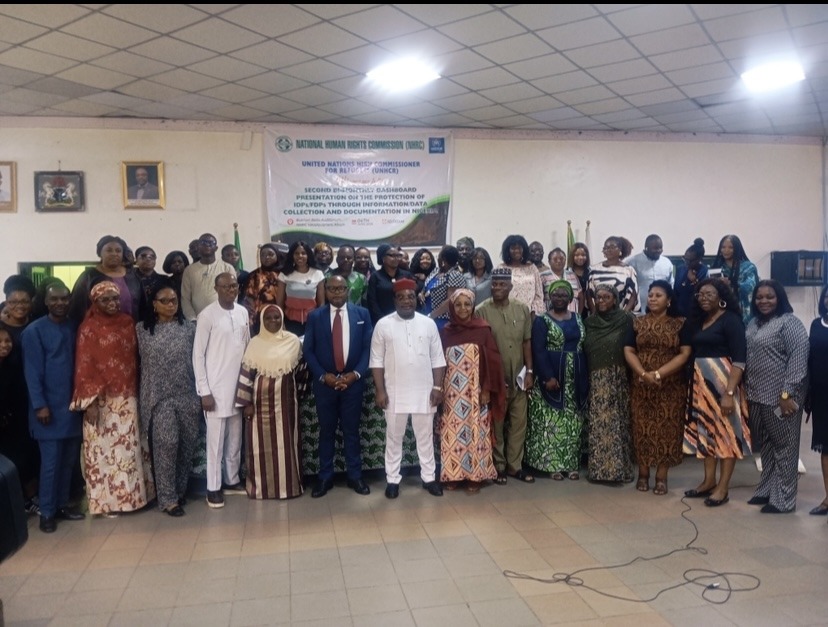
The Executive Secretary of the National Human Rights Commission (NHRC), Dr Tony Ojukwu, has advocated for stronger protection, sustained funding, and increased political commitment to safeguard the rights of forcibly displaced persons, warning that insecurity and humanitarian challenges continue to threaten vulnerable populations across Nigeria.
Speaking at the presentation of the NHRC’s second bi-monthly dashboard for 2026 on the promotion and protection of the rights of forcibly displaced persons (FDPs) in Abuja, Ojukwu said the report reflects not merely statistics but the lived experiences of internally displaced persons (IDPs), refugees, asylum seekers, returnees, and host communities across nine project states.
According to the report, the Commission reached 8,472 internally displaced persons between March and April 2026, compared to 10,884 in the previous reporting period. It also documented 5,772 children, down from 6,003 recorded in January and February.
READ ALSO: Democracy Thrives on Citizens’ Participation – NHRC
Ojukwu explained that the decline does not indicate a reduction in displacement but rather limited access to communities affected by insecurity.
“The high number of children consistently over 5,700 underscores that displacement is not just a crisis of not having a house to live in; but also, it is a crisis of non-enjoyment of childhood, including non-attendance of school, and loss of opportunities for a good standard of living for children in the future,” he said.

The dashboard showed a rise in the refugee population from 1,159 to 1,205, particularly in Cross River and Borno States, while the number of asylum seekers dropped sharply from 527 to 160 due to restricted access to border communities and fears of identification by authorities.
Describing the trend as a serious protection concern, Ojukwu stressed that displacement remains fluid and complex.
“Populations move, hide, return, and flee again. Hence, our data collection and protection response must remain active to ensure that every displaced person gets the human rights protection they need,” he stated.
The report identified access to food and shelter remained a major challenge for displaced persons, with 344 reported cases of inadequate housing and food shortages. Social tensions linked to land disputes, discrimination, and communal conflicts also rose from 36 to 68 cases.
Although documentation-related complaints declined from 195 to 140, Ojukwu warned that many displaced persons remain excluded from essential services.
“These people would be unable to access schools, healthcare, employment, or legal protection,” he said.
The Commission also recorded violations relating to freedom of movement, access to justice, prolonged detention, and denial of legal representation, while Sexual and Gender-Based Violence (SGBV) remained a major concern. Domestic violence cases increased from 19 to 26 during the period.
Ojukwu noted that the increase in reported abuse cases partly reflects growing public confidence in reporting violations.
The dashboard further revealed a sharp rise in safety and security incidents, which climbed from 387 to 872 cases, driven by worsening insecurity in parts of Taraba, Katsina, and Yobe States.
Child protection concerns also escalated, with cases involving neglect, abuse, child labour, and lack of parental care increasing by 67 per cent, from 244 to 407.
The NHRC chief reaffirmed the Commission’s commitment to ensuring that the rights of displaced persons remain at the forefront of national and international humanitarian efforts, despite the continuing challenges posed by conflict, insecurity, and forced displacement.