

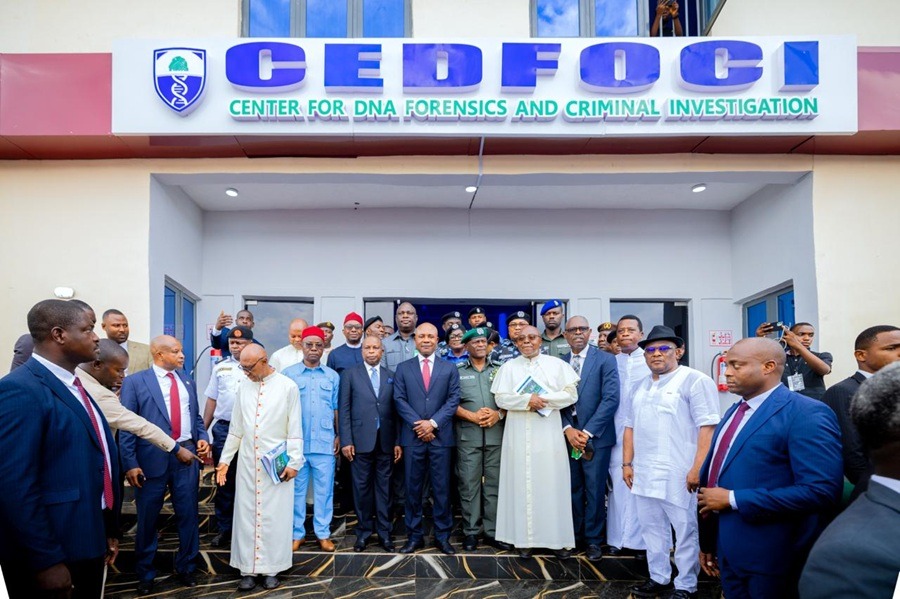
The Nigerian Government, the Nigeria Police Force and other stakeholders have hailed the inauguration of the Centre for DNA Forensics and Criminal Investigation (CeDFoCI) in Enugu State, describing it as a landmark development that will strengthen criminal investigations and the administration of justice in Nigeria.
The facility, established by the Enugu State Government in partnership with Godfrey Okoye University (GOUNI) and the DNA Learning Centre Nigeria, was commissioned at the university’s Ugwuomu Campus in Nike, Enugu.
Speaking at the event, Governor Peter Mbah said the centre would revolutionise crime detection by providing scientific evidence capable of identifying perpetrators and securing convictions.
He warned criminals that the state now possesses advanced forensic capabilities to investigate crimes and bring offenders to justice.
“Every crime scene leaves a trace, and we now have the capacity to identify and use that trace as evidence. Those who intend to commit crimes in Enugu should know that they can run, but they cannot hide,” the governor said.
Mbah urged residents not to tamper with crime scenes, stressing that footprints, fingerprints, blood samples, strands of hair and other biological materials could provide crucial evidence for investigators.
The Vice-Chancellor of Godfrey Okoye University, Rev. Prof. Christian Anieke, described the facility as another milestone in the state’s ongoing security reforms.
He said the centre would enable security agencies to rely on forensic science rather than speculation in criminal investigations, while also providing paternity and maternity testing after obtaining the necessary regulatory approvals.
Attorney General of the Federation and Minister of Justice, Prince Lateef Fagbemi (SAN), described the project as a major step towards integrating forensic science into Nigeria’s justice system.
According to him, scientific evidence has become the global standard for identifying offenders, exonerating innocent persons and ensuring that justice is based on objective facts rather than speculation.
Fagbemi commended the collaboration between the Enugu State Government, academia and the private sector, describing it as a model worthy of emulation.
He also linked the project to the Federal Government’s fiscal reforms, noting that increased allocations to states were already translating into impactful development projects.
Representing the Inspector-General of Police, senior police officials described the centre as a strategic national asset that would strengthen investigations into homicide, kidnapping, terrorism, armed robbery, sexual offences, human trafficking and other serious crimes.
The Founding Director of the DNA Learning Centre, Prof. George Ude, said the facility was established to ensure that criminal justice in Nigeria is anchored on scientific evidence while also training the next generation of forensic scientists and investigators.
In a goodwill message delivered on behalf of the Catholic Bishop of Enugu Diocese, Most Rev. Callistus Onaga, Rev. Fr. Victor Eze commended the partnership, saying the collaboration demonstrated how government, educational institutions and faith-based organisations could work together to promote justice, security and national development.
The Centre for DNA Forensics and Criminal Investigation is expected to enhance criminal investigations, support judicial processes and position Enugu State as a leading hub for forensic science and criminal justice in Nigeria.

