


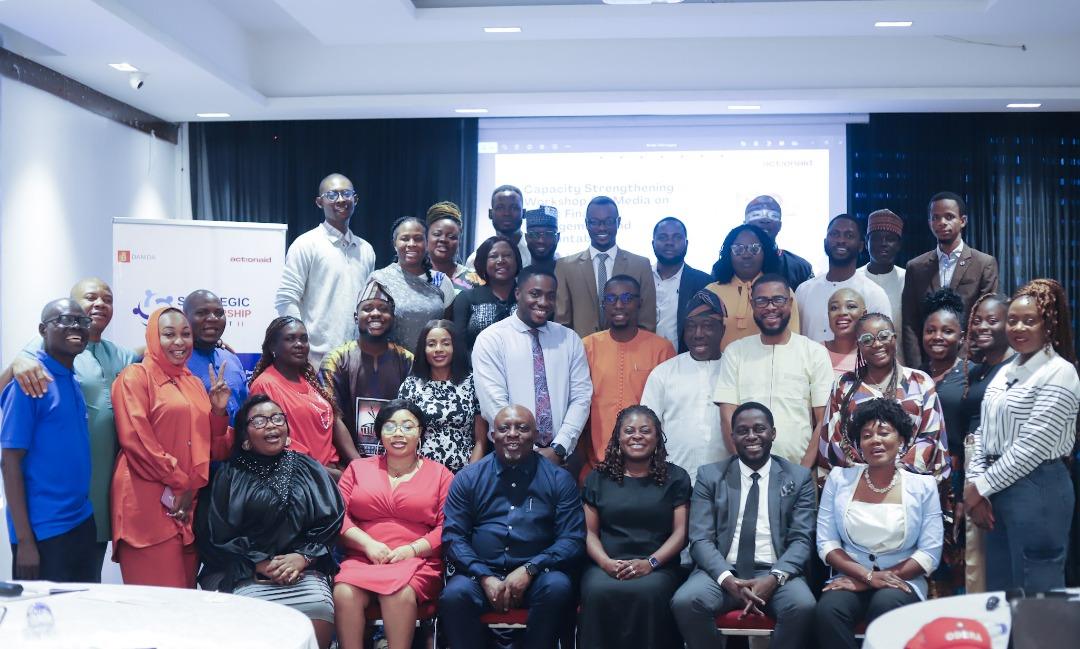
ActionAid Nigeria, with support from the Danish International Development Agency (DANIDA), has concluded a three-day media capacity-building workshop aimed at equipping journalists with the tools to effectively report on public finance management and budget accountability.
The workshop, held at the Watercress Hotel in Lagos, brought together journalists from across the country to deepen their understanding of public budgets and how to translate complex fiscal information into impactful stories that promote transparency and good governance.
Bridging the Gap Between Budget Allocations and Service Delivery.
Despite substantial government allocations in national budgets, many Nigerians still face limited access to essential services such as healthcare, education, and clean water.
According to ActionAid Nigeria, this disconnect is often rooted in the complexity and inaccessibility of public finance information.
Speaking at the event, the Country Director of ActionAid Nigeria, Mr. Andrew Mamedu, represented by the Head of Programmes, Mr. Celestine Odo-Okwudili, stressed the importance of the media in transforming public finance reporting into people-cantered narratives.
“’Behind every budget line is a real story, a child waiting for a school, a community hoping for clean water, a hospital that needs equipment.
The way public money is managed affects everyday life for millions of Nigerians,” Mamedu said.
Media as a Bridge Between Policy and the Public.
The training focused on positioning journalists as interpreters of public finance who can simplify technical budget documents for public understanding.
Mr. Odo-Okwudili urged participants to play a more active role in monitoring how public resources are allocated and spent.
“You have the power to dig into the numbers, connect them to people’s realities, and make sure those in power know that citizens are watching.
Your stories can spark conversations, influence policies, and hold leaders accountable,” he said.
Highlighting current economic realities, Mamedu noted that the 2025 Appropriation Act exposes an ₦18 trillion budget deficit, with over 70% of national revenue directed toward debt servicing.
He expressed concern over Nigeria’s rising debt profile, weak revenue generation, and poor spending priorities, which continues to limit investments in key social sectors.
He called for stronger legislative oversight, adherence to financial management laws, and more transparent budget processes adding that the media must shine a light on these issues to foster accountability.
To strengthen fiscal reporting.
Blessing Ifemenam, Project Advisor for the Strategic Partnership Agreement 2 (SPA II), explained that the workshop was part of ActionAid’s broader fiscal justice campaign.
She outlined the core goals of the training: enhancing media capacity on public financial management, promoting progressive taxation, and integrating gender-responsive budgeting into public discourse.
Participants engaged in practical sessions focused on breaking down budget documents, identifying irregularities in public spending and crafting impactful stories that reflects the lived experiences of ordinary Nigerians.
In a technical session, Dr. Terfa Abraham a renowned economist offered insights into Nigeria’s fiscal challenges.
He identified the growing number of political appointees as a key contributor to inflated governance costs and urged structural reforms.
“The growing number of political appointees is inflating the cost of governance. Reforms must start with cuts to political excesses, not worker wages,” Dr. Abraham said.Organisers say the workshop is expected to result in improved media reporting on public finance issues, ultimately promoting better governance and civic engagement.
By building journalists’ capacity to simplify fiscal data and expose inefficiencies, ActionAid Nigeria aims to empower citizens with the information needed to demand effective service delivery and equitable resource distribution.
The initiative underscores the importance of the media in advancing citizen-led governance, transparency, and public accountability in Nigeria.
Victoria Ibanga