


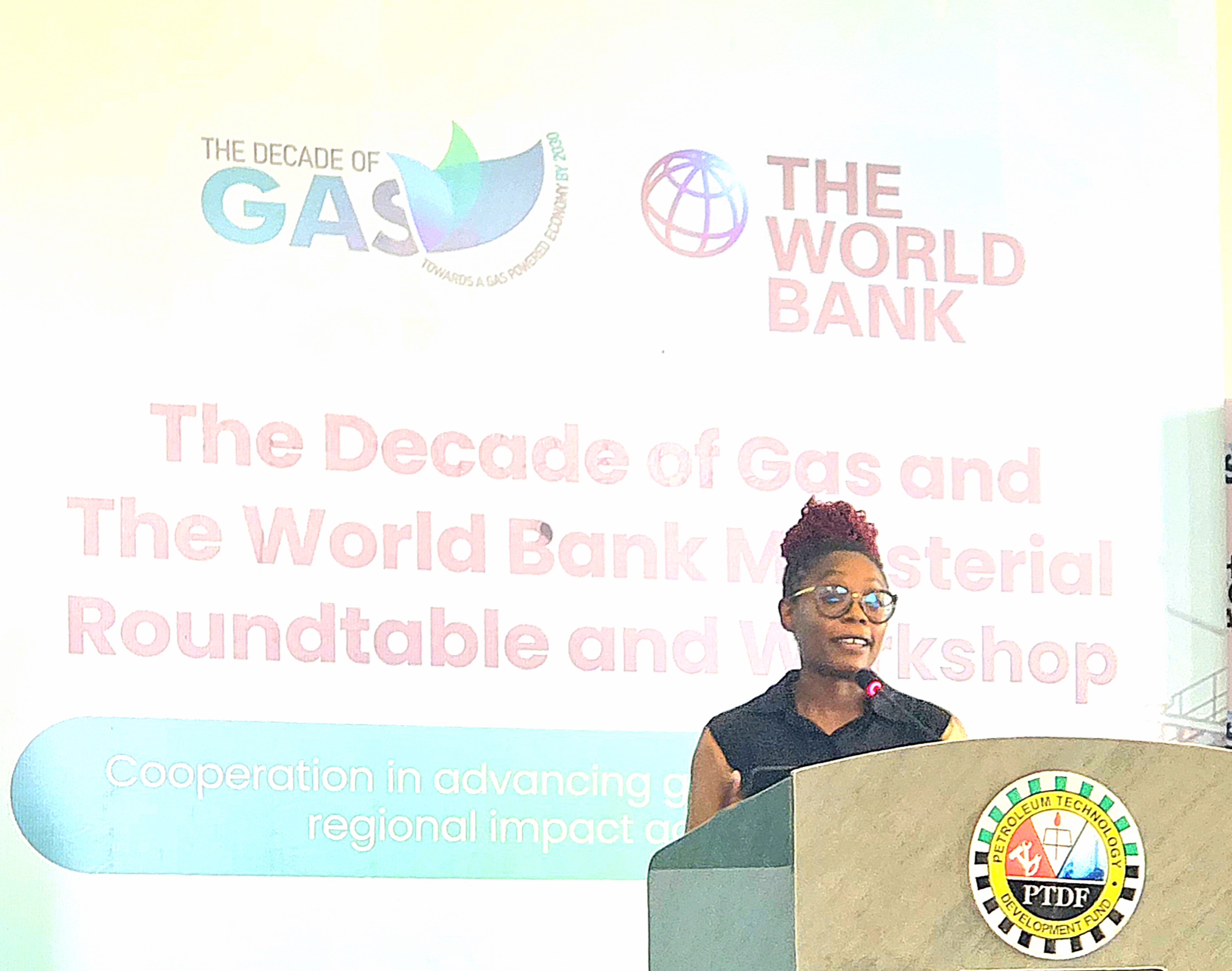
An expert associate partner at McKinsey and Company, Eleanor Okubor, has declared that Africa’s accelerating demand for gas is central to unlocking industrial growth, expanding energy access and reducing costs, while emphasising stronger inclusion of women and small businesses in the value chain.
Speaking to Voice of Nigeria on the margins of “The Decade of Gas and The World Bank Ministerial Roundtable and Workshop” in Abuja, Okubor positioned gas as critical to Africa’s development. “If you forget everything, do not forget the demand for gas in Africa is growing faster than it is globally,” she said.
She stressed that while renewable energy will expand power generation, it cannot stand alone. “They still need a base load energy source which gas will provide to enable flexibility of the grid system so that there is reliable supply of gas or excuse me, electricity,” Okubor stated.
On affordability, she highlighted gas as a viable alternative for households and enterprises. “Gas is a cleaner alternative that is also cheaper but it is also cheaper than generating power using diesel or PMS,” she said.
Women Inclusion and Last-Mile Access
Okubor underscored the need to intentionally include women and MSMEs in gas utilisation. “We are also thinking about last mile distribution, but very importantly, the people who are actually going to use gas,” she said.
She pointed to both access and awareness as key barriers. “Do they know that you can use gas for this particular problem that you are trying to solve?” she asked, noting that many women-led businesses remain constrained by limited information and infrastructure.
Highlighting solutions, she said enabling participation requires both market readiness and policy support. “What needs to be resolved is being a credible off-taker for gas,” she stated.
“So this is where it is very important to get ahead very quickly. Today, a lot of the gas in Nigeria is exported, but there is domestic demand and consumption that is being met by producers,” she said.“today the price of gas is regulated for the strategic sectors, but for any credible functioning market environment to work, you need to go with the market forces,” she added.
For MSMEs, she identified aggregation as key. “For MSMEs, something that could work is potentially how do we pull together, and this is a role that organisations like the Gas Aggregation Company of Nigeria play where they aggregate gas demand,” she said.
“How do we aggregate that demand such that you can actually purchase gas at a cost-effective price from the upstream producers or the marketers?” she added.
Okubor emphasised collaboration at all levels. “There actually needs to be local collaboration as well to be sure that the demand for gas is sizable,” she said.
“It makes the producers or the marketers interested or incentivised enough to say, okay, I am willing to put a small spiral line to this village in Gboko, for example, and get my gas from Akwa Ibom to Gboko because there is a sizable need, and I am pretty sure that if I deliver gas, I will be paid, and it makes the value chain work,” she explained.
Future Outlook
Okubor said, “the role of gas in the future is to reduce the cost of operations, to make things cleaner, cleaner energy for anybody who needs it, but also it is going to drive industrialisation in Nigeria and on the continent.”
She added, “There is still a lot of education that needs to happen for women or any other MSMEs who could potentially be using gas.”