

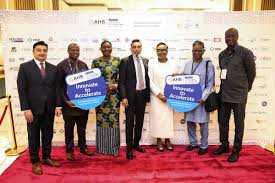
The 2025 Africa Health Business Symposium concluded on Friday in Abuja with a strong call for increased investment in diagnostics, local manufacturing, and indigenous innovations to drive progress toward Universal Health Coverage (UHC) across the continent.
The event, which brought together over 200 delegates from more than 30 countries, ended with a series of high-level statements emphasizing collaboration, sustainability, and health sector reform as key priorities for achieving UHC in Africa.
The statements highlighted the need for urgent action beyond policy commitments and into the realm of financing, partnerships, and scalable solutions.
READ MORE:Nigeria Reaffirms Commitment to Achieving Universal Health Coverage
Ms Rebecca Enonchong, Vice Chair of the Board, World Health Organisation (WHO) Foundation, said that health must no longer be seen as a cost.
Enonchong said that it should rather be seen as one of the smartest investments that countries and partners could make.
“Every dollar invested in WHO programmes yields 35 dollars in health and economic return, a figure any investor would envy,” she said.
She said that the Foundation launched WHO’s first-ever round in 2024 to raise 7.1 billion dollars.
According to her, it has already secured over 50 per cent of its goal, including historic contributions from African governments and private sector partners.
She said that the funds were earmarked to support core priorities between 2025 and 2028, including pandemic preparedness, primary healthcare, digital health systems, mental health and emergency response.
“This is not about charity. It is about innovation that saves lives. We must move forward with urgency and partnership because delays cost lives,” she said.
She also announced a 50 million dollars pledge, with catalytic support from philanthropic groups like the Tai Tantuma Foundation.
Mr Moholu Johnson, President of the Healthcare Federation of Liberia, announced the finalisation of a draft policy for a Liberian Health Equity Fund.
Johnson said that this was a joint effort between the government and the private sector.
“The fund aims to ensure UHC for all Liberians, regardless of income or geography.
“Our objective is clear; no one should be denied medical care because they can not afford it.
“Our partnerships here have already begun to take shape. We are committed to translating conversations into real impact,” he said.
The incoming leadership of the Ghana Health Care Federation made a heartfelt appeal to participants and partners to engage the country’s health foundations.
Dr Francis Ohanyido, CEO of the West African Institute of Public Health and one of the co-hosts of the symposium, challenged participants to reframe Africa’s health development vision.
“Universal Health Coverage is not a destination, it is a process that must be defined by the context of each country,” Ohanyido said.
He praised the intentional design of the week’s events, particularly the merging of the Africa Primary Healthcare Forum and the Africa Health Business Symposium.
He said that it allowed stakeholders from public, private and development sectors to explore the business of health through a PHC lens.
He called attention to topics ranging from investment in digital innovation and climate change to the decolonisation of language, urging the audience to discard the term sub-Saharan Africa.
“It is a colonial construct that does not make sense anymore. We have one continent, Africa. Let’s start speaking that way, especially when climate change knows no borders.
“Let us use primary healthcare, not just as a delivery platform, but as an early warning system for climate change,” he said.
Dr Amit Thakker, Executive Chairman of Africa Health Business and Africa Healthcare Federation, one of the lead conveners of the symposium, lauded Nigeria’s leadership in the health sector.
Thakker described the event as a boot camp for African health transformation.
“This symposium is not an event, it is a process. We have made new connections and developed practical ideas. Now, we must carry them forward,” he said.
He outlined a draft seven-point action plan for UHC resilience, emphasising public-private partnerships (PPP), inclusive financing and policy coherence as central pillars.
According to him, Africa is not waiting to catch up. It is leading, from drone-delivered vaccines to AI-powered diagnostics
Ms Valerie Boulet, the Chief Development Officer, WHO Foundation, invited African partners to participate in the upcoming WHO Investment Round, designed to bridge the gap between donors and implementers.
“Achieving UHC demands more than policy, it needs innovation, sustainable financing and practical partnerships.
“That is what the WHO Foundation is here to support, to be a bridge between the private sector and public health action,” she said.
Boulet said that African solutions were critical to global health success, and that the continent’s leadership in innovation and partnership should be scaled and funded
The Newsman reports that the AHBS25, with the theme, “Leveraging Innovations to Advance Universal Health Coverage in Africa”, provided a platform for knowledge exchange, deal-making and networking.
It emphasised climate-health synergies, digital transformation, local pharmaceutical manufacturing, and public-private collaboration as critical pathways to achieving health equity across Africa.