

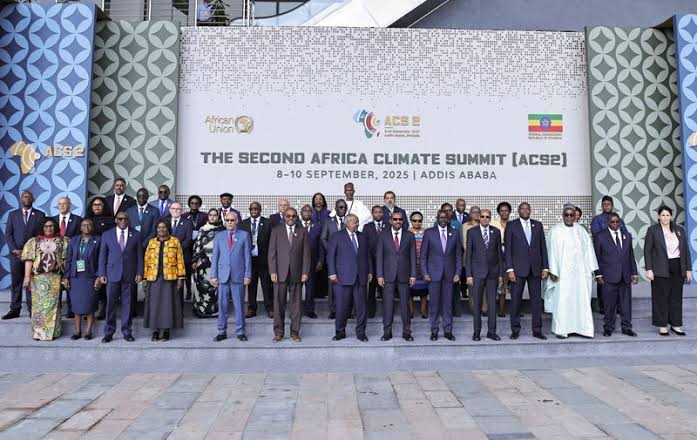
African leaders say the continent is ready to serve as a global model in tackling the climate crisis through green investments.
This renewed commitment follows the United States’ withdrawal from the Paris Climate Agreement, a move that weakened global momentum against climate change.
Building on that resolve, the leaders are meeting at the second African Climate Summit in Ethiopia to present a common position ahead of COP30 in Brazil.
With the continent reeling from severe floods, droughts, and landslides this year, they are pressing for stronger action and investment to confront the worsening impacts of climate change.
“We are not here to negotiate our survival. We are here to design the world’s next climate economy,” Ethiopian Prime Minister Abiy Ahmed said at the opening ceremony.
Leaders are positioning the 54-nation continent as a prime destination for investments in carbon capture, renewable energy, critical minerals for green technology, and food production, in a bid to sustain development amid the climate crisis.
“If we make the right choices now, Africa can be the first continent to industrialise without destroying its ecosystems,” said Abiy, who wants his country to host COP32 in 2027.
He called for a new Africa climate innovation initiative, funded by the continent, bringing together African universities, research institutions, startups, rural communities and inventors to deliver 1,000 solutions to tackle climate challenges by 2030.
The Leaders had sought more financing at the inaugural summit in Nairobi two years ago to help governments tackle climate challenges amid fiscal constraints and heavy debt burdens, but the continent is still badly short of funding, receiving just 1% of the annual global climate financing, officials say.
African countries, which are among the most vulnerable to the adverse effects of manmade global warming despite being among those least responsible for it, have long demanded that COP meetings yield more funds to help them adapt and launch clean energy projects.
“Climate finance must be fair, significant and predictable,” the Chair of the African Union Commission, Mahamoud Youssouf,
He said; “The vulnerability of our member countries, caused by climate change, debt burden and the structural inequalities of the international financial architecture, must be redressed through climate justice.”
The leaders also voiced concern over the risks posed by a weakening multilateral approach to tackling climate change. They stressed that global cooperation remains essential if meaningful progress is to be achieved.
Kenyan President William Ruto underscored this point, saying: “Too often, commitments are broken and international solidarity is dismissed as weakness, precisely when the scale of the climate crisis demands enhanced cooperation, not less.”
US President Donald Trump’s administration pulled out of the landmark Paris agreement on climate change for the second time earlier this year and has also withdrawn from clean energy partnerships with countries such as South Africa.
REUTERS/Christopher Ojilere