


By Chinwe Onuigbo, Awka
The Centre for Democracy and Development (CDD), a leading West African election monitoring and policy think tank, has highlighted the need for deeper reforms to boost civic engagement and electoral trust following the Anambra State governorship election.
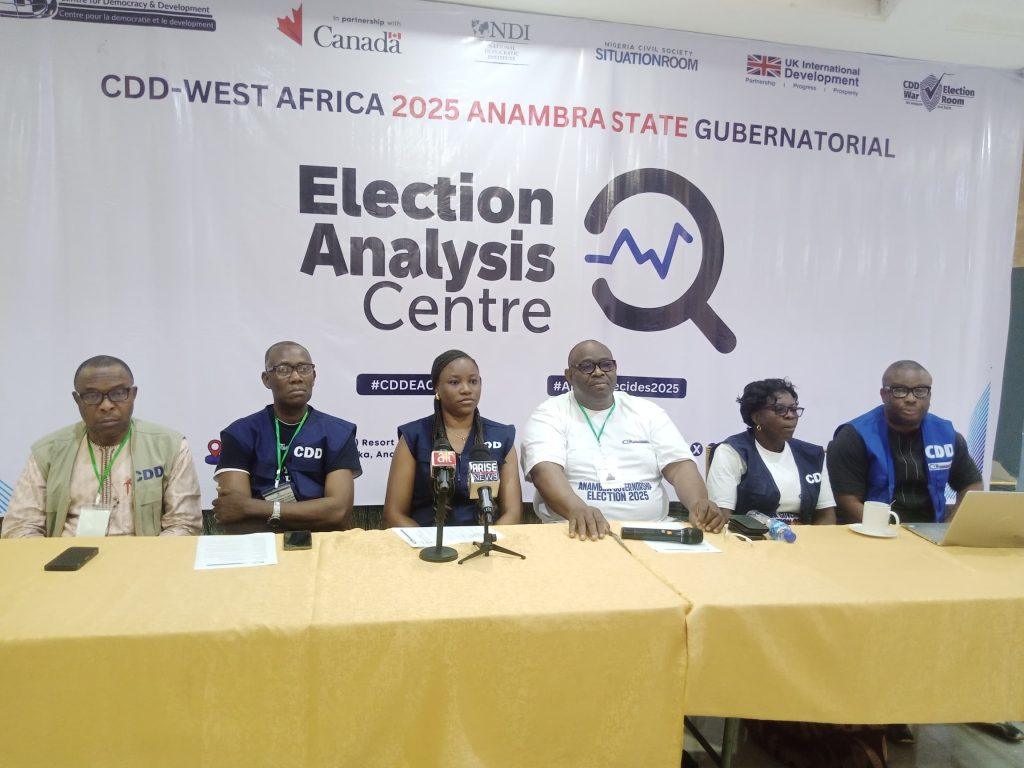
Speaking at the organisation’s post-election press conference in Awka on Sunday, the CDD noted that voter turnout increased to 21.4 percent, a significant improvement from 10.2 percent recorded in the 2021 election, despite persistent apathy among young people, women, and persons with disabilities.
CDD described the election as “largely peaceful” and praised the Independent National Electoral Commission (INEC) for operational improvements, including the 98.8 percent Permanent Voter Card (PVC) collection rate and 99.62 percent of results uploaded on the INEC Result Viewing Portal (IReV).
“Weak institutions, elite dominance, economic hardship, insecurity, and lack of accountability continue to undermine citizens’ confidence in the democratic process,” the CDD said in its statement.
The CDD called for ongoing electoral reforms to focus on strengthening INEC’s operational capacity through timely funding, decentralised planning, and consistent communication.
It recommended: Mandatory real-time publication of results via IReV; early voting for essential personnel; enhanced logistics and personnel training; issue-based campaigns and internal party democracy as well as transparent campaign financing.
On governance, the CDD urged all tiers of government to develop “a sustainable security architecture” to guarantee year-round safety for residents and to address root causes of insecurity.
It also emphasised that curbing vote buying must go hand-in-hand with improving governance and promoting civic education to counter transactional politics.
Mrs. Seyi Awojulugbe, a Misinformation, Disinformation, and Hate Speech Analyst at the CDD, said that while the turnout improvement was encouraging, it remained worryingly low.
“Despite high registration numbers, turnout was only 21.4 percent. This is an improvement from 2021’s 10.2 percent, but it still reflects troubling disengagement from the democratic process,” she said.
Awojulugbe noted that a significant portion of the youth population abstained from voting despite their enthusiasm during the Continuous Voter Registration exercise.
“Women and persons with disabilities also faced multiple barriers, including limited accessibility to polling stations and the absence of voting aid materials,” she added.
She called for renewed efforts in civic education, electoral reform, and governance that inspires public trust.
Prof. Victor Adetula, Director and Chair of the CDD–West Africa Election Analysis Centre, raised concerns about the economic cost of halting commercial activities on election day.
“The shutdown of economic activity during elections has not translated into higher voter turnout. Instead, it results in economic losses that compound the problem,” he said.
Adetula suggested that policymakers should consider alternative systems that allow elections to be held without disrupting economic life, in order to reduce the burden on citizens and businesses.