


In a groundbreaking move to boost Nigeria’s creative economy, Woodhall Finance House has unveiled a ₦1.5 billion Creative Sector Fund alongside a podcast hub called The Creative Currency Podcast.
This initiative was made possible through the support of the UK Government’s Department for Business and Trade, Polaris Bank, and the Lagos State Government.
While the fund is aimed at supporting export-ready businesses and SMEs across fashion, film, music, beauty, and digital arts, the Creative Currency Podcast is a dynamic new platform designed to serve as both a storytelling hub and an economic engine for the continent’s creative sector.
Hunponu-Wusu, Woodhall Capital Founder and President, said the twin-initiative would significantly give Nigerian creatives the opportunity to build capacity while at the same time telling Nigerian stories to a global audience.
“Creativity is not just an abstract concept—it’s a bankable commodity. We must start treating it as such. Nobody can tell the Nigerian story better than Nigerians,” she stated.
“This fund is our commitment to building our own systems, financing our own stories, and converting cultural capital into real economic power.”
Growth
Jonny Baxter, British Deputy High Commissioner, said the initiative is poised to harness the power of policy, capital, and narrative to unlock sustainable growth within one of Africa’s most promising export sectors.
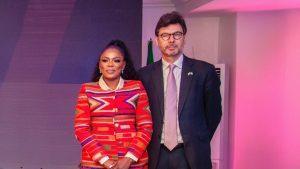
“The UK is proud to support Nigeria’s creative economy through long-term partnerships that blend innovation, investment, and cultural exchange,” he said.
“Platforms like The Creative Currency Podcast, along with the Creative Industries Technical Working Group established under the UK-Nigeria Enhanced Trade and Investment Partnership (ETIP), reflect our deep commitment to creating real opportunities, building lasting partnerships, and empowering the next generation of African talent to shine globally.”
“The launch event, held in Lagos, brought together an influential mix of policymakers, investors, development finance leaders, high-net-worth individuals, and prominent creatives from across Africa.”
The initiative is poised to harness the power of policy, capital, and narrative to unlock sustainable growth within one of Africa’s most promising export sectors.
Positioned at the intersection of finance, culture, and diplomacy, The Creative Currency Podcast aims to catalyze investment, foster international collaboration, and strengthen the UK-Nigeria creative alliance—helping to transform the sector into a global economic force.
Representing Lagos State Governor Babajide Sanwo-Olu, the Commissioner for Commerce, Cooperatives, Trade and Investment, Mrs. Folashade Bada Ambrose, delivered a keynote that reinforced Lagos’s role as Africa’s creative heartbeat.
A high-level panel discussion on financing Africa’s creative economy featured Mrs. Abimbola Ozomah (Executive Director, Polaris Bank), Sola Carrena (MD/CEO, Helios Investment Partners), and Mrs. Mojisola Hunponu-Wusu (President, Woodhall Capital). The session emphasized the urgent need for innovative funding mechanisms—such as blended finance, creative bonds, and factoring—to unlock the sector’s full economic potential.
The evening also featured a vibrant fireside chat on “UK-Nigeria Cultural Synergies to Drive Global Innovation and Transformation,” with contributions from fashion designer Veekee James Atere, actress and singer Shaffy Bello, and Mark Smithson, UK’s Country Director for the Department for Business and Trade.
The trio explored how cross-cultural collaboration can open new creative frontiers.
The celebration wrapped up with a cultural exchange under the UK’s Jollof and Tea campaign—a symbolic blend of British and Nigerian identities through food, storytelling, and high-level networking. Guests shared reflections on identity, investment, and the future of African creativity on the global stage.
The Creative Currency Podcast is more than just a platform—it’s a strategic tool for economic transformation.
As global demand for African creativity accelerates, initiatives like this are essential to turning visibility into viability, and culture into capital.