


The Apapa Port Area Command of the Nigeria Customs Service (NCS) has called on port users and stakeholders to prepare for more seamless trade processes, as the Service advances its modernisation project with the commencement of fixed scanner installations.
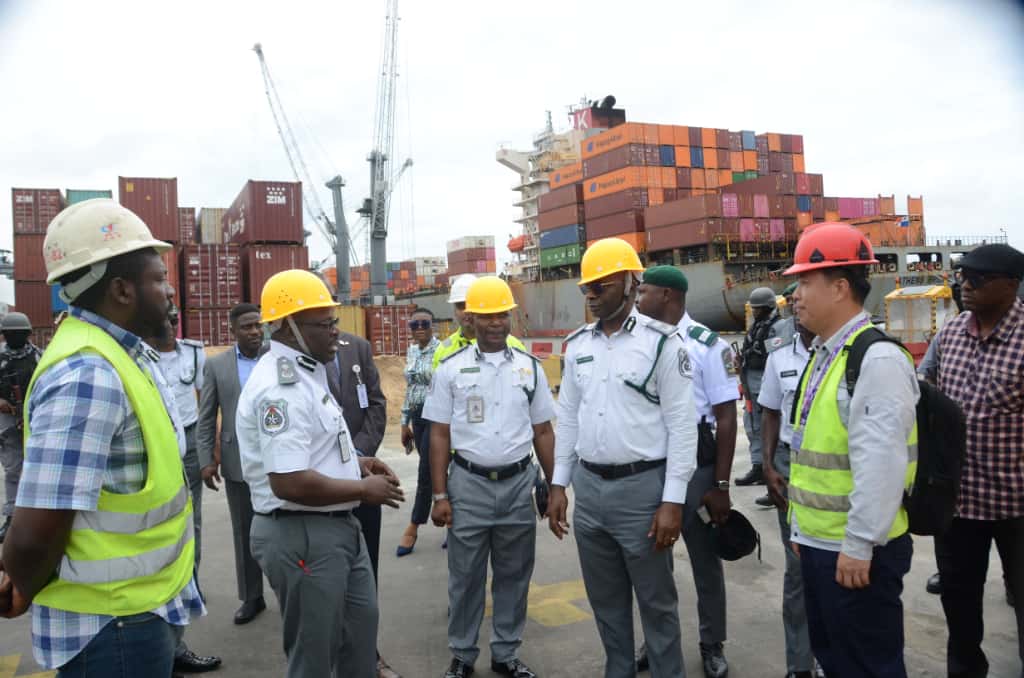
Speaking after inspecting the designated site for the installation of three new scanners at the Lagos port, the Command Area Controller, Comptroller Oluwadare Oshoba, said the Command is set to exceed expectations, with the scanners capable of examining 200 containers per hour.
Describing the quayside location for the scanners as “an operational masterstroke”, Comptroller Oshoba promised that “no consignment would escape the high-tech, non-intrusive inspection system, as the scanners would be strategically positioned close to the berthing area.”
Read Also: Nigeria Records 4.23% GDP Growth in Second Quarter
He commended Comptroller-General of Customs, Bashir Adewale Adeniyi, for his relentless commitment to the NCS modernisation drive, urging officers to prepare for intensive “train-the-trainer” sessions.
He explained that “once installation is complete, training will be the next crucial phase before full deployment.”
The Comptroller further advised NCS ICT officers to improve their capacity for tier-one and tier-two maintenance of the scanners, which he described as “the first of their kind in the West and Central Africa sub-region”.
Calling the project a “great milestone about to happen,” Oshoba urged port users—particularly importers, exporters, and their agents to embrace honest declarations, warning that false declarations and concealment would be exposed by the new technology.
Expressing gratitude to the CGC, Oshoba said; “I want to on behalf of our officers and men, thank the CGC for leading us through an era of revolutionary customs modernisation. The coming of these scanners is one of the many great fruits we shall be harvesting from the modernisation project.
“Our partners, the Trade Modernisation Project (TMP), have assured us that the installation would last for 45 days, and we are expecting two units of scanners from them with an additional one from APM Terminals.
“These three scanners would ensure that there is no downtime for cargo examination here and reinforce our position as the number one destination for port activities in Nigeria.”
“All hands must be on deck to see to the full realisation of this dream which would save time, increase revenue, enhance national security, promote trade and prevent port related crimes from the earliest point of entry,” the CAC said.
Also speaking, TMP Team Leader, Aliyu Suleiman, gave details on the scanners, which are produced by Nuctech in China. He identified them as the NUCTECH FS6000, a high-throughput, non-intrusive, drive-through X-ray inspection system for cargo and vehicles.
He explained that “the scanners use high-penetration, dual-energy X-ray transmission technology to inspect trucks and containers in one pass, at speeds of up to 15 km/h. This allows for uninterrupted inspection at busy locations such as ports and border crossings.”
According to Suleiman, the system provides detailed images to help identify concealed contraband and dangerous materials, while its compact, modular design allows for easy relocation and integration with other systems, such as Licence Plate Recognition (LPR) and Radio Frequency Identification (RFID).
In addition to the three fixed scanners being installed, APM Terminals has also pledged to provide a mobile scanner to support operations in the event of unexpected downtime.