

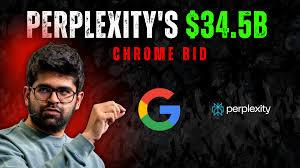
Artificial intelligence start-up Perplexity AI has stunned the tech world with a surprise $34.5 billion (£25.6bn) takeover offer for Google Chrome, the world’s most popular web browser with an estimated three billion users. The three-year-old firm, backed by Amazon founder Jeff Bezos and chip giant Nvidia, is led by Aravind Srinivas, a former Google and OpenAI employee.
READ ALSO: Microsoft Launches AI-Based Copilot Mode On Edge
The bid comes as Google faces mounting antitrust pressure in the United States, including two major lawsuits and a pending federal court ruling that could force it to break up its search business. Google has said it would appeal any order to spin off Chrome, calling such a move an “unprecedented proposal” that would harm both consumer choice and online security.
Perplexity described its offer as a commitment to “the open web, user choice, and continuity for everyone who has chosen Chrome.” In a letter to Alphabet CEO Sundar Pichai, the company argued that moving Chrome to an independent operator focused on user safety would benefit the public.
However, doubts about the seriousness of the bid emerged almost immediately. Judith MacKenzie, head of Downing Fund Managers, called it an “unsolicited bid” that is not yet funded, while technology investor Heath Ahrens labelled it a “stunt” and “nowhere near Chrome’s true value” given the browser’s vast data and reach. Perplexity, valued at $18 billion as of July, has not disclosed how it plans to finance the acquisition.
The start-up has been positioning itself as a rising challenger in the generative AI race, competing with OpenAI’s ChatGPT and Google’s Gemini. Last month, it launched an AI-powered browser called Comet. But Perplexity has also faced controversy, particularly from media organisations accusing it of copyright infringement. In June, the BBC sent a legal letter claiming the company reproduced its content “verbatim” without permission. Perplexity rejected the accusation, framing it as part of an effort to protect Google’s “illegal monopoly.”
This is not the first time Perplexity has made headlines for an audacious move. Earlier this year, it offered to buy the U.S. operations of TikTok, which faces a September deadline to be sold by its Chinese owner or be banned in the country.
As part of its Chrome proposal, Perplexity said it would keep Google as the browser’s default search engine while allowing users to change settings. It also pledged to continue supporting Chromium, the open-source platform that underpins Chrome and other browsers such as Microsoft Edge and Opera.