Nigeria has said that strategic and robust public-private collaboration is crucial to driving increased production, innovation, and quality investments in agrifood systems across the Sahel region.
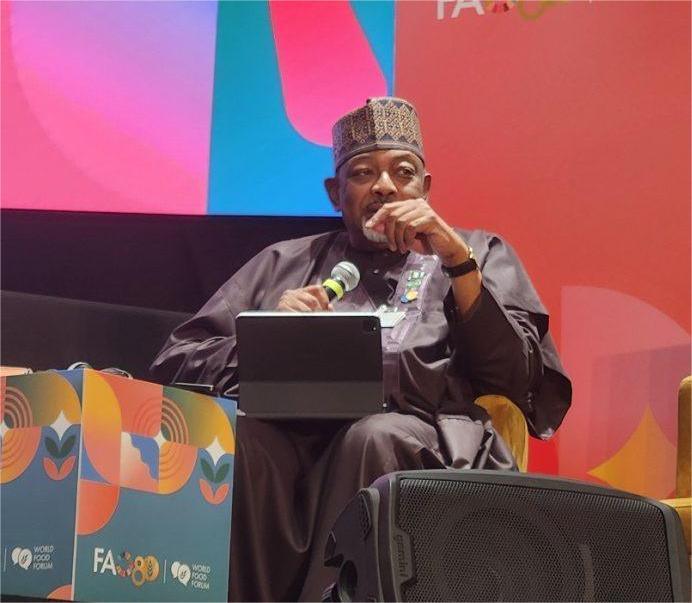
The Minister of Agriculture and Food Security, Senator Abubakar Kyari, made the remarks during a high-level panel discussion at the FAO Hand-in-Hand Sahel Regional Initiative held in Rome, Italy.
The session focused on accelerating capacity, partnerships, and investments to transform agrifood systems in the region.
Kyari underscored the importance of building a Sahel region that leverages strong institutions, innovative financing, and effective public-private collaboration, alongside smart governance, to unlock the full potential of farmers, processors, and small businesses—ultimately transforming the agricultural ecosystem.
He outlined key reforms and programmes designed to boost private sector participation, including:
- The National Agrifood System Investment Plan (NASIP): currently being upgraded into a National Public–Private Investment Portal — a transparent digital platform showcasing bankable opportunities in mechanisation, irrigation, storage, processing, logistics, and digital agrifood services.
- Streamlined Incentives: targeted investment tax breaks and import duty reliefs aimed at attracting private sector investment, supported by risk-sharing facilities developed with international partners.
- Expansion of the Special Agro-Industrial Processing Zones (SAPZ): the largest such initiative in Africa, now being scaled up from eight to 27 states to provide integrated infrastructure and lower operational costs for agro-processors.
- Implementation of the Nigeria Postharvest Systems Transformation Programme (NiPHaST): designed to tackle the estimated ₦3.5 trillion lost annually to postharvest inefficiencies through improved storage, cold-chain, and warehousing solutions.
“The pathway to scale up is through implementation,” Kyari said. “Implementation is not abstract; it requires due diligence, smart governance, and unwavering political will.”
He reaffirmed the ministry’s commitment to the “hard, practical work of aligning policy with possibility” — turning investment pledges into tangible projects that create jobs, feed families, and empower communities.
Kyari stressed that under the leadership of President Bola Ahmed Tinubu, GCFR, Nigeria remains committed to creating an enabling environment where investors and farmers can thrive together.
He pledged: “We will work hand in hand with FAO, IFAD, AfDB, the World Bank Group, ECOWAS, and the private sector to turn investment promises into concrete projects that feed families, create jobs, and strengthen food sovereignty.”