A collaboration between UNICEF and the Katsina State Government has transformed the lives of thousands of adolescent girls in the state as the adolescent girls REACH Programme has shown measurable impacts across six local government areas in the state.
Jointly implemented by UNICEF and the State Universal Basic Education Board (SUBEB), the REACH initiative provided educational opportunities, life skills, and vocational training for out-of-school girls and those at risk of dropping out.
The programme is being hailed as a model of effective government-development partner synergy.
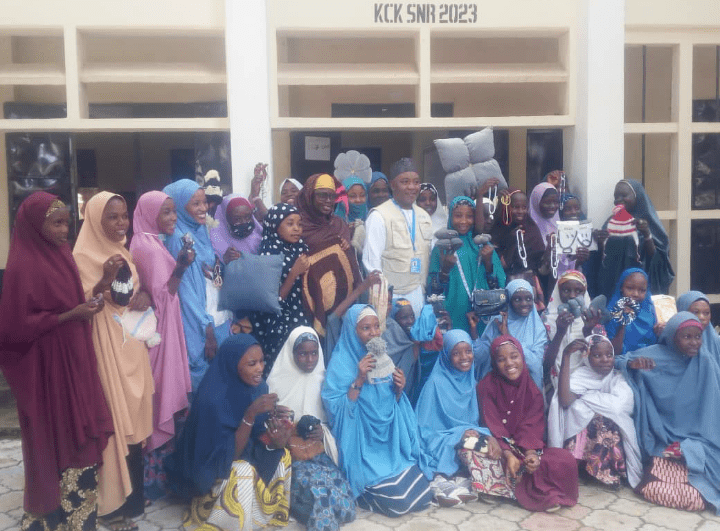
At a town hall meeting with girls and parents at Katsina College Katsina (KCK) in Katsina, the Unicef Adolescent Development Specialist, Ngozi Izuora-Songu said “We are here today in Katsina as part of ongoing efforts to assess and consolidate the gains of the REACH programme which has been implemented for the past 2 years.”
The engagements which were conducted across 6 Local Government Areas (LGAs) in the state provided a unique opportunity to evaluate the barriers to the transitioning of adolescent girls from Primary to Secondary School and to understand possible enabling factors that could support their journey, both in formal education and and alternative pathways such as vocational training and psychological support.
“These town halls served as inclusive platforms to dialogue among key stakeholders, including adolescent girls (both in and out of school), parents, principals, teachers, and education officials—allowing communities to reflect on the impact of REACH interventions such as mentorship, safe spaces, and life skills sessions.
“We are back to take stock and celebrate the wins in collaboration with the State Government,” specialist said.
She noted with appreciations the successes recorded through the collaboration and the number of girls that benefitted which demonstrated how far the Programme achieved its cause within the targeted Local government areas
“Today we are proud that more adolescent girls are said to be in school within these focus LGAs Girls who transitioned reported major improvements in reading, writing, hygiene, and confidence. As we have seen support from mothers and uncles been critical in overcoming cultural resistance and early marriage threats.
Since transitioning, the girls say they’ve seen real growth in themselves. They can now read and write much better and communicate more clearly — in both English and Hausa.
Inspire them
They also learned about personal hygiene and how to take care of themselves during their menstrual cycle, through the G4G sessions which also helped to inspire them to learn more.
A number of out-of-school adolescent girls, including GBV survivors, were equipped with financial literacy and vocational skills such as knitting, crochet, henna design, cap making, and throw pillow creation. These skills provided the girls with a foundation for income generation .
The vocational skills acquired by the girls align with local market demands, making their products (such as henna designs, caps, and throw pillows) highly marketable within their communities and in urban centers.
The Director planning and Statistics, State Universal Education Board, Katsina state, Tanimu Muazu was aimed following up the commitment so far made by the parents of the girl childs in ensuring the enrolment, retention up to the completion of their children’s education, especially from primary One to 6 and to transit to the secondary school up to the completion.
He said the collaboration is a testament to the commitment of the state governor, Dikko Umaru Radda in ensuring children in Katsina state get the best education they deserve.
“In an effort to give room for the out of school children to return back and transit to the required level, the state government encourages parent through various empowerments aimed at motivating them to enrol and retain their chidren’s education up to the meaningful level in order to achieve the desired result,” Mu’azu assured.
New skills
The programme has changed lives across the state. Halimatu Abdul’aziz, 17 who had dropped out of school, now supports her family through weaving and has returned to formal education. Aisha Musa 22, a young mother, regained her literacy and acquired new skills to support herself.
“I didn’t just go back to school, I found myself again,” Aisha said.
“We were skeptical at first,” said , a parent in Katsina. “But now we’ve seen our girls learn tailoring and baking, grow in confidence, and contribute to our household.”
For younger girls who stayed in school, REACH offered confidence-building and leadership development. One such beneficiary, 14-year-old Fatima Hamisu , now aspires to become a doctor.
“This programme gave me a voice,” she said. “Now, I know I can make a difference.”
Though REACH is concluding, the structures it has left behind—from trained teachers and mentors to active community support groups—promise sustained benefits.
Many communities have pledged to continue supporting girls’ education beyond the programme.
Officials say the partnership model between UNICEF and Katsina State could be replicated in other regions to tackle entrenched barriers to girl-child education.
As girls across Katsina move from the margins to the mainstream, the REACH programme stands as a powerful example of what is possible when international expertise meets local commitment.
Lateefah Ibrahim