Home Blog Page 545

Defence Headquarters Refutes Amnesty Allegations Of Extrajudicial Killings

0

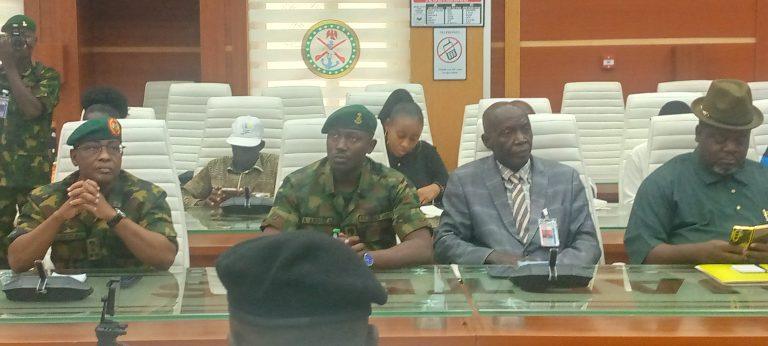
Defence Headquarters, DHQ has refuted recent allegations by Amnesty International that troops conducting operations in the South East have engaged in extrajudicial killings, describing them as unfounded.

The Director, Defence Media Operations, Major General Markus Kangye stated this during the weekly briefing of the ongoing military operations by the Armed Forces of Nigeria across the country in Abuja, Nigeria’s capital.

According to him, soldiers cannot carry their weapons, go to the street and start shooting people.

He noted that everybody with a phone in their hand is a potential source of information to the whole world.

He said that the military is not engaged in any extrajudicial killing in the southeast”.

Nigerian Government Reiterates Commitment to Transforming Livestock Sector

0

The Nigerian government has reiterated its commitment to transforming Nigeria’s livestock sector through sustainable pasture cultivation, describing it as the bedrock of improved animal nutrition, higher productivity, and peaceful co-existence between herders and farmers.

Speaking at the inaugural National Pasture Planting Day held at the Kawu Grazing Reserve, Bwari Area Council, FCT, the Minister of Livestock Development, Idi Mukhtar Maiha, noted that pasture cultivation is a strategic intervention to secure the future of livestock production in the country.

“The National Pasture Planting Day is a vital part of our renewed strategy to modernise livestock production in Nigeria. As we gather on this fertile land in Kawu, we are reminded of the urgent need to shift to more sustainable and productive models for pasture and fodder that benefit both pastoralists and farmers, while also safeguarding our environment,” the Minister stated.

He described grazing reserves, such as the one in Kawu, as “hubs of opportunity” for pasture and crop production, breed improvement, veterinary health services, conflict mitigation, youth employment, women’s empowerment through organised milk production, and food security.

The Kawu community, comprising 36 villages and covering about 9,000 hectares, is expected to benefit significantly from this initiative.

Mukhtar further disclosed that through the National Pasture Development Programme, the Ministry has recorded significant milestones this year, including the release and registration of eight new pasture varieties into Nigeria’s national seed system.

Other ongoing interventions include the training of herders and extension officers, the establishment of strategic pasture seed banks and feedlots, the installation of irrigation and water harvesting systems, and robust research partnerships with universities, the National Animal Production Research Institute (NAPRI), and international agencies to develop high-yielding, drought-tolerant pasture species.

In a goodwill message, the Minister of the Federal Capital Territory, Nyesom Wike, represented by the Minister of State, Dr. Mariya Mahmoud Bunkure, pledged his administration’s commitment to providing essential infrastructure in Kawu, noting that modernising the grazing reserve would create jobs and boost meat and milk production.

Earlier, the Permanent Secretary of the Ministry, Dr. Chinyere Ijeoma Akujobi, represented by the Director of Ranch and Pastoral Resources Development, Mr. Shekamang Ayuba, said pasture planting would not only improve feed availability but also promote environmental restoration, reduce conflicts, and support the livelihoods of livestock farmers.

Goodwill messages were also delivered by representatives of SAHEL Consulting Agriculture and Nutrition Ltd., the National Animal Production Research Institute (NAPRI), pastoralist associations, and cooperatives, who pledged their support for the initiative, describing it as a step towards modernising livestock production in the country.

The event featured the symbolic planting of pasture seedlings by both Ministers, in the presence of officials of the Ministry, community leaders, and livestock farmers.

Lagos State Engages Stakeholders on Water-Service Delivery Reform

0

The Lagos State Government has convened a stakeholders’ engagement on a pilot Public-Private Partnership (PPP) initiative for the Lagos Water Corporation (LWC) to explore innovative and technology-driven approaches to improving water service delivery.

The meeting, with the theme, “Attracting Investment for Improved Water Supply in Lagos State through Public-Private Partnership,” was held on Thursday in Lagos.

The two-day event was organised by the LWC with the support of WaterAid Nigeria.

Speaking at the event, the Special Adviser, Ministry for the Environment and Water Resources, Mr. Rotimi Akodu, described the initiative as a critical step in addressing the state’s growing water demand, driven by rapid urbanisation and population growth.

Akodu said the initiative reflected the state’s recognition that achieving universal access to potable water required both substantial capital investment and operational efficiency, elements that could be enhanced through strategic PPP.

The Permanent Secretary, Office of Drainage Services and Water Resources, Mr. Mahamood Adegbite, noted that the state had made commendable progress in expanding water infrastructure.

Adegbite, however, said the scale of current challenges, from ageing facilities to the impact of climate change, demanded innovative partnerships that prioritise sustainability, resilience, and accountability.

According to him, the government’s vision is clear, to guarantee uninterrupted access to clean and safe water for all Lagosians.

He added that the partnership model would ensure enhanced infrastructure to serve future generations.

“We urge stakeholders to support and embrace this new structure for the greater good of our citizens,” Adegbite said.

Also, the Permanent Secretary, Office of Environmental Services, Dr. Omobolaji Gaji, said that shortages in funding and the reduction in foreign support had made it compelling for the government to be innovative in funding the water sector.

“Therefore, there is no better time to partner with the private sector to bring in funding and to improve water services than now,” Gaji said.

Speaking at the event, the Managing Director of Lagos Water Corporation, Mr. Mukhtaar Tijani, reiterated the government’s vision to transform the water sector into a modern, efficient, and sustainable system.

Tijani said the government envisioned a system capable of meeting the current and future needs of residents, supporting economic growth, and aligning with global best practices in water resource management.

He noted that the PPP framework offered a unique opportunity to combine public oversight with private sector innovation, operational efficiency, and investment capacity to boost production, reduce water losses, and ensure efficient distribution to underserved communities.

According to him, the PPP initiative is not an attempt to privatise water resources but rather a strategic collaboration to improve service quality, expand coverage, and ensure the financial viability of operations.

“The decision to pilot the model through selected mini and micro waterworks is guided by the need to leverage private sector expertise, innovation, and funding,” he said.

Reeling out the overview of the Pilot Public-Private Partnership for the LWC, Tijani described the initiative as a crucial step in the state’s broader strategy to modernise public utilities, safeguard public health, and stimulate economic growth.

He assured that the state is committed to transparent procurement processes and robust regulatory oversight to safeguard public interest and foster a commercially attractive investment climate.

He commended WaterAid Nigeria for its commitment to supporting the Lagos Water Corporation to improve urban water supply in Lagos State.

In her remarks, the Country Director of WaterAid Nigeria, Evelyn Mere, called on the government to scale up the Akilo water scheme management model aimed at achieving sustainable urban water supply.

Mere said that PPP remained a feasible panacea to improve urban water supply in Lagos and to ensure residents have access to affordable and quality potable water.

She commended Gov. Babajide Sanwo-Olu for assenting to the WASH policy in February 2024.

She disclosed that Akilo waterworks, which is being rehabilitated by WaterAid Nigeria, would be inaugurated in September.

The country director charged the state government to use Akilo as a model to resuscitate others.

Stakeholders at the meeting lauded the state government’s strategic drive to provide essential water resources and its openness in involving communities and private partners in decision-making.

Nigerian Government, NWAPDI Partner to Empower Farmers

0

The Nigerian Government is collaborating with the Nigeria Women in Agriculture Progressive Development Initiative (NWAPDI) to equip smallholder farmers with the tools to thrive in a technology-driven marketplace.

The Minister of State for Agriculture and Food Security, Sen. Aliyu Abdullahi, stated this at the NWAPDI’s Sovereign AgroTrade System (SAS) official unveiling and summit on Thursday in Abuja, the federal capital territory of Nigeria.

The Sovereign AgroTrade System is a groundbreaking digital and physical trade infrastructure designed to connect Nigerian farmers, especially women and youth, directly to national and international markets.

The theme of the summit is “Building Wealth from the Soil-Digitally and Inclusively.”

The minister, who was represented by his Special Adviser on Strategy, Mr Mohammed Jobdi, said the initiative is a landmark contribution to the national agricultural transformation journey.

“I am proud to stand here as we witness the official birth of the Sovereign AgroTrade System (SAS), a digital ecosystem created by NWAPDI to transform agriculture from subsistence to significance.

“The SAS system, including tools like AgriXchange Marketplace, NWAPDI Grow, AgriCert, and FarmAssure, is an embodiment of what agricultural innovation should look like in the 21st century.

“Through this ecosystem, we are equipping smallholder farmers with the tools to thrive, not just survive, in a modern, technology-driven marketplace.

“Today, we are not just unveiling a platform. We are launching a movement, a movement designed by Nigerians, for Nigerians, particularly our women and youth,” he said.

He said that for too long, Nigerian rural farmers, especially women and youth, have remained at the mercy of middlemen.

According to him, they were disconnected from global markets and deprived of the financial systems that could help scale up their productivity, adding that SAS has changed that narrative.

“Through NWAPDI Grow, farmers can now access microloans, cooperative financing, savings platforms, and mobile payments directly from their phones. This is financial inclusion redefined, bringing banking to the bush and banking on our people’s success,” he said.

The minister commended NWAPDI, its leadership, and its team for the initiative, bold vision, and tenacity.

“You are not only solving problems, but you are also setting new national standards in line with the essence of the Renewed Hope Agenda of empowering people, building inclusive prosperity, and restoring dignity through hard work, innovation, and purpose.

“The Federal Government is committed to creating an enabling environment for this system to thrive, scaling its impact, and integrating its data and insights into our broader national agricultural strategy,” he said.

Earlier, NWAPDI’s National Coordinator, Omolara Svensson, said the initiative aimed to move farmers from subsistence to prosperity.

SAS is not just technology but a promise that farmers will no longer be at the mercy of middlemen and volatile markets.

“This is how we keep our youth on the land, not because they have no other option, but because agriculture now offers dignity, opportunity, and a future worth staying for.

“SAS is a bridge linking farms to markets, farmers to finance, and communities to global opportunities. It is a tool for wealth creation, food security, and national pride,” she said.

She urged all women farmers, every young agripreneur, and every community leader to own the initiative.

“Use it; let it lift you from where you are to where you dream to be, because when women farmers rise, nations are fed, economies are strengthened, and communities are transformed,” she said.

Mr Dion Croom, President of Norcom, LLC, and Lead Consortium Partner, said the AgroTrade System was developed to empower women and youth in agriculture.

Croom said that the system also aims to promote food security and sustainable farming practices.

Nigeria Launches Interest-Free Loans For Tertiary Institution Workers

0

The Nigerian government through the Federal Ministry of Education has launched the Tertiary Institutions Staff Support Fund (TISSF), a non-interest loan scheme aimed at improving the welfare, professional growth, and financial stability of workers in the nation’s tertiary institutions.

The 10 million naira interest-free loan for each tertiary institution staff, with a year’s repayment tenure, also has a one-year moratorium to reduce repayment pressure.

Minister of Education, Dr. Maruf Olatunji Alausa, while unveiling the initiative in Abuja, Nigeria described it as a strategic empowerment platform that would give both academic and non-academic staff the financial support they needed to serve students with renewed dedication and live with dignity.

The minister explained that the TISSF programme, a joint initiative of the Federal Ministry of Education and the Tertiary Education Trust Fund (TETFund), implemented in partnership with the Bank of Industry (BoI)  is an integral part of President Bola Tinubu’s Renewed Hope Reform Agenda for the education sector.

He said the programme prioritises people as the nation’s greatest asset in transforming the education sector and driving economic growth.

“Each eligible staff member can access up to N10 million, subject to a cap of 33.3% of their gross annual salary. The loans are interest-free, repayable over five (5) years, with 12 12-month moratorium before repayment begins.

“Under the scheme, beneficiaries can access interest-free loans for medical expenses, family and accommodation needs, transportation (including electric vehicles and CNG conversions), small-scale enterprises (SMEs) and agriculture- poultry, fishing for food security, as well as academic advancement through certifications and capacity-building programmes,” he said.

According to him, the fund is more than a financial product as it was designed as a workforce transformation tool by easing financial burdens.

“The fund responds to the economic pressures and professional development gaps faced by our staff. Studies show that over 70% of tertiary institution staff in Nigeria have not participated in structured capacity-building programmes in the last five years. TISSF is here to change that.

“We expect it to improve staff retention, boost morale, and enhance institutional performance for better student outcomes,” he said.

Dr. Alausa said eligibility for the sustainable loan involves confirmed full-time staff of all federal universities, polytechnics, and colleges of education, stressing that applicants must have at least five years to retirement and a members of recognised staff unions such as ASUU, NASU, COEASU, and SSANIP. 

He said 248 institutions comprising Federal Government-owned Universities, Polytechnics, Colleges of Education and one state-owned institution in each category per state are eligible for the disbursement.

The Ministe, however, warned Busars of the beneficiary institutions that are coordinators of the fund not to become a stumbling block to life-changing initiatives.

“Bursars must be fast and transparent in their responsibilities. There will be consequences if we notice any bottleneck challenges from you,” he warned.

The Vice Chancellor of the state University of Jos, Professor Tanko Ishaya, while responding on behalf of the Universities expressed happiness over the TISSF initiative stressing that the fund will go a long way in assuaging their challenges and improving the education sector.

“When tertiary institution staff are taken care of, quality of education improves and when quality of education improves the nation moves forward,” he said

The National President of the Non-Academic Staff Union, NASU represented by Abubakar Aliyu promised to give full support to the initiative as “it is bound to transform their lives and livelihoods.”

The Managing Director of the Bank of Industry, Dr. Olasupo Olusi said investing in tertiary institution staff is equals to investing in the future of Nigerian youths as the workers serve as guardians of the students, promising to be transparent in the management of the loan. 

“We are committed to delivery with integrity and transparency. It will be on first come first to serve, he said.

Government Donates CNG Buses for Abuja Public Transport

0

The Federal Government, through the Presidential Compressed Natural Gas Initiative, has donated four 50-seater hybrid buses to the Federal Capital Territory Administration, through the FCT Minister, Nyesom Wike.

The Chief Executive Officer and Program Director of the PCNGi, Michael Oluwagbemi, who donated the Minister’s office on Thursday, said the President was committed to seeing Nigerians moving around cheaper, safer and reliable.

Recall that the PCNG Initiative is a flagship program of the Federal Government of Nigeria launched in 2023, to promote the widespread adoption of Compressed Natural Gas (CNG) and electric vehicles especially in mass transit systems driving cost savings, job creation, energy security, and an environmentally friendly transport system.

Oluwagbemi hailed the FCT Minister as one of the biggest supporters of the CNG initiative, adding that the donated buses will serve as “a foundation asset” for the operation of the new terminals in the city. 

“This is a Presidential initiative, Mr President wants to see Nigerians move around cheaper, safer and reliable. On behalf of the board of the PCNGi and the Management and Staff of the Presidential CNG Initiative, I hand over these keys to you of these four CNG hybrid buses to the glory of God, to the service of humanity and for the employment of the people of the FCT,” he said. 

Receiving the keys on behalf of the FCT Minister, the Mandate Secretary, Transport Secretariat, Chinedu Elechi, thanked the President for the donations, noting that the buses will complement the transportation infrastructure efforts of the FCT Minister.

“So, public transportation is meant to move people from one point to the other, especially those who cannot afford private transportation, or those who can afford private transportation but opt to go on the public system. 

“We are going to get more buses, the Minister is already working on that and we thank you so very much for this,” Elechi said.

Nigerian Government Launches Major School Enrollment Drive In Kano

0

The Nigerian Government has launched a major school enrollment campaign in Kano State to address the high number of out-of-school children across Northern Nigeria.

The initiative, led by the Universal Basic Education Commission (UBEC) in collaboration with the Kano State Universal Basic Education Board (SUBEB) and UNICEF, was officially flagged off at Lausu Primary School in Rano Local Government Area.

Speaking at the event, UBEC Executive Secretary, Dr. Aisha Garba, represented by Deputy Executive Secretary (Technical), Dr. Razaq Akinyemi, described the drive as a strategic step towards ensuring that every school-age child in Nigeria is enrolled, retained, and completes basic education.

She explained that UBEC is enhancing the learning environment by providing more teaching materials, improving teacher quality, and strengthening community involvement through School-Based Management Committees.

“We must confront the challenges facing boy-child and girl-child education, street children, the Almajiri system, and children with special needs.

“This campaign requires the active participation of all stakeholders to identify and address barriers to enrollment,” she said.

The Director of Quality Education at the Federal Ministry of Education, Bello Rabe, representing the Minister of State for Education, reaffirmed the Tinubu administration’s commitment to revitalising the education sector.

Also, the Kano State Governor Abba Kabir Yusuf, represented by the Commissioner for Education, Ali Makoda, welcomed the program, describing it as a wake-up call. 

He announced that all head teachers in the state must ensure the enrollment of every school-age child within 30 days, in line with the 2025–2026 National Enrollment Initiative.

Northern States SUBEB Chairmen, represented by Malam Yusuf Kabir of Kano SUBEB, called on parents, guardians, and traditional leaders to support the campaign. 

“Enrolling your child in school is the greatest investment in their future,” he said.

UNICEF’s Chief of Field Office in Kano, Rahama Farah, represented by officer-in-charge  Michael Banda, stressed the importance of community involvement in ensuring children not only enrol but remain in school. 

Development partners such as PLANE also pledged their support for improving education standards and boosting enrollment.

The Emir of Rano, Ambassador Muhammad Umar, both urged parents to embrace education, describing it as the foundation for growth and development.

The event featured the distribution of free school uniforms, bags, and books to pupils as part of efforts to encourage enrollment.

Residents Hail President Tinubu For Eke-Obinagu Flyover Project

0

Residents of Enugu and Ebonyi states have commended President Bola Tinubu for the ongoing construction of the Eke-Obinagu Flyover bridge along the Enugu-Abakaliki Road.

Those who spoke with Voice of Nigeria on Thursday at the site of the project said the project, which is nearing completion, would ease the movement of people and goods along the road.

A carpenter, Emmanuel Nwankwo who comes from Nnewi, Anambra State, to buy wood at the Eke-Obinagu market, said the bridge would, not only decongest traffic on the road but also reduce accidents.

“I expect that at completion, the bridge will make it easy for vehicles to move, particularly the trucks that cause heavy traffic on the road,” Nwankwo said.

While commending President Tinubu and the Minister of Works, Dave Umahi, for the project, Nwankwo said that the bridge a similar one constructed at Nkalagu Junction also on the road, has endeared him to the administration.

Describing the project as “magnificent”, Stella Eduzor, who works at a firm in the area, said the Eke-Obinagu Bridge makes her feel a sense of belonging in the country as it would bring to the people what has been seen in other parts of the country.

“In this area, there’s always heavy traffic, especially in the morning when people are going to work in Enugu.

“With this flyover, I’ve seen that President Tinubu is bringing something wonderful to Enugu and its environs,” she said.

Also speaking, Chidimma Ijenwagu, a resident said the project, even though still under construction, brings a new aesthetic value to the area.

“This new flyover gives the entire Eke, Emene and other places a new look, she stated.

Oyo State Compensates Property Owners Affected by Road Project

0

The Oyo State Government on Thursday paid ₦100 million to the second batch of 50 individuals whose properties were affected in the first segment of the Ibadan Circular Road project.

The presentation of cheques to the property owners was held at the conference room of the Ministry of Lands, Housing and Urban Development, State Secretariat, Agodi, Ibadan, Southwest Nigeria.

The Commissioner for Lands, Housing and Urban Development, Mr. Williams Akin-Funmilayo, while distributing the cheques, said that the payment was in fulfilment of Governor Seyi Makinde’s promise.

Akin-Funmilayo, who said that the sum of ₦300 million was paid during the first batch of the exercise, assured that those in the third batch would get theirs in the next few weeks.

He commended the beneficiaries for their perseverance and patience, urging them to use the money judiciously.

Responding on behalf of the beneficiaries, Mr. Jelili Folorunso and Mrs. Mustura Adigun appreciated the state government for keeping its promise.

The duo said that the money would go a long way in ensuring their resettlement in other places.

Yobe, UNICEF Enrol 2,550 Residents For Free Healthcare

0

The Yobe State Government, in collaboration with UNICEF, has begun enrolling 2,550 less-privileged residents for free healthcare services.

Dr Babagana Tijjani, Executive Secretary of the Yobe State Contributory Healthcare Management Agency (YSCHMA), disclosed this on Thursday while supervising the exercise in Damaturu.

He said 150 poor and vulnerable persons were selected from each of the state’s 17 local government areas to benefit from the programme.

READ MORE:Residents Receive Free Medical Outreach In Cross River State

Tijjani explained that the initiative aims to achieve Universal Health Coverage (UHC) in line with Governor Mai Mala Buni’s health policy.

He added that the enrolment would enable beneficiaries to access free healthcare at primary health centres across the state.

According to him, more than 277,000 individuals are currently benefiting from the state’s health insurance scheme, which covers the formal and informal sectors, the equity fund, and the Basic Healthcare Provision Fund (BHCPF) jointly financed by the state and Federal Government.