

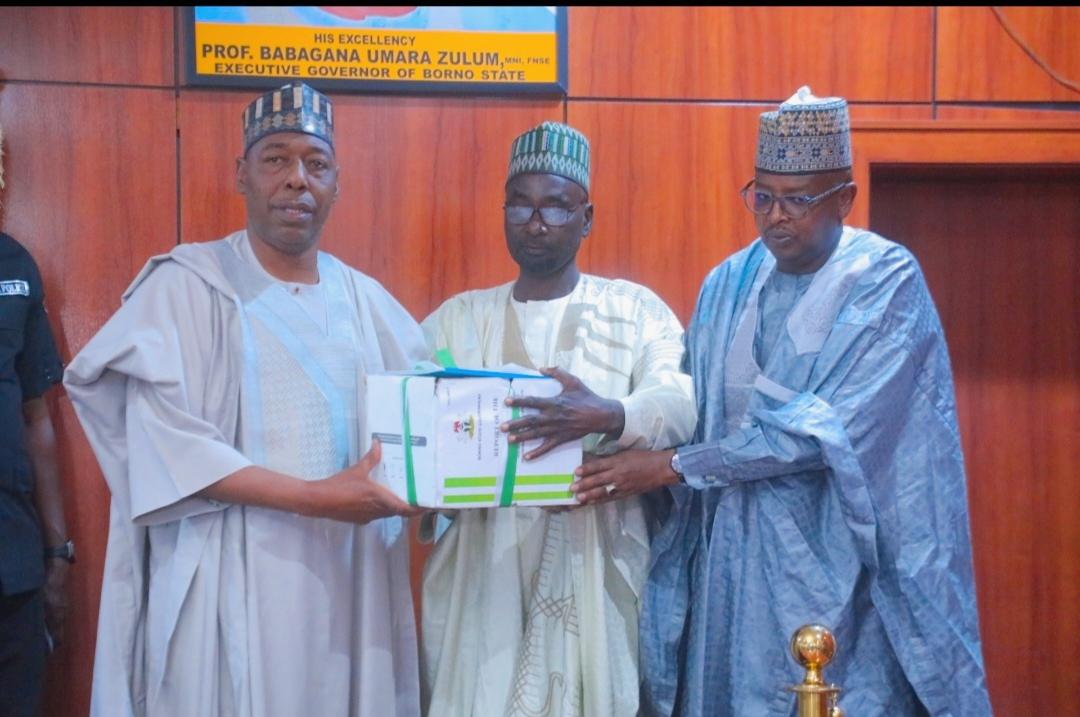
The nine-man committee set up by the Borno State Government to review the status of Technical and Vocational Education and Training (TVET) has submitted its report to Governor Babagana Umara Zulum, calling for stronger institutional reforms to reposition the sector as a driver of economic growth.
The Committee, inaugurated on May 19, 2025, by the Secretary to the State Government, was tasked with assessing TVET institutions across the state, identifying challenges, and proposing strategies for improvement.
Presenting the report at Government House, Maiduguri, Chairman of the Committee, Alhaji Goni Ibrahim, said the review was conducted through site visits, stakeholder consultations, and comparative studies.
“Borno State currently has 26 TVET institutions, including technical schools, vocational centres, and second-chance schools for women and girls. While there is huge potential, non-functional centres, inadequate infrastructure, a shortage of qualified instructors, and weak industry linkages remain major obstacles. However, from our comparative visits, we can proudly say that Borno stands out among the best-performing states,” Ibrahim explained.
He added that the Committee recommended consolidating and upgrading existing institutions, creating a Borno State TVET Board (BOS-TVB), aligning programmes with NBTE and NABTEB standards, strengthening partnerships with industries and donors, and developing inclusive programmes for women, youth, and people with special needs.
In his response, Governor Zulum expressed appreciation for the Committee’s work and assured that the recommendations would be carefully studied for implementation.
“It is my privilege to receive this report today. One of the most important issues raised is the mismatch between our universities and the labour market. If we want to address this, we must ensure that a strong TVET system is established in Borno,” the governor said.
He noted that beyond infrastructure, the lean number of instructors posed a challenge to effective skills training.
“The issue of institutional arrangements and motivation for instructors is very important. We must strengthen partnerships and ensure quality delivery across all centres,” he stressed.
Governor Zulum also disclosed plans to integrate technical and vocational training into Sangaya (Islamic) schools.
“In Canada and other advanced countries, those in the TVET line receive more incentives. Here in Nigeria, it is the reverse. We want to change that. Carpentry, ICT, welding, jewellery-making, and computer maintenance are among the courses we are considering for Sangaya schools so that our youths can graduate with practical, employable skills,” he explained.
While commending the committee members for their dedication, the governor said the state government would issue a white paper on the report and ensure full implementation of key recommendations.