

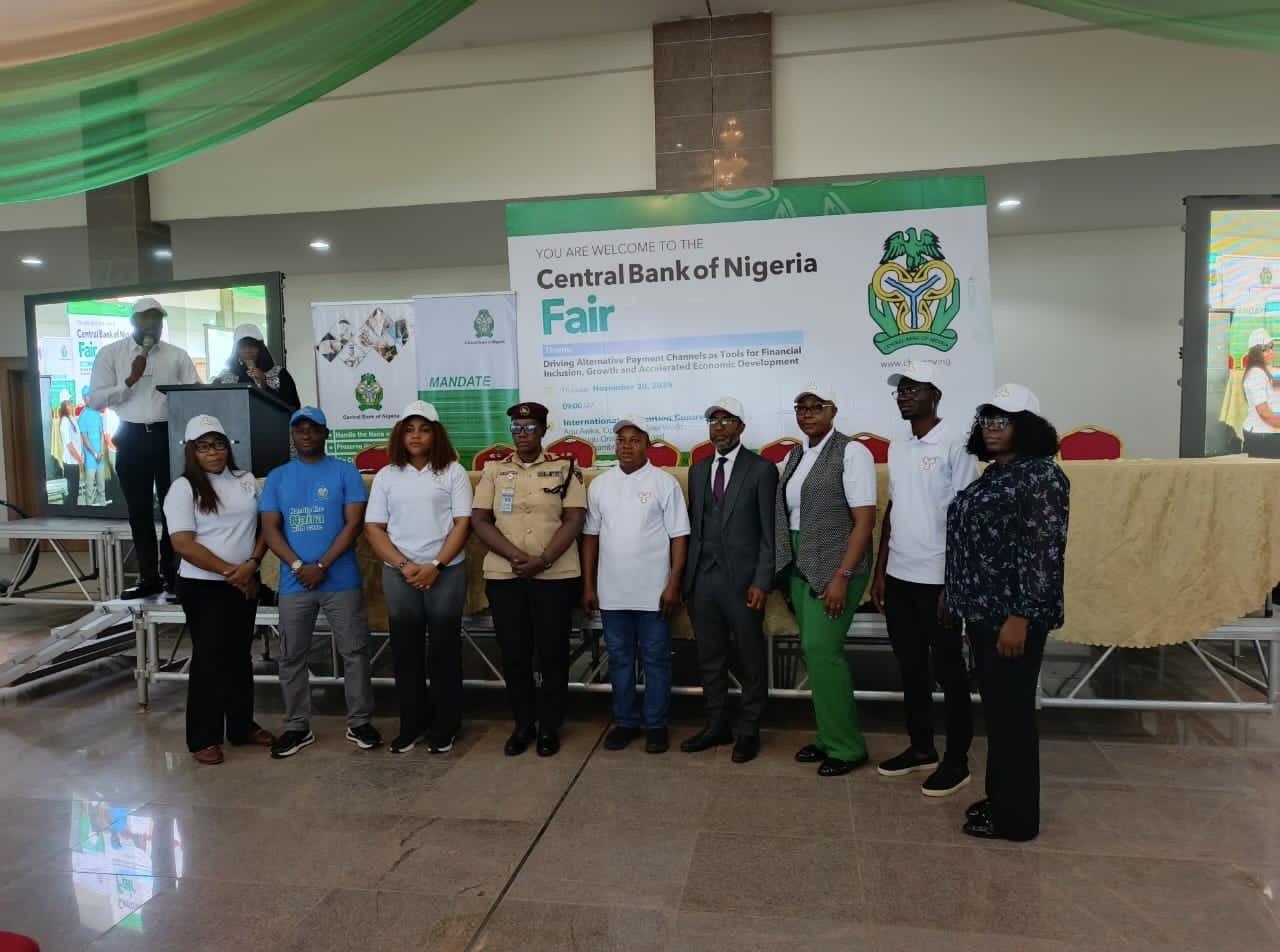
The Central Bank of Nigeria (CBN) has restated its commitment to boosting national productivity, widening financial inclusion, and sustaining monetary and price stability as part of ongoing efforts to strengthen the country’s economy.
Speaking at the 2025 CBN Fair held at the International Convention Centre in Awka, Anambra State, South East Nigeria, the Bank engaged residents on financial literacy and urged Nigerians to safeguard the integrity of the national currency.
In her opening address, the Acting Director of the Corporate Communications Department, Hakama Sidi Ali, said the fair serves as a direct interface with the public to deepen understanding of the CBN’s policies aimed at sustainable economic growth.
She noted that this year’s theme, “Driving Alternative Payment Channels as Tools for Financial Inclusion, Growth and Accelerated Economic Development,” underscores the critical role of digital payments and modernised financial systems in achieving monetary, price, and financial stability.
“As we emphasised in Lagos, Abeokuta, Kano, Kaduna, Uyo, Calabar and Enugu, this fair is designed to engage Nigerians on the Bank’s policies for fostering sustainable economic growth and improving livelihoods,” Ali said.
She highlighted improvements in key economic indicators, pointing to a continued decline in inflation, rising foreign reserves, and greater stability in the foreign exchange market.
“The Naira continues to strengthen, with the spread between the official and Bureau de Change rates narrowing to below two per cent. Nigeria’s foreign reserves now exceed $43 billion, providing more than 11 months of forward import cover and supported by sustained inflows and renewed investor confidence.”
Ali added that several reforms introduced under the CBN Governor in the past two years have laid the groundwork for inclusive growth, job creation, and poverty reduction.
These reforms, she said, include exchange rate unification, bank recapitalisation, the introduction of the non-resident BVN for Nigerians abroad, the BMatch FX trading system, and the rollout of the Nigeria Payments System Vision 2028.
The Bank has also implemented a 75 per cent Cash Reserve Ratio on non-TSA public-sector deposits to strengthen liquidity management and curb inflationary pressures.
She appealed to Nigerians to rely only on verified CBN communication channels and to uphold the dignity of the Naira.
“Refrain from spraying, hawking, mutilating, or counterfeiting the Naira,” she said. “It is our essential national symbol.”

Participants were encouraged to engage actively in the discussions, which included interactive question-and-answer sessions with CBN officials.
Public Outreach
In his welcome remarks, the Branch Controller of the CBN Awka Branch, Akobundu Onwuchekwa, commended the Corporate Communications Department for sustaining public outreach efforts that support financial inclusion and the development of the financial ecosystem.
He said feedback from the fair would aid the CBN in improving service delivery and policy implementation.
“This event presents a timely opportunity for the Bank to sensitise the public on its various initiatives and to engage directly with stakeholders,” Onwuchekwa stated.
He emphasised the strategic role of the CBN in modernising Nigeria’s payment systems and enhancing the economic welfare of citizens.
“Awka Branch remains committed to supporting the Bank’s mandate and the economic aspirations of Anambra State through stakeholder engagement, financial literacy campaigns, and seamless service delivery,” he added.
The event drew participants from state agencies, security institutions, deposit money banks, microfinance banks, ministries and departments of government, the National Youth Service Corps, the All Farmers Association of Nigeria, market associations, and other stakeholder groups.
The fair featured interactive sessions on financial literacy, the preservation of the Naira, and various aspects of the CBN’s reform agenda, with officials providing clarifications and solutions to a wide range of public inquiries.