

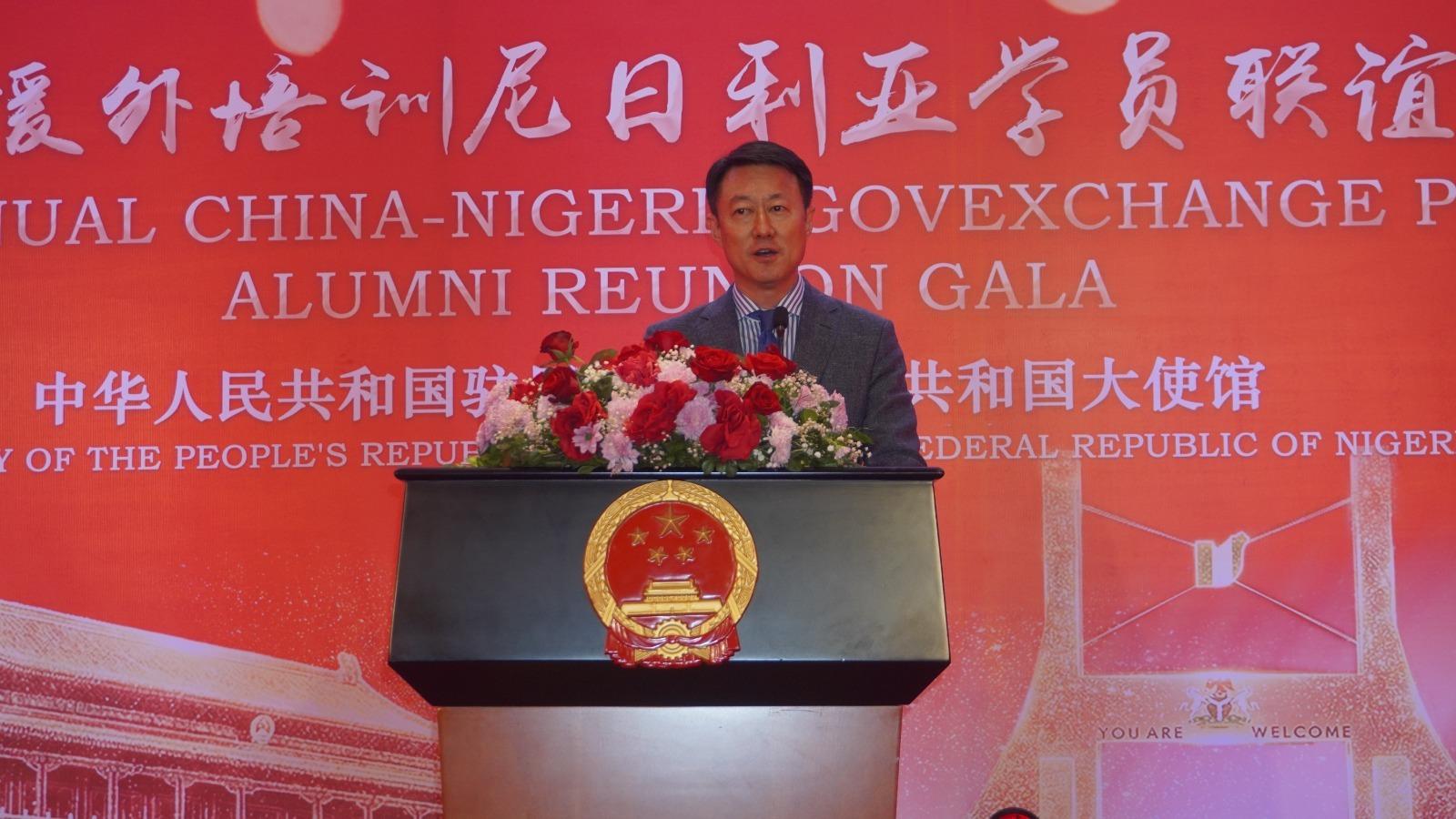
The Ambassador of the People’s Republic of China to Nigeria, Yu Dunhai, has reaffirmed China’s commitment to deepening bilateral relations with Nigeria through people-focused cooperation, capacity building, and expanded trade, describing both countries as natural partners with shared interests as members of the Global South.
Speaking at the 1st Annual China-Nigeria GovExchange Program Alumni and Reunion Gala in Abuja, Ambassador Yu said the gathering was meant to reconnect beneficiaries and strengthen networks that contribute directly to China–Nigeria relations.
“You are all friends of China. You are all messengers between China and Nigeria. The purpose of tonight’s gathering is to provide a platform for our alumni who attended the Chinese government exchange programme to stay connected, to exchange ideas, and thus to contribute to China–Nigeria relations.”
Ambassador Yu disclosed that China has provided more than 10,000 training opportunities to Nigerians over the years, covering governance, poverty reduction, manufacturing, agriculture, public health, trade, investment, science and technology, and the digital economy.
Explaining the rationale behind the programmes, the ambassador said: “China and Nigeria are natural partners. Over half a century, our friendship has gone from strength to strength, and we have always supported each other when it comes to our respective core interests and major concerns.”
He cited recent diplomatic engagements as evidence of that support, stressing that China consistently stands with Nigeria on issues of sovereignty and global representation. He also highlighted Nigeria’s growing role in international affairs and Beijing’s backing of Nigeria’s aspiration to join the G20.
Also Read: Nigeria, Thailand Deepen Bilateral Cooperation
On the economic front, the envoy said bilateral trade has already surpassed 22 billion dollars this year, exceeding last year’s total, while China’s direct investment in Nigeria rose by 130 per cent and Nigeria’s exports to China increased by more than 200 per cent.
“We are working very closely with the Ministry of Industry, Trade and Investment to implement the zero-tariff policy announced last June. China is going to provide zero tariff for 100 per cent of products from all 53 African countries, including Nigeria. This is an opportunity to expand Nigeria’s exports and enhance its position in the global trading system.”
While drawing parallels between China’s development trajectory and Nigeria’s potential future, the Chinese Ambassador stressed that China’s today is Nigeria’s tomorrow. He outlined China’s economic transformation over the past four decades, noting that the country’s new five-year development blueprint would inject stability into the global economy.
“China would like to work with Nigeria to join hands to achieve sustainable economic development and modernisation.”
Human Capacity Development
Responding on behalf of alumni, the Permanent Secretary of the Federal Capital Territory Administration, Social Development Secretariat, Olubunmi Olowookere, said the training programmes had delivered tangible benefits to public service and social development.
“The training exposed us to practical and people-centred development models, innovative social protection strategies and community-based approaches that have contributed significantly to China’s remarkable development journey. It wasn’t just book knowledge; it was seeing development in action.”
She added that the experience had strengthened participants’ capacity to design and implement programmes that reduce vulnerability and promote inclusive growth.
“The knowledge gained across various sectors will continue to be invaluable as we operate in our respective roles.”
Also speaking, the Special Assistant to the Minister of State for Humanitarian Affairs and Poverty Reduction, Atiku Kalgo, said the programme was “eye-opening and humbling,” particularly the lessons from China’s poverty eradication model.
“China’s story demonstrated that poverty eradication is not a distant dream. When policies are well coordinated, leadership is persistent and if people are at the centre of development, real change is achievable.”
He said field visits showed how formerly impoverished communities had become self-sustaining through infrastructure, entrepreneurship, education, and social support.
“This holistic approach reinforced my belief that poverty reduction requires strong systems, commitment and community partnership,” he added.
On his part, the Director of the Director-General’s Office, Center for Management Development, Mr. Francis Iyanya, described the reunion as a celebration of shared learning and cooperation, noting that under China’s Aid for Shared Future Initiative, dozens of Nigerians participated in capacity development programmes in 2025.
Speakers at the event expressed optimism that lessons from the exchanges would translate into stronger institutions, improved public service delivery, and deeper cooperation between Nigeria and China in the years ahead.