


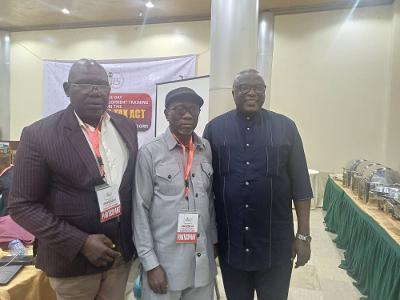
The Chairman of the Presidential Committee on Fiscal Policy and Tax Reforms, Taiwo Oyedele, has urged the National Assembly to support constitutional amendments that will safeguard Nigeria’s fiscal reforms against reversal.
Oyedele made the call on Wednesday in Abuja while delivering a keynote address at a one-day capacity-building training on the Nigeria Tax Act (2025) for members of the State House Press Corps.
He emphasised the need for legal measures to criminalise the arbitrary imposition of levies by sub-national authorities, ensuring stability and integrity in Nigeria’s fiscal policy framework.
Oyedele said; “Our democracy must be structured to outlive political cycles. Otherwise, we waste sacrifices, and the country pays a heavy price. Reform is not about one administration; it must be institutional.”
The tax reform expert explained that the reforms focus on strengthening institutions rather than individuals, stressing that Nigeria’s democracy must be structured to withstand political cycles.
Addressing concerns about the introduction of a new tax identification system, Oyedele clarified that the reform merely harmonises existing means of identification to simplify the process.
He said; “We are not creating another layer of bureaucracy. What we have done is to harmonise identification. If you already have a National Identification Number (NIN) or Bank Verification Number (BVN), you need not worry. These will serve as tax IDs. The objective is simplification, not complication.”
Oyedele highlighted the dangers of policy inconsistency, warning that frequent reversals had cost the country trillions of naira and undermined reform efforts.
“The simple question at the time was not how to stop leakages at toll gates, but why we did not build systems to ensure accountability. Because of that reversal, we are now back to discussing tolling and fuel surcharges more than two decades later. The same thing with refineries — if we had not reversed the sales, Nigeria would have saved over ₦20 trillion and created jobs.” he explained.
On fuel subsidy, Oyedele asserted that the savings from its removal are insufficient to meet Nigeria’s vast development needs.
“Even if you remove corruption and waste completely, the resources at our disposal are not enough to transform Nigeria. Subsidy savings alone cannot deliver the level of infrastructure and services required. Our fiscal space is simply too small,” he further said.
Oyedele revealed that the Nigerian National Petroleum Company Limited (NNPC) not only withheld remittances but also used future crude oil production as collateral to finance petrol imports, worsening fiscal vulnerability.
Commenting on the recently debated 5 per cent fuel surcharge, he clarified that it is not a new tax but a provision embedded in the Federal Roads Maintenance Agency (FERMA) Act since 2007.
“This surcharge will not commence automatically in 2026. It requires a commencement order from the Minister of Finance, duly published in the Gazette. The intent is to ensure openness and accountability in application, unlike in the past,” Oyedele explained.
He stressed that over 150 countries dedicate fuel-related levies to road maintenance, stressing that Nigeria cannot continue depending on printed money to fund its infrastructure.
“You cannot grow an economy when people and goods cannot move around efficiently. The reality is that we need dedicated funding for roads and infrastructure. Subsidy savings will not cover this gap,” Oyedele said.
On the reliefs provided by the new tax reforms, he noted that small businesses with an annual turnover below ₦100 million would enjoy zero per cent corporate tax, while about 97 per cent of low- and middle-income earners are exempted or relieved from several tax burdens.
Oyedele also stated that essential goods and services such as food, education, and healthcare have been classified as zero-rated for Value Added Tax (VAT), enabling producers to reclaim input VAT and thereby lowering production costs and stabilising consumer prices.
He urged Nigerians, particularly the media, to report responsibly and avoid negative narratives that could undermine reforms designed for the public good.
“We must focus on facts. The subsidy removal stopped an imminent economic collapse, but it is only the beginning. The wider tax reforms are meant to create fairness, remove multiple taxation, and provide sustainable funding for infrastructure. If we stay the course, the benefits will begin to manifest at the household level from 2026,” Oyedele assured.
PIAK