


The 70th session of the Commission on the Status of Women (CSW70), has closed at the United Nations headquarters in New York with a resounding call for urgent, justice-centred action to advance gender equality globally.
The session which convened two Heads of State, one Vice President, five Deputy Prime Ministers, and 75 ministers including Nigeria’s Minister for Women Affairs and Social Development, Imaan Sulaiman-Ibrahim alongside more than 4,600 civil society representatives and 255 side events underscored the scale and urgency of the agenda.
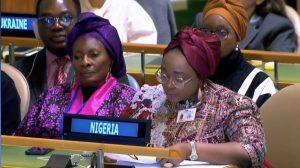
Nigeria’s Minister of Women Affairs and Social Development, Imaan Sulaiman-Ibrahim, at the convergence spotlighted national priorities anchored on President Bola Ahmed Tinubu’s declaration of 2026 as the Year of Families and Social Development.
“Nigeria remains committed to working with the international community to accelerate progress on gender equality and women empowerment as a cornerstone for inclusive action, equitable justice, safeguard of rights, and sustainable development,” she affirmed.
At the core of CSW70 outcomes were “historic agreed conclusions” placing women’s and girls’ access to justice at the centre of the global gender equality agenda.
Executive Director of UN Women, Sima Bahous, emphasised the global stakes:
“Gender equality and women’s rights are the foundation on which our peace, security, economic prosperity, and sustainable development ambitions rely without their equal access to justice our nations will not progress.”
She highlighted concrete demands to governments: “Review discriminatory laws… strengthen measures to prevent and respond to violence ensure universal access to legal aid.”
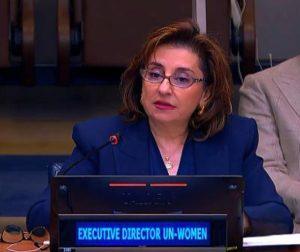
While recognising community justice workers, paralegals, and women in detention within justice frameworks, Bahous further drew attention to the disproportionate toll on women in crisis settings, noting “They pay the highest price from Afghanistan to Gaza, Sudan, Somalia, and beyond,” and urged sustained global focus.
Chair of CSW70, Ambassador Maritza Chan Valverde, distilled the session’s purpose with precision, “Access to justice is the answer. The mechanism that transforms a right into a remedy.”
She underscored persistent systemic gaps, courts that women cannot reach, remedies that arrive too late or not at all.
While stressing that negotiated outcomes must translate into lived realities, she added, “What was agreed here has to reach the women it was written for the road between law and life is long.”
Echoing the moral urgency of the moment, she invoked Malala Yousafzai submission: “We cannot succeed when half of us are held back.”
CSW70 also marked institutional renewal, introducing a multi-stakeholder hearing, a high-level forum on violence against women, and a ministerial roundtable on older women, broadening inclusivity and policy depth.
With 190 member states represented and 2030 fast approaching, the Commission warned that no Goal 5 indicators have been fully met, setting the stage for CSW71 to assess gender equality across the Sustainable Development Goals.
In closing, the message was unequivocal: progress is visible, but fragile; commitments are strong, but must be matched with implementation so that, women and girls everywhere are not only protected, but leading forward.