


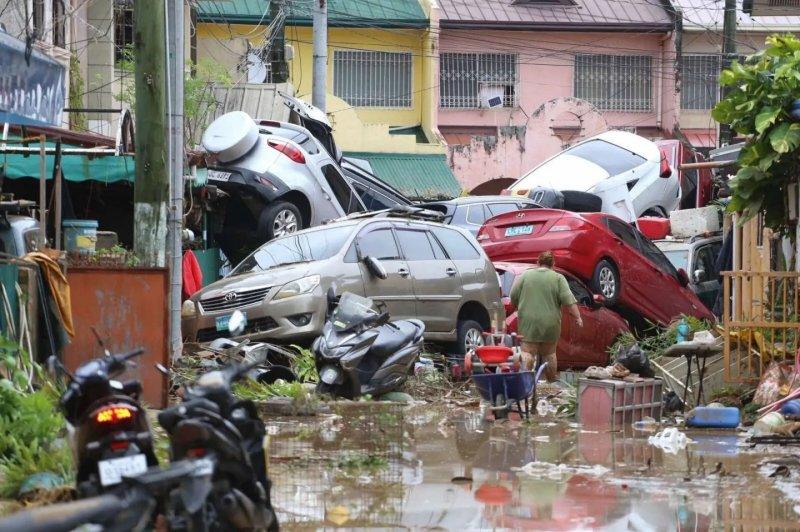
Residents in the hardest-hit province of Cebu in the Philippines are struggling to recover from the devastation caused by Typhoon Kalmaegi, which has left homes in ruins, streets filled with debris, and many lives disrupted.
Authorities have confirmed that the death toll has risen to 66. In Talisay City, survivors are combing through the wreckage, trying to salvage what remains of their belongings.
Among them was Eilene Oken, 38, who walked through what used to be her neighborhood, only to find her home completely destroyed.
“We worked and saved for this for years, then in an instant, it was all gone,” she said, her voice breaking.
But Oken said she remains grateful because her family, including her two daughters, were unharmed.
Scenes of devastation emerged in Cebu, a major tourist hub, as floodwaters receded, revealing destroyed homes, overturned vehicles, and widespread debris.
Among the 66 fatalities were six military personnel whose helicopter crashed in Agusan del Sur on the island of Mindanao during a humanitarian mission.
The Disaster Agency reported 26 people missing, and 10 injured.
The devastation from Kalmaegi, locally named Tino, comes just over a month after a magnitude 6.9 earthquake struck northern Cebu, killing dozens and displacing thousands.
Kalmaegi, the 20th storm to hit the Philippines, slightly intensified as it was crossing the South China Sea on its way to Vietnam where preparations are underway ahead of the typhoon’s expected landfall on Friday.
More than 200,000 people were evacuated across the Visayas region, including parts of southern Luzon and northern Mindanao, ahead of a storm that submerged homes and caused widespread flooding and power outages.
In September, Super Typhoon Ragasa swept across northern Luzon, forcing schools and government offices to shut down as it brought fierce winds and torrential rain.
Reuters/Hauwa M.