

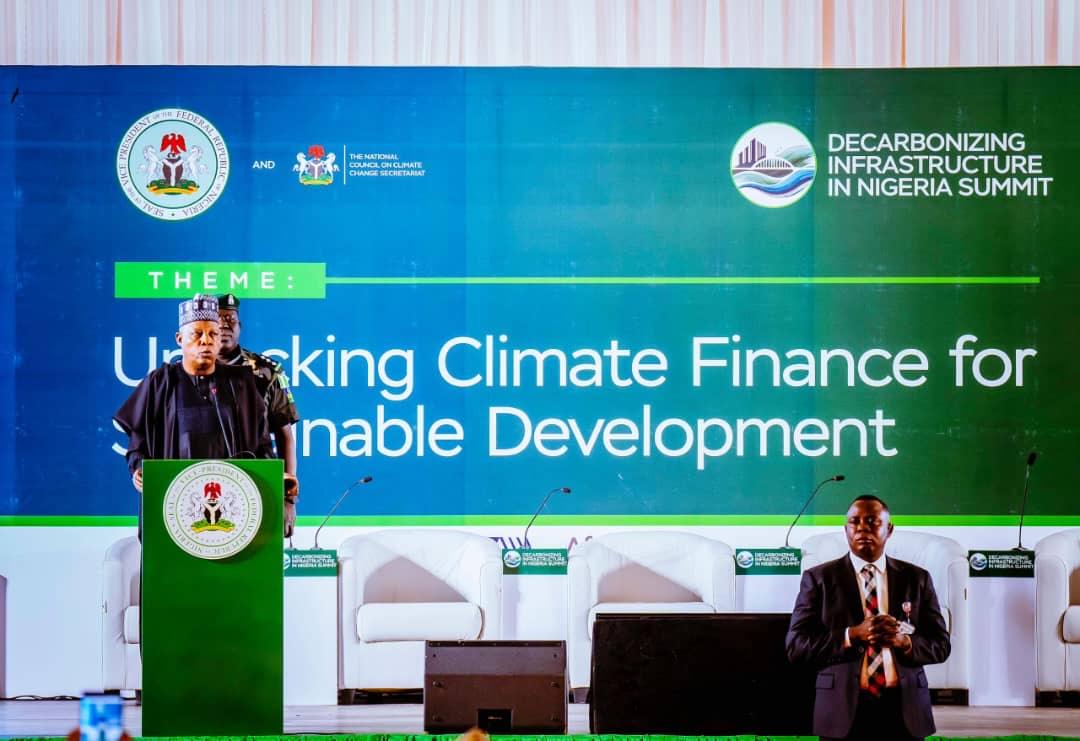
Vice President Kashim Shettima has stated that Nigeria is on course to phase out diesel dependency and significantly reduce carbon emissions through the deployment of an integrated hybrid energy system.
He made the remark on Wednesday while declaring open the Decarbonising Infrastructure in Nigeria Summit (DIN Summit) in Abuja, where he warned that Nigeria would struggle to compete globally if its climate ambitions fail to align with its development realities.
The Vice President stressed that “while the truth about the nation’s climate question is that the country can no longer build yesterday’s infrastructure for tomorrow, climate action has now become an economic necessity and not a luxury.”
Citing a practical example, he said “Onne Port, for instance, is already emerging as the template for our quest to breathe life into a robust green economy. Discussions are currently underway with private investors to commit nearly $60 million to electrify the port and transform it into Nigeria’s first green port.”
He added that “this is a strategic leap. Through an integrated hybrid energy system, we will phase out diesel dependency, slash carbon emissions, and provide 24/7 sustainable and affordable power to terminal operators and port users.”
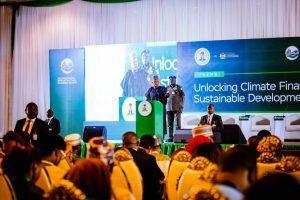
VP Shettima noted that 75 percent of Nigeria’s greenhouse gas emissions are generated from the infrastructure sector, including energy, transport, urban development, and agriculture. These sectors, he said, are not only carbon-heavy but also represent the backbone of the nation’s economy, especially agriculture, which supports 70 percent of rural livelihoods.
While describing the emission figures as a wake-up call, he maintained that “the only way out of the predicted doom is to decarbonise these systems,” emphasising the need to “build a Nigeria with infrastructure that heals, and not one that harms.”
He described the summit’s theme, “Unlocking Climate Finance for Sustainable Development,” as timely and relevant, stating that the country faces the urgent challenge of decoupling economic growth from carbon-intensive models of the past, without leaving any Nigerian behind.
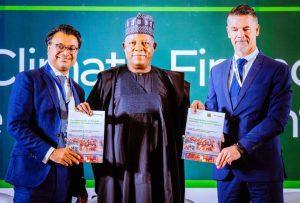
According to him, “this is why we must strengthen our regulatory frameworks. This is why we must harmonise policy across sectors and tiers. This is why we must launch tools like the Green Investment Portal to connect capital to climate-smart opportunities.”
He added that “this is why we must have our states at the forefront of this march to the future—to show that decarbonisation must not stop at Abuja’s gates. It must reach every local government, every community, every home.”
Also speaking at the event, the Director General of the National Council on Climate Change (NCCC), Dr Nkiruka Maduekwe, underscored the urgent need for Nigeria to transition to a low-carbon economy, despite the country’s minimal contribution to global emissions.
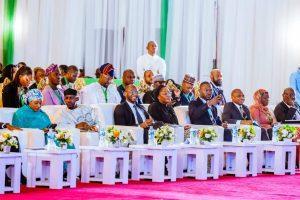
She said, “Although Nigeria’s contribution to the global carbon emission is very minimal, Nigeria is highly vulnerable to the impacts of climate change because of its location in the African continent and because of our low adaptive capacity.”
Dr Maduekwe identified priority areas for transformation, including smart agriculture to reduce emissions and boost sustainability, renewable energy adoption, and enhanced carbon sequestration through improved land management.
She also called for increased private sector investment in sustainable infrastructure, particularly in energy and transportation systems.
Personal Assistant to the President on Subnational Infrastructure, Musaddiq Adamu, reinforced the administration’s focus on empowering subnational leadership to drive climate innovation.
He stated that “today’s summit is not just about emissions but about equity, economic survival and building a future where infrastructure does not bury the planet but restores hope and empowers society, especially the young, the poor and the marginalised.”