


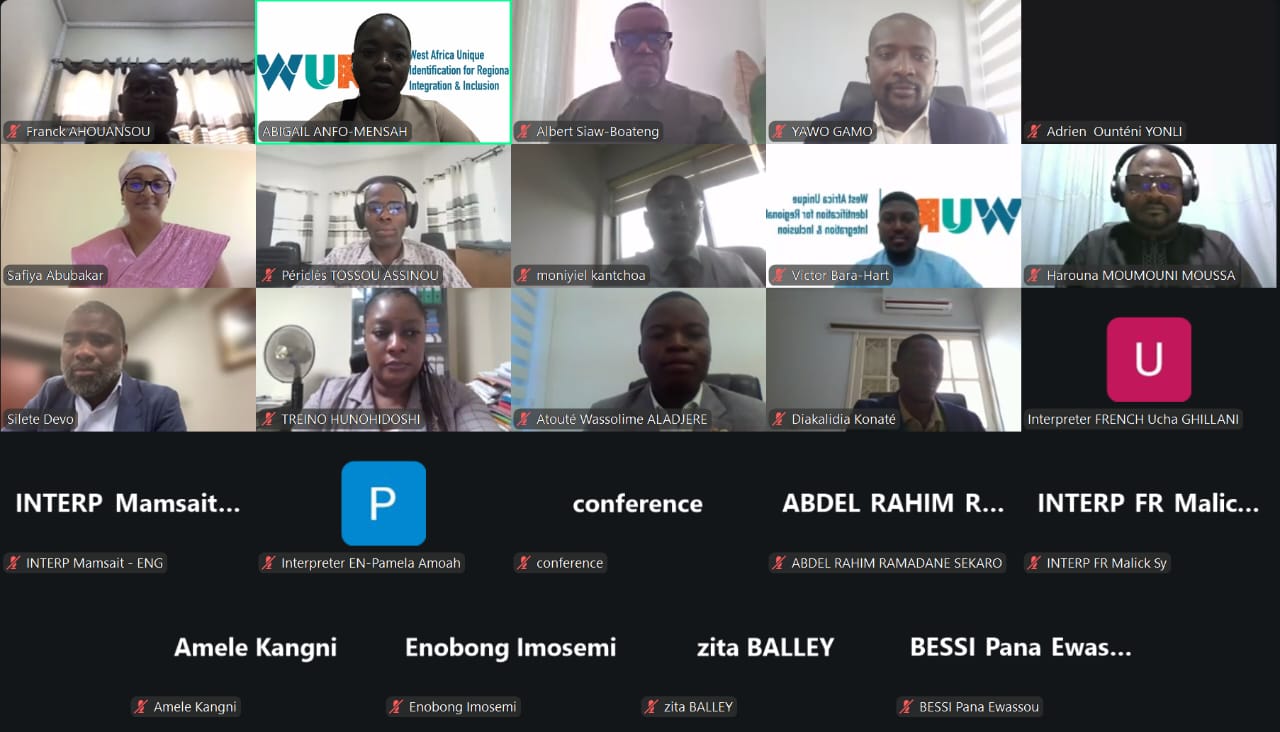
The Economic Community of West African States, ECOWAS Commission and the World Bank as co-secretariat, have convened the 2nd meeting of the Supervisory Committee of the West Africa Unique Identification for Regional Integration and Inclusion, (WURI) Programme which held virtually.
The meeting brought together members of the Supervisory Committee, representatives of the ECOWAS Commission, and the World Bank to review progress and provide strategic direction for the implementation of the WURI Programme.
Representing the ECOWAS Commissioner for Economic Affairs and Agriculture, the Director for Free Movement of Persons and Migration and WURI Project Coordinator, Mr. Albert Siaw-Boateng, underscored the importance of digital identification systems as a critical enabler of regional integration, service delivery, and economic inclusion.
He emphasised that ‘interoperable and inclusive identification systems are essential to facilitating the free movement of persons, enhancing cross-border trade, and strengthening social protection systems across the region’.
Delivering on a goodwill message on behalf of the World Bank, Mr. Paul Nguyen said, “Digital identification systems are now globally recognised as foundational infrastructure for service delivery, financial inclusion, trade facilitation, and migration management’.
“The challenge before us is to move beyond national systems and build interoperable frameworks that can function across borders, despite differences in legal, technical, and institutional environments. It is this ambition that inspired the creation of the WURI programme as a pioneering initiative within the World Bank’s portfolio.”
During the opening remarks of the Chairperson of the Committee and Director General of the National Agency for the Identification of Persons and Permanent Representative of the Togolese Republic to the WURI Programme Governance Committee, Mr. Silété Devo, recalled the importance of setting up a governance system.
He said Cross-border interoperability can only be achieved through continued dialogue, alignment of standards, and a shared commitment to common objectives.
Progress Made
The Supervisory Committee reviewed key progress made since the inaugural Supervisory Committee meeting in 2023 and deliberated on the outcomes of the Technical and Coordination Committee meetings and validated key strategic documents to guide programme implementation.
These included the Stakeholders’ Assessment, Engagement and Management Strategy; the Regional and Cross-border Interoperability Strategy; the Communication Strategy; and the Monitoring and Evaluation Framework.
The meeting also provided an opportunity to assess the harmonisation of technical specifications among participating countries and to review the Regional Work Plan for 2026, which aims to accelerate progress toward achieving full interoperability and mutual recognition of identification credentials across the region.
In their interventions, representatives of the participating countries reaffirmed their commitment to the WURI Programme and highlighted the importance of sustained collaboration and coordination in achieving the programme’s objectives.
At the end of the meeting, the Supervisory Committee endorsed key strategic actions and adopted the necessary documents to guide the next phase of implementation, marking an important step toward building a harmonised and inclusive digital identity ecosystem in West Africa.
‘The ECOWAS Commission and the World Bank reiterated their commitment to supporting Member States through technical assistance and coordination, to ensure the successful implementation of the programme and the realisation of its regional integration goals’.
The WURI Programme remains a flagship regional initiative contributing to ECOWAS Vision 2050 by promoting inclusive development, strengthening regional integration, and enhancing access to services for all citizens.
The ECOWAS is implementing critical and strategic programmes that will deepen cohesion and progressively eliminate identified barriers to full integration.
In this way, the estimated 300 million citizens of the community can ultimately take ownership for the realisation of the new vision of moving from an ECOWAS of States to an “ECOWAS of the People: Peace and Prosperity to All” by 2050.