

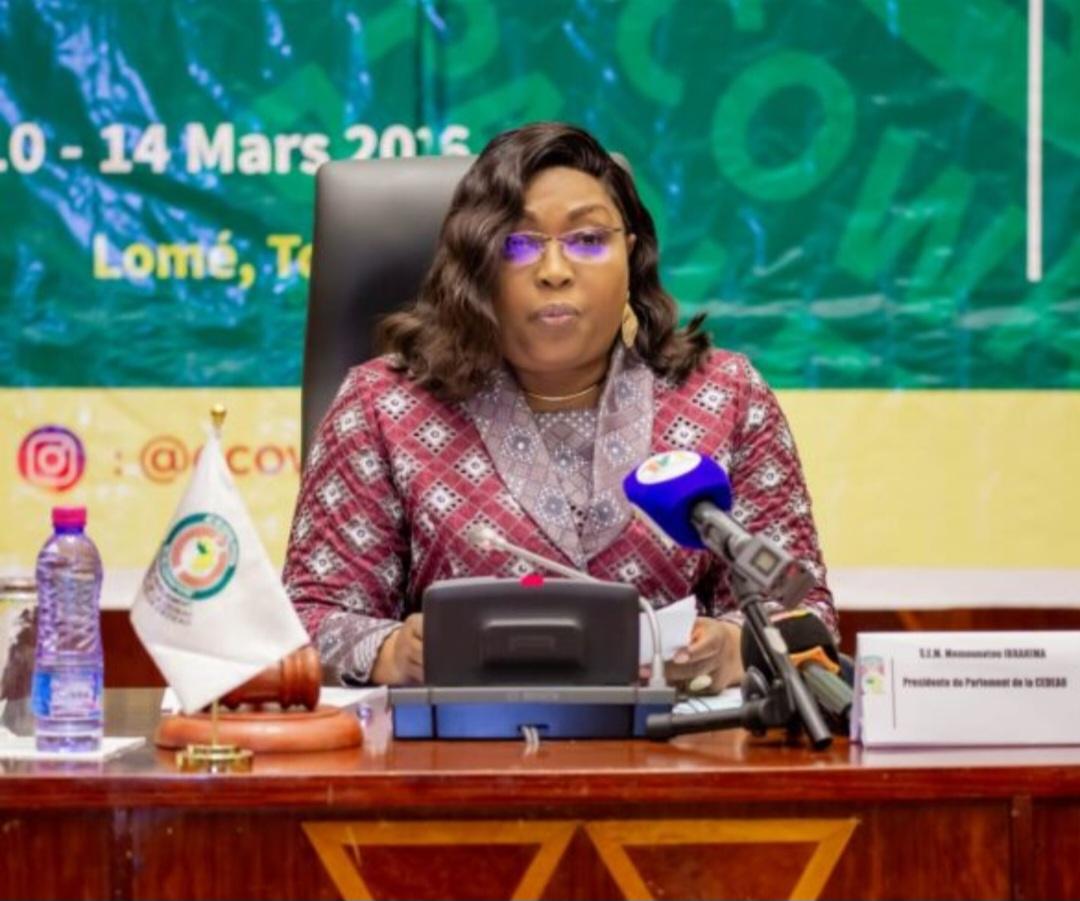
The Speaker of the ECOWAS Parliament, Memunatu Ibrahima, has described education as the cornerstone of the region’s aspiration for deeper integration and sustainable development.
Ibrahima said education remains a critical multiplier that can transform the sub-region’s youthful population into a productive economic force capable of driving regional growth.
She made the remarks at the closing session of a delocalised joint meeting on strengthening curriculum alignment with the socio-economic needs of the sub-region held in Lomé, Togo.
The meeting brought together members of the Parliament’s Committees on Education, Science and Culture, Health, as well as Telecommunications and Information Technology. It was held under the theme: “Strengthening Curriculum Alignment with Socio-Economic Needs of the ECOWAS Region.”
Represented at the event by Chairman of the Joint Committee, Orlando Pereira Diaz, a member of the Cape Verdean delegation to the regional parliament, Ibrahima stressed that education must remain the central investment if West Africa is to move beyond geographical proximity to genuine community integration.
“If the ECOWAS intends to be more than a geographical space, if it intends to be a community in the broadest sense, then our greatest investment must be in the minds and capacities of our people,” she said.
According to her, regional integration should not be defined merely by borders or political agreements but by the ability of citizens to contribute meaningfully to economic development and shared prosperity.
“Our curriculum must reflect the realities of our economies. The future of our young population depends not only on the process of education but also on the relevance of this education for agriculture, technology, transformative industries, renewable energies, creative industries, entrepreneurship and regional value chains,” she said.
Demographic Surge
She noted that West Africa is experiencing a demographic surge, with one of the youngest populations in the world, saying that the region must harness this demographic advantage through relevant and practical education.
“Education continues to be the cornerstone of this aspiration because it is the great multiplier. It transforms competence into productivity and converts demographic potential into economic power,” she said.
According to Ibrahima, the vision of the Economic Community of West African States goes beyond political cooperation to building a fully integrated region driven by the capabilities of its people.
She stressed that human capacity, innovation and knowledge are essential for economic diversification, industrial growth and democratic stability across member states.
“Regional integration is not only sustained in agreements but in human capacity — citizens sufficiently qualified to compete, sufficiently innovative to solve problems and sufficiently capable to lead change,” she said.
The Speaker also urged member states to take advantage of the region’s youthful population to avoid the risks of unemployment, migration and social instability.
“We must choose to take advantage of this demographic dividend or risk the consequences of unemployment, migration and social instability,” she said, noting that aligning academic curricula with labour market needs is both an economic necessity and a security strategy.
Support Policies
Ibrahima reaffirmed the commitment of the regional parliament to support policies that strengthen education systems across member states.
According to her, the Parliament will continue to provide political oversight and support initiatives that promote cooperation among governments, universities, technical institutions and the private sector to ensure that education responds to the needs of regional economies.
She also emphasised the importance of harmonising qualifications across member states to promote labour mobility, while calling for stronger investment in technical and vocational education.
“Digital literacy must become fundamental and not optional. Research and innovation must be closely linked to the use of digital technology,” the Speaker said.
Ibrahima further stressed the need for inclusive education policies that ensure women, girls, persons with disabilities, rural communities and other marginalised groups are not excluded from educational opportunities.
“Our curricula must reflect the values and systems of knowledge within ECOWAS while remaining globally competitive.
“The future of West Africa will not be driven by chance. It will be driven by the decisions we make today in our classrooms, our parliaments, our institutions and our economies,” she added.
Parliamentarians are optimistic that the meeting would go beyond discussions to produce concrete reforms and stronger partnerships aimed at transforming education in the region.