

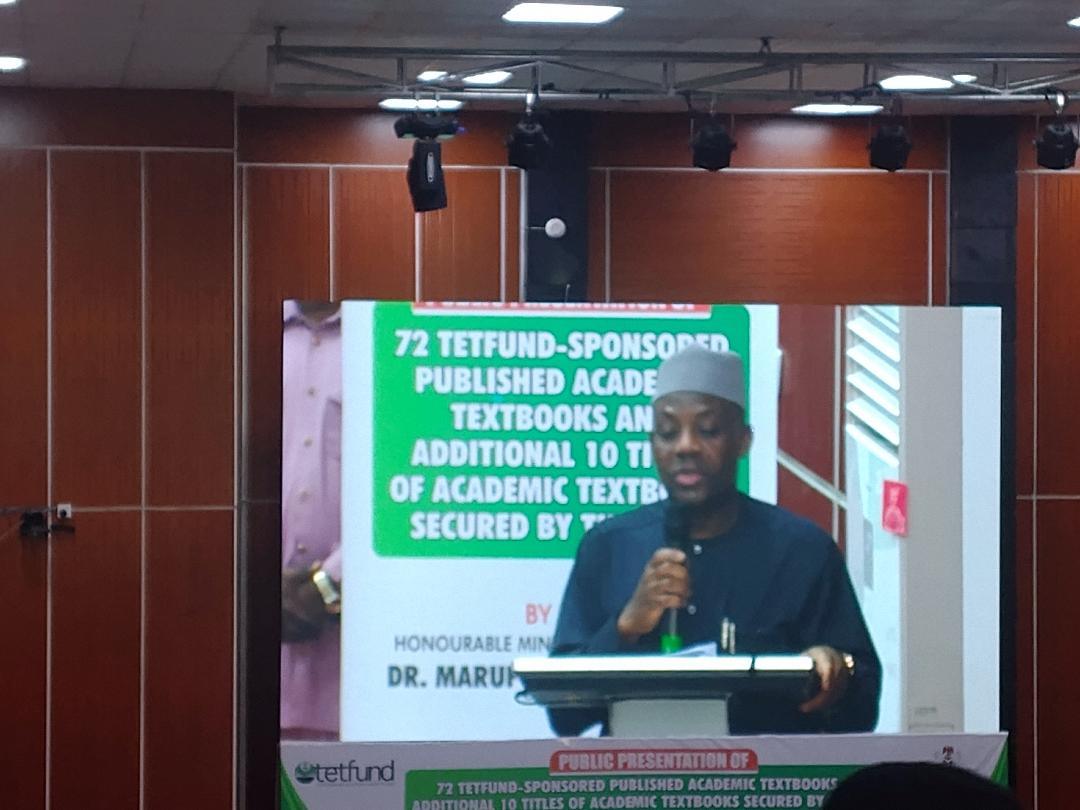
The Nigerian government, through the Federal Ministry of Education, has presented 82 academic textbooks authored by Nigerian scholars to strengthen teaching and learning in tertiary institutions.
The Minister of Education, Dr Tunji Alausa, during the public presentation in Abuja, said that the books were developed under the Higher Education Book Development Intervention Project of the Tertiary Education Trust Fund (TETFund).
He explained that 72 of the titles were newly authored under the TETFund project, while 10 others were written by reputable scholars and secured for use by beneficiary institutions.
Dr Alausa said the initiative “underscores the Federal Government’s commitment to quality education and the promotion of academic excellence in Nigeria’s higher education system.”
According to him, “the intervention aims to address the shortage of locally authored textbooks and reduce the country’s dependence on foreign publications.”
He noted that Nigerian tertiary institutions had increasingly relied on foreign textbooks, “putting pressure on foreign exchange and discouraging indigenous authorship.”
He added that “encouraging Nigerian scholars to produce quality academic textbooks would ensure the availability of relevant learning materials across diverse disciplines,” and highlighted that the initiative would particularly support fields such as science, technology, and engineering, “which are critical to national development.”

Dr Alausa explained that the TETFund Book Development Intervention focuses on the publication of academic textbooks, support for professional association journals, and the establishment of academic publishing centres.
He said the Board of Trustees of TETFund established a Technical Advisory Group in 2009 “to develop a framework for implementing the book development programme in tertiary institutions.”
The minister noted that “the federal government continues to support academic research journals and publishing centres to ensure adequate indigenous learning materials in universities, polytechnics, and colleges of education.”
He commended the authors, publishers, and stakeholders involved in the project “for their contributions to strengthening Nigeria’s academic reputation globally,” and acknowledged the support of President Bola Tinubu for reforms aimed at improving the education sector.
According to Dr Alausa, “the administration is committed to ensuring stable academic calendars in tertiary institutions across the country.” He expressed hope that the textbooks “would help bridge the gap in indigenous academic publishing and improve access to relevant learning materials in tertiary institutions,” and urged academic unions “to continue dialogue with the government to resolve outstanding issues in the sector.”
The minister also challenged TETFund “to explore ways of expanding access to the books beyond tertiary institutions to promote wider knowledge sharing.”
Also speaking, the Executive Secretary of TETFund, Arc Sonny Echono, said the book initiative was “designed to address the persistent shortage of quality tertiary-level textbooks in Nigeria and strengthen teaching, learning, and research in higher institutions.”
According to him, 72 of the titles were newly authored under the TETFund project, while 10 others were written by reputable scholars and secured for use by beneficiary institutions. He disclosed that the Fund “has so far published 202 academic textbooks, with several others currently undergoing evaluation.”
Echono also revealed that “over 400,000 copies of the books will be distributed to institutions nationwide, while digital versions will be made available online to enhance accessibility.”
Earlier in the gathering, he led participants in observing a minute’s silence in honour of one of the authors, Valerie Young Harry, who passed away shortly before the event.
On his part, the Chairman, Board of Trustees at TETFund, Aminu Bello Masari, described the late author’s work as “a lasting legacy, noting that knowledge passed from generation to generation ensures a person’s impact outlives their lifetime.
Masari also stressed “the importance of applying knowledge practically” and called for strategies “to commercialise the books so authors and their families can benefit from their intellectual contributions.”