

President Bola Tinubu has defended his assent to the Electoral Act 2026, saying the decision reflects his administration’s firm commitment to the principles of the rule of law and democratic governance.
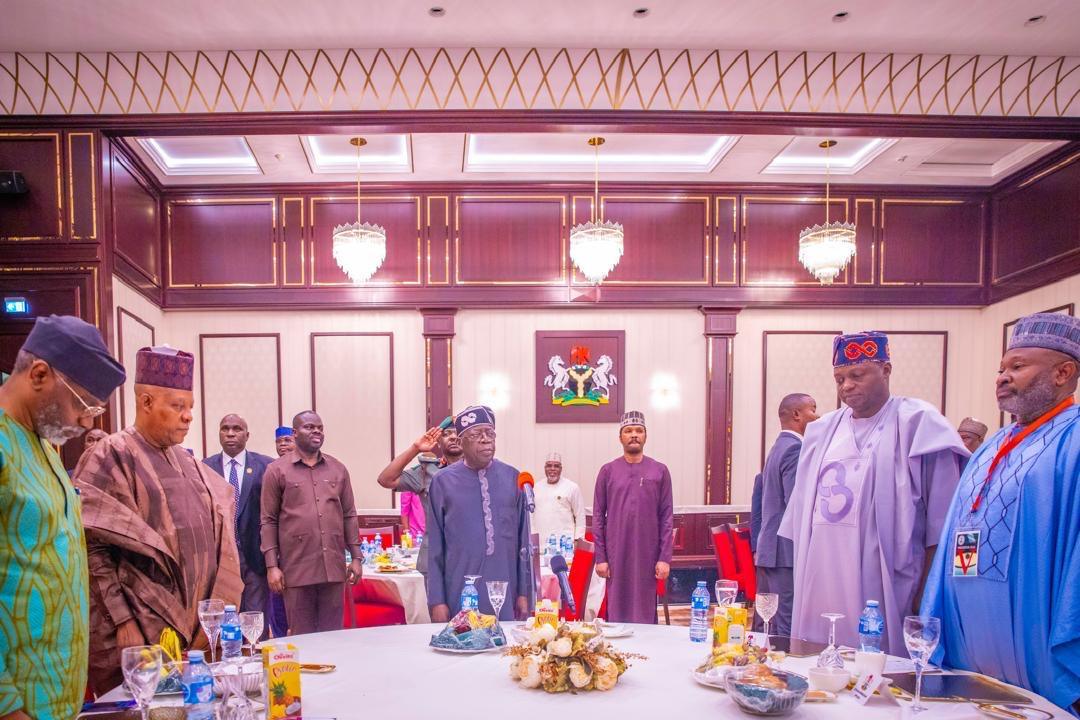
The President stated this on Wednesday while he hosted an interfaith/Iftar Breaking of fasts for leaders of the All Progressives Congress (APC) Executives and National Working Committee (NWC), as well as the Inter-Party Advisory Council (IPAC) at the State House, Abuja.
He recalled his long-standing democratic credentials, shaped by decades of political struggle, including periods of detention, exile, and his role in the formation of the National Democratic Coalition (NADECO).
Drawing from history, the President urged political actors to prioritise peace and stability while demonstrating commitment to the rule of law as essential pillars for sustaining Nigeria’s democratic governance.
President Tinubu declared himself a “die-hard democrat”, calling on Nigerian politicians across party lines to embrace true democratic principles and submit to the rule of law as well regardless of political affiliation or personal interests.
“We are all democrats and we all subscribed to this democracy voluntarily, willingly, and we’ve been at it selflessly in the last 26 years. Some of us have the bruises from it, struggling for it. We went to detention, we protested, we went on exile and all of that, We formed NADECO, We got here.
“The Rule of Law must prevail in any democracy. Yes, Rule of Law. Majority will have their say and their way, and minority will have their say and might not have their way. That is the sweetness, the essence of democracy,” Prrsident Tinubu said.
The Nigerian leader highlighted that his commitment to democratic ideals was not merely political positioning but a deeply held personal philosophy.
Addressing IPAC National Chairman, Yusuf Dantalle directly, President Tinubu emphasised that party membership must remain voluntary, even when it brings persecution.
“We are all democrats, voluntarily, party alliances, party ideologies or no ideology, party boat, party platform, in whichever form, it’s voluntary. Be persecuted for it. So no threat from any democrat,” he said.
Intellectual Debate
The President urged political actors to engage in intellectual debate rather than confrontation.
“Argue it, debate it intellectually, interrogate each other, honestly and sincerely, but we are committed to the same thing, peace and stability of the country, and we adhere to it,” the President said.
He noted that he had been in opposition himself for years without threatening anyone except “military junta,” and expected others to show similar restraint.
“I’m a registered voter. I’m on the same platform with you, or not, I’m going to stick to my platform. When it was against me years past, I toed the line,” he said.
Need for Unity and Tolerance
Concluding his remarks, President Tinubu emphasised the need for unity, tolerance and adherence to democratic principles among political actors.
He noted that while political competition can be intense, stakeholders must learn to accommodate and support one another in strengthening democratic institutions.
The Chairman of the All Progressives Congress (APC), Professor Nentawe Yilwatda, commended the President for providing strong leadership and ensuring the skillful management of human and material resources in a diverse and multi-ethnic society.
“We thank you for inviting the leadership of the APC, IPAC and other political parties to be part of this breaking of fast. This means so much for us as a party and people,” the APC Chairman said.
Party Support
Yilwatda assured President Tinubu of the party’s support in realising his lofty vision for the country.
“We are grateful to God to have you as a leader of this country. We shall support you, and we will stand by you as a party,’’ he said.
Earlier in the proceedings, IPAC National Chairman, Yusuf Dantalle, praised Tinubu as a “listening father and an inclusive president” but raised several concerns about the new Electoral Act.
Dantalle revealed that IPAC had previously worked behind closed doors with INEC to prevent democracy from being derailed during the 2023 election collation process.
The IPAC chairman specifically appealed for reconsideration of three provisions: the 21-day deadline for submitting membership registers with mandatory National Identification Numbers, which he argued would disenfranchise many voters; the removal of indirect primaries, which he said disadvantaged smaller parties with limited resources; and the withdrawal of government subventions to political parties.
“We are not saying give us money to go and spend, no, but prudently what we can use to take care of administration of our political parties. You are a product of multi-party democracy, Your Excellency,” Dantalle pleaded.
Federal Assistance
Dantalle also requested federal assistance to relocate IPAC from its current “rented apartment” and noted that the council had buried many potential crises to allow the President to focus on governance.
Recall that President Tinubu had on February 18th, signed the Electoral Act 2026 (Amendment) into law after the National Assembly had on Tuesday passed the Electoral Act 2026 (Amendment) Bill.
The new law mandates direct or consensus primaries, abolishing delegate voting, requires digital membership registers submitted 21 days before primaries, and restricts courts from stopping electoral processes .